
Dear Reader,
Did you know 51% of Americans expect a major stock market meltdown?
It's true.
But here's the craziest part.
According to former $200M money manager Jeff Clark...
What we're seeing right now is just the start of a major economic shift...
A shift that could blindside anyone invested in the stock market.
And we have just weeks to act.
That's why I sat down with Jeff to get the full story.
The last interview we did like this went viral with over 2.7 million views...
And I expect this one to be even bigger.
That's because he's giving an urgent update on the economy that could impact every single American...
Whether they have $500 or $500,000 in savings.
This is the interview Wall Street doesn't want you to see...
Because it reveals some pretty upsetting things about what's happening.
Kim Moening
Host, TradeSmith
GE Vernova Beats Earnings by 790% as Data Center Demand Explodes
Authored by Chris Markoch. First Published: 4/23/2026.

Key Points
- GE Vernova delivered a massive earnings beat, with EPS of $17.44 far exceeding expectations and driving a sharp rally in the stock.
- Record free cash flow and raised guidance highlight accelerating demand, particularly from data center electrification projects.
- Strong technical momentum and a breakout from consolidation suggest further upside, despite elevated valuation concerns.
- Special Report: Have $500? Invest in Elon’s AI Masterplan
There’s no sense in hiding the ball. GE Vernova (NYSE: GEV) just delivered a blowout earnings report, sending shares up more than 13% in a single day. The company beat on both the top and bottom lines, but it was the bottom line that produced the most eye-popping results.
Heading into the release, analysts had forecast adjusted earnings per share (EPS) of $1.95 — a 427% year-over-year (YOY) increase that many investors seemed to have already priced in. GE Vernova didn’t just beat that number; it beat it by more than 790%, delivering adjusted EPS of $17.44.
The SpaceX "Headfake" (Look here instead) (Ad)
When the SpaceX IPO launches, most investors will already be too late. The real opportunity isn't the IPO itself - it's the infrastructure behind it.
One small-cap company supplies a mission-critical component to Musk's xAI Colossus site that can't be built around. While retail waits for a ticker that doesn't exist yet, early money is moving into this supplier at a fraction of its potential value.
See the small-cap stock powering the SpaceX buildout todayThe more important fuel for the bull case is the cash picture. Free cash flow came in at roughly $4.8 billion for Q1, which exceeds GE Vernova’s full-year 2025 FCF of $4.6 billion. What’s more bullish is that the record quarter is accelerating off a base that was already growing in Q4 2025.
To add perspective, what was likely the company’s strongest FCF quarter in 2025 now looks like it could be the floor for 2026. Management raised full-year FCF guidance to $6.5–$7.5 billion, which implies the remaining three quarters would still represent strong cash generation. Crucially, the company ended Q1 with a $10.2 billion cash balance — even after closing a $5.3 billion acquisition and returning $1.4 billion to shareholders through buybacks and dividends.
GE Vernova Solves the NIMBY Problem
One obstacle to data center construction is who pays for the added energy demand. Early on, that often meant passing costs to consumers. Predictably, consumers push back and petition against data centers in their communities, even when the projects could provide local economic benefits.
The NIMBY (Not In My Back Yard) problem runs deeper than electricity bills. Communities object to the physical footprint of new transmission lines, substations and other power infrastructure that large-scale data center development requires. The challenge is moving the power, not just generating it.
That’s why President Trump called on hyperscalers to provide their own power in his 2026 Address to Congress. GE Vernova is well positioned to help. Its Electrification segment — which includes HVDC systems, substations, switchgear and transformers — essentially provides the complete infrastructure stack a hyperscaler needs to build a self-sufficient power ecosystem.
In Q1 alone, GE Vernova booked $2.4 billion in Electrification equipment orders specifically to support data centers — more than in all of 2025 combined. For hyperscalers looking to sidestep the NIMBY issue by owning power infrastructure end-to-end, GE Vernova is one of the few companies that can deliver at that scale.
GEV Has Momentum That Suggests Higher Highs Are Coming
GEV traded at roughly 64x earnings in late April. Before the report, analysts were forecasting earnings growth of about 55%. That makes the “elevated” P/E less of a premium, especially given the company’s massive beat and the raised full-year outlook.
Momentum is clearly on GEV’s side, which investors should weigh if they’re considering chasing the post-earnings gap. The stock broke above the upper Bollinger Band at $1,078, which can signal overbought conditions and makes a pullback to around $944 a legitimate concern.
At the same time, the MACD indicates strong bullish momentum: the MACD line has crossed sharply above its signal line and is accelerating to levels that dwarf prior peaks over the past year. That suggests unusually strong momentum behind this move.
Context matters. The stock spent nearly eight months consolidating between $700 and $900 before this breakout, giving the move the character of a resolved base rather than an exhaustion gap. Investors waiting for a pullback may find one, but earnings momentum of this magnitude often carries a stock further than valuation metrics alone would imply.
A Split That Investors May Not Be Considering
GEV now trades at more than $1,100 per share. For some retail investors, a four-figure share price can be an attention filter, but momentum alone doesn’t guarantee a conventional stock split. Management has given no indication that a price split is being considered.
There could, however, be a structural “split” that matters as much or more. The Wind segment remains a laggard, and there’s been chatter — including from CNBC’s Jim Cramer — that GE Vernova should consider spinning off its Wind business. Separating the units would allow each to trade on its own fundamentals.
That’s not a prediction, just a possibility. A strategic separation of the Wind business seems at least as plausible as a traditional stock price split, and it could be more consequential for shareholders.
Carmax at 5-Year Lows: Is Now The Time to Buy?
Authored by Thomas Hughes. First Published: 4/16/2026.

Key Points
- Carmax stock is poised to plunge following weak guidance.
- Contracting margins and weak demand are undercutting cash flow and capital return.
- A convergence of factors, including suspended buybacks, suggests new long-term lows are coming.
- Special Report: Have $500? Invest in Elon’s AI Masterplan
Carmax (NYSE: KMX) shares are trading near five-year lows, offering an intriguing opportunity. However, as insulated as the company may be from financial implosion, market forces are aligned to keep this stock from rising in the near term.
The takeaway from the fiscal Q4 2026 results and forward guidance is that business conditions are less than optimal — so much so that management paused its share buybacks to preserve capital. This is significant because FY2025 buyback activity reduced the share count by a high single-digit percentage.
The SpaceX "Headfake" (Look here instead) (Ad)
When the SpaceX IPO launches, most investors will already be too late. The real opportunity isn't the IPO itself - it's the infrastructure behind it.
One small-cap company supplies a mission-critical component to Musk's xAI Colossus site that can't be built around. While retail waits for a ticker that doesn't exist yet, early money is moving into this supplier at a fraction of its potential value.
See the small-cap stock powering the SpaceX buildout todayThe likely outcome is that Carmax weathers these changes and ultimately comes out ahead. The key questions are how long that will take and how low the stock price may fall before a recovery begins.
Carmax Near Price Floor: Sell-Side Support Isn’t Firm
Technically, the stock is trading near a potential price floor in early Q2 2026, roughly aligned with COVID-19 era lows. The problem is that the 2020 decline led to a quick turnaround, while price action in 2026 is languishing at low levels with little to invigorate buyers. Analysts who might otherwise identify a floor are unlikely to do so given the guidance update and the weakening sentiment trend.
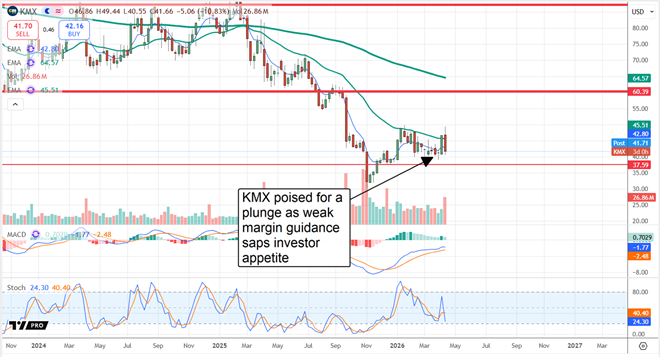
MarketBeat’s data shows a high-conviction "Reduce" rating based on 18 analysts, and sentiment has deteriorated. The 2026 trend includes numerous downgrades and price-target cuts, with consensus valuing the stock near the technical floor and the low end at $28. In that scenario, KMX could easily fall to fresh lows and potentially lose more than 25% before finding support.
Meanwhile, short sellers are adding to positions. Short interest, at about 10%, isn’t astronomical but has been rising in recent reports and can act as a meaningful headwind. Short interest may increase further given the buyback pause and potential weakness in upcoming reports. The decisive factor will be institutional investors, who own a significant portion of the stock — roughly 99% — and whose activity remains ambiguous.
The data shows institutional accumulation in early 2026 ahead of the Q1 release, but the trailing 12-month balance is essentially neutral. Buying and selling are balanced, reflecting a market in limbo and highly susceptible to news. The risk is that weak 2026 guidance and the buyback pause push institutions into distribution, driving the stock through critical support to fresh lows. In that case, short sellers are likely to lean into their positions, adding momentum and depth to any decline.
Carmax Headwinds Build, Impair Outlook for 2026
Carmax struggled in its fiscal Q4, with margins compressing amid weak demand and pricing pressures. Total unit sales rose 0.7%, driven by a 3% advance in Wholesale but offset by a 0.8% decline in Retail. Comparable units fell nearly 2%. Total retail sales were down more than 1%, and the guidance failed to inspire optimism.
Margin news was also disappointing. Adjusted earnings per share beat MarketBeat’s reported consensus but were affected by one-offs and overshadowed by weak margin guidance. Adjusted EPS of $0.34 was down more than 40% year over year, even after accounting for the positive impact of share buybacks. Margin contraction is expected to continue.
Rising Debt and Margin Pressure Sap Enthusiasm for KMX Stock
Other concerns include the balance sheet and higher leverage. The company is not near bankruptcy, but 2025 activity resulted in reduced cash, higher inventory, and lower equity, leaving leverage above target and signaling potential weakness ahead. Management expects additional cost savings from turnaround efforts, but those are likely to be offset by reduced margins and lower overall profitability.
Risks also include intense competition and worsening margins. Carmax is behind the curve on digital capabilities and is struggling to gain share against more digitally focused operators such as Carvana (NYSE: CVNA). Carvana’s end-to-end digital process resonates with consumers by enabling quick, hassle-free shopping. Carmax offers similar features but achieves only a low double-digit percentage of its sales through fully digital channels, while Carvana sells a larger share of its vehicles digitally and captures higher margins as a result.
Catalysts this year include operational improvements under the new CEO. Keith Barr took over earlier this year and is expected to push digitization and operational gains. Market-share opportunities could emerge as smaller used-car dealers consolidate. The question is whether Carmax can capitalize on that opportunity ahead of competitors and do so profitably. Interest-rate trends may also help, increasing consumer appetite for pre-owned cars, but the market is pricing a slow pace of cuts — with the next rate reduction not fully priced into futures until sometime in 2027.
This email content is a paid advertisement sent on behalf of TradeSmith, a third-party advertiser of MarketBeat. Why was I sent this message?.
This ad is sent on behalf of TradeSmith at 1125 N. Charles Street, Baltimore, Maryland 21201. If you're not interested in this opportunity, please click here.
If you need help with your subscription, please email our U.S. based support team at contact@marketbeat.com.
If you would no longer like to receive promotional emails from MarketBeat advertisers, you can unsubscribe or manage your mailing preferences here.
© 2006-2026 MarketBeat Media, LLC. All rights reserved.
345 N Reid Place, Sixth Floor, Sioux Falls, South Dakota 57103. United States..