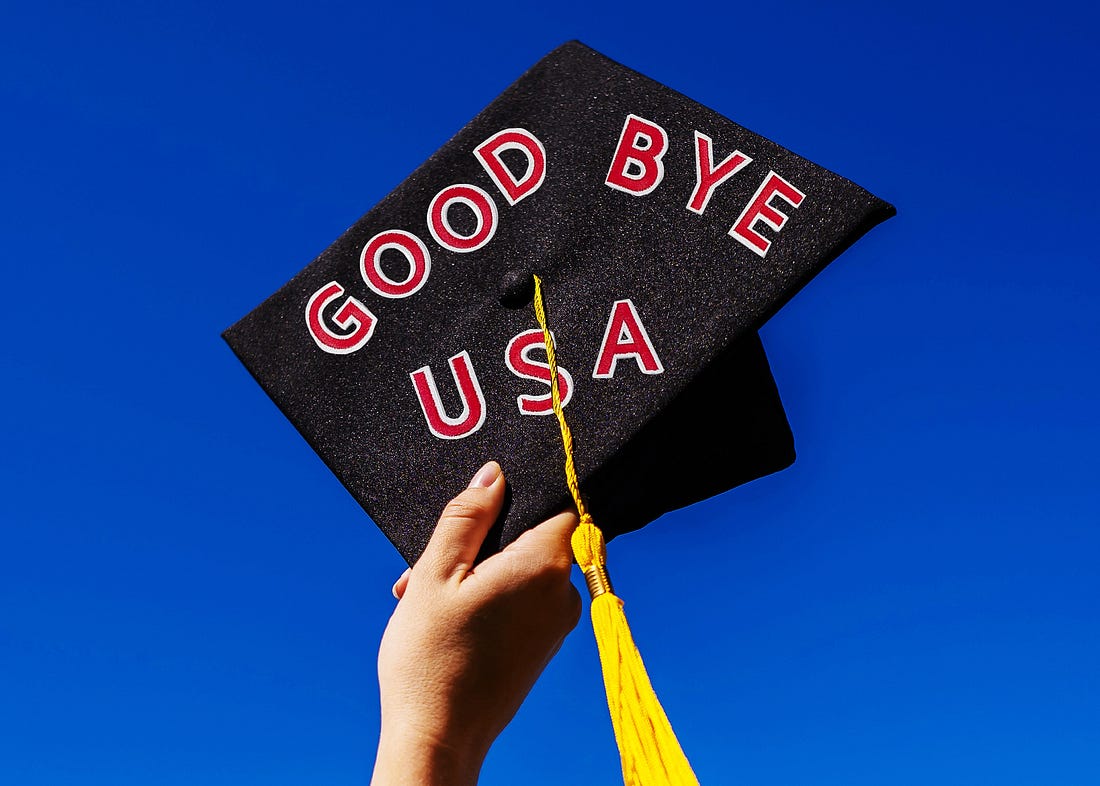
Welcome. This week’s edition of Receipts is a deep-dive into the massive own goal our government is committing right now by purging scientists from the civil service and driving away global talent from everywhere else. Much of this is happening through Trump’s sabotage of the legal immigration system, including sweeping bureaucratic changes that are less visible than the violent thuggery happening in the streets. Trump is expected to cut legal immigration by between a third and half over four years. Our loss will be other countries’ gain, since top talent will go abroad and make new discoveries and found new businesses. As one headline in an Irish newspaper put it: “The idiot wind now howling through the US offers Ireland a transformative windfall.” Honestly, we’d be lucky if they ended up in Ireland rather than, say, China, which has been investing heavily in R&D for the technologies of the future. Are there other ways that we’re driving away top-tier talent? Drop me a note in the comments. And if you don’t already subscribe to Bulwark+, I hope you’ll consider doing so. Our country may be experiencing brain drain, but we still have some decent brain power here—we hope! –Catherine Trump Is Making America StupiderHow MAGA is purging scientists and other skilled workers from both the private and public sectors.
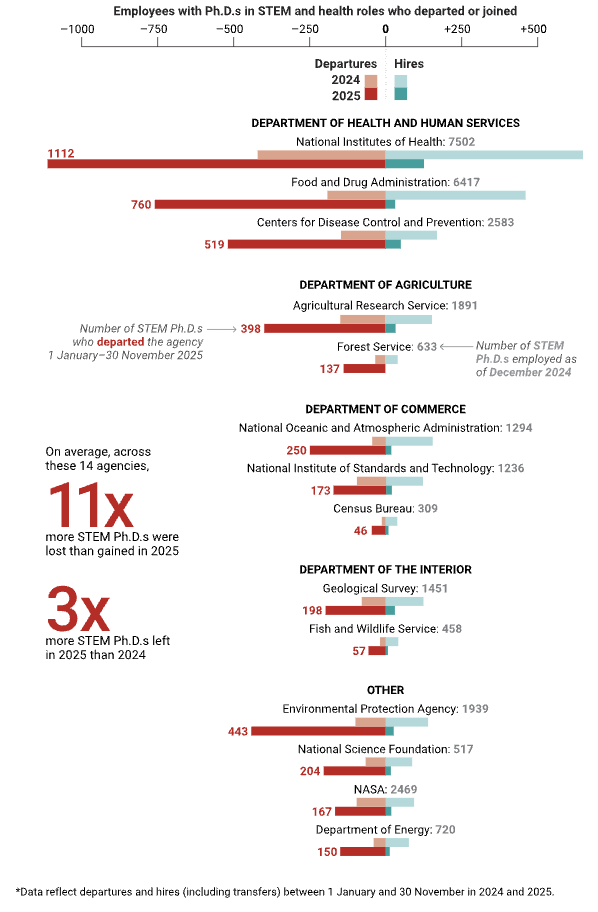
“I LOVE THE POORLY EDUCATED,” Donald Trump once declared. That was back in 2016, during his first presidential campaign. Now, a decade later, he and the rest of the MAGA movement have manifested that love into policy, with a series of changes that have hobbled America’s entire knowledge sector. It’s been both disruptive and deeply damaging. For over a century, America’s knowledge economy has been our golden goose. Thanks to both private and public R&D, we have developed the strongest military, the most cutting-edge tech companies, and global dominance in the fields of science and medical research. These successes didn’t happen by accident. They were the result of deliberate policy choices going all the way back at least to the Morrill Act of 1862. That’s the law that created land-grant colleges during the middle of the Civil War, just to give you a sense of how long America has prioritized higher education even in the direst of circumstances. Over subsequent decades our policymakers made other choices to invest in and harness knowledge creation. They did so through our regulatory regime and federal investment in R&D. Perhaps most importantly, they opened up our immigration system in the mid-twentieth century to attract the best and brightest scientific talent from around the world. By one estimate, foreign STEM workers immigrating to the United States accounted for between 30 to 50 percent of all U.S. productivity growth between 1990 and 2010. These international STEM workers came to the United States to study, research, and collaborate with native-born scientists; they invested their skills in growing the U.S. economy. They also founded blockbuster businesses.¹ Today, as other countries invest in developing the technologies of the future, our advantage is being rapidly unwound. This, too, is not something that has just happened on its own. It was not inevitable. It was a choice. It’s the Great American Brain Drain, courtesy of MAGA. TRUMP SOMETIMES CLAIMS he wants more high-skilled immigration. But his record shows the opposite. In the past year, Trump has made it dramatically harder for high-skilled workers to come to or stay in the United States, where they would otherwise be able to contribute their talents to our economy. Some of these actions have gotten some press coverage, such as the $100,000 fee he’s tacked on to the so-called skilled-worker visa, known as an H-1B.² This is, needless to say, prohibitively expensive for virtually any employer, who already must certify that the workers they’re sponsoring are being paid the prevailing wage and are not taking the job of an equally qualified U.S. citizen. But the six-figure visa fee is hardly the only brick in Trump’s wall keeping out high-skilled immigrants. In December, the administration finalized a new rule that will make it harder for recent graduates to get high-skilled worker visas, including those who graduate from U.S. universities. This is not to be confused with yet another rule expected in the next few months that would make it harder for graduates of STEM degree programs at U.S. universities to stay and work after graduation through their student visas.³ These are among a slew of recent under-the-radar regulatory changes that will make it hard or impossible for high-skilled immigrants to come or stay here. Some changes haven’t even been formally announced: For example, immigration attorneys have reported that U.S. consulates in India abruptly canceled visa interviews at the beginning of this year⁴—and won’t allow applicants to reschedule their appointments until 2027. Red states are getting in on the fun, too. The governors of Florida and Texas both recently announced plans to block public educational institutions from hiring workers on H-1Bs. This will be disastrous for some of these states’ strongest and most prestigious institutions, whose success depends on being able to hire the best researchers and clinicians regardless of nationality. Take the University of Texas MD Anderson Cancer Center, the largest cancer center in the world. Government data shows that MD Anderson has hired around 100 new H-1B workers annually in recent years. Based on both how long these visas last and expected turnover, “a conservative estimate would be that MD Anderson has 400 to 500 people working in H-1B status,” according to Stuart Anderson, executive director of National Foundation for American Policy, a pro-immigration think tank. (MD Anderson did not reply to a request for comment.) Other federal measures target international students specifically. Last fall, matriculation by new international students plummeted 17 percent, in part due to visa issues, and the administration has taken measures to drive numbers even lower. For example, Columbia’s settlement with the Trump administration—supposedly designed to combat antisemitism—included a commitment to decrease international student enrollment. At a broader level, the administration is also working on a rule to change student visas from lasting for the duration of academic program to a fixed four-year term, and then making them much harder to renew. This would destroy U.S. universities’ ability to attract international students pursuing advanced degrees in STEM fields. After all, the median time to complete a Ph.D. is 5.7 years, according to the National Science Foundation. All of this amounts to almost masochistic levels of economic self-sabotage. Higher education is one of our most successful “exports,” and consistently has a huge trade surplus. Consider that, in dollar terms, the rest of the world paid as much to travel to the United States for education-related purposes as they did to buy our natural gas and our coal in 2024. We’re also depriving our country of access to the next generation of critical thinkers. In the recent past, roughly half of STEM doctorates went to international students each year; those doctoral recipients historically have tended to stay in the United States after graduation, work in labs or private companies, and start their own businesses that employ American workers. At least, that has been the case. What are America's most competitive exports? By dollars, not coal or corn. Dollar value of exports in select sectors, 2024 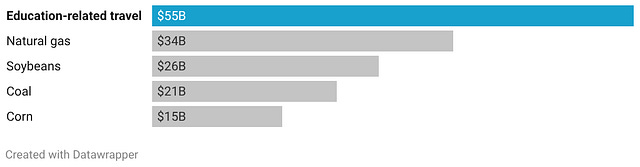 Supporters of the Trump administration’s approach insist it will redound to the benefit of native-born Americans, who will now find a bevy of opportunities that didn’t otherwise exist in STEM programs. But despite what the xenophobes in the administration claim, international students aren’t stealing American students’ slots. To the contrary: their tuition dollars enable more American students to attend college. That’s because international students are more likely to pay full freight, and so they end up cross-subsidizing the tuition charged to U.S.-citizen undergrads. The administration’s professed concern for reserving educational and employment slots for American scientists rings a little hollow for other reasons, as well. Chief among them: They’ve been snatching funding away from researchers regardless of their country of origin. Meanwhile, the federal government has engaged in a mass purge from its own ranks. In the past year, the federal workforce lost more than 10,000 STEM Ph.D.s, according to an analysis in Science. Yes, you read that number correctly. The losses were disproportionately large in some agencies; the National Science Foundation lost about 40 percent of its doctorate-holding experts, for instance.
Trump officials seem unperturbed by this historic brain drain. Treasury Secretary Scott Bessent even gushed last year that all those expert civil servants laid off by DOGE would soon be freed up to work in the factories newly created by Trump’s trade wars. Alas, that plan hasn’t panned out either: The manufacturing industry is hemorrhaging jobs. Turns out the sectors driven by brains and brawn are both struggling in the Trump economy. Ramparts— At long last Trump may be announcing his choice for the next Federal Reserve chair; on Thursday evening he said he’d name his pick “tomorrow.” Stay tuned. The next big question will be whether the outgoing Fed chair, Jerome Powell, intends to stay on the Fed Board, since his term as a board governor is separate from his chairmanship and doesn’t end until 2028. Usually Fed chairs leave the institution entirely when their term as chair ends; only twice in history has the chair opted to stick around, with the last time in 1978 for only a couple of months. But for a host of reasons, including the DOJ’s political investigation of Powell, he may decide to stay. — One reason why the public may care less about the decimation of our research institutions is that Americans from all political persuasions have increasingly soured on college. Even a slight majority of Democrats now say college is not worth the (substantial) cost, according to recent polling from NBC News. Of course, whether these respondents still send their own kids to college is a different question entirely. At some point I’ll write a newsletter on how college became a political football, and what universities can and should do to recover their image. — Maybe Trump’s love of the poorly educated explains why he and his underlings struggle to do basic math. — Last week, I wrote about Trump’s collection and weaponization of confidential government records. There have since been developments on that front. In one viral video, an ICE agent told a protester she was going in his “nice little database” and would be labeled a “domestic terrorist.” The White House claimed no such database exists. However, CNN reports that ICE agents received a memo instructing them to collect “intel” on protesters:
Additionally, in a sworn statement, at least one ICE observer said she had her TSA PreCheck revoked after an encounter with immigration officials. And of course, Attorney General Pam Bondi’s demand for voter rolls as ransom for taking ICE out of Minnesota is another troubling example of how the administration seems to be hoovering up and weaponizing data for political purposes. Please drop me a line if you know of other developments I should track. — The Congressional Budget Office estimates that federal troop deployments to U.S. cities cost a total of $496 million last year. Continuing current deployments will cost $93 million per month. This is, to be sure, not the most important reason why the military should be ejected from U.S. cities, but it is a useful data point nonetheless. — The “sell America” trade continues: According to BlackRock, investors can no longer hedge their bets using bonds. 1 Roughly half of all firms in the Fortune 500 were founded by immigrants or their children. 2 You may recall that the fight over H-1Bs has been a big schism within the MAGA movement, and is among the reasons Steve Bannon called for Elon Musk—who supports more H-1Bs—to be deported. 3 Changes to what’s known as the “Optional and Practical Training” program were teased recently in the Federal Register, and were previously laid out in Project 2025. 4 The cancellations were ostensibly related to a new policy requiring visa applicants to give over their social media activity to U.S. officials, which is a whole ’nother anti-immigrant/anti-dissident can of worms. You’re a free subscriber to The Bulwark—the largest pro-democracy news and analysis bundle on Substack. For unfettered access to all our newsletters and to access ad-free and member-only shows, become a paying subscriber.We’re going to send you a lot of content—newsletters and alerts for shows so you can read and watch on your schedule. Don’t care for so much email? You can update your personal email preferences as often as you like. To update the list of newsletter or alerts you received from The Bulwark, click here. Having trouble with something related to your account? Check out our constantly-updated FAQ, which likely has an answer for you.
|