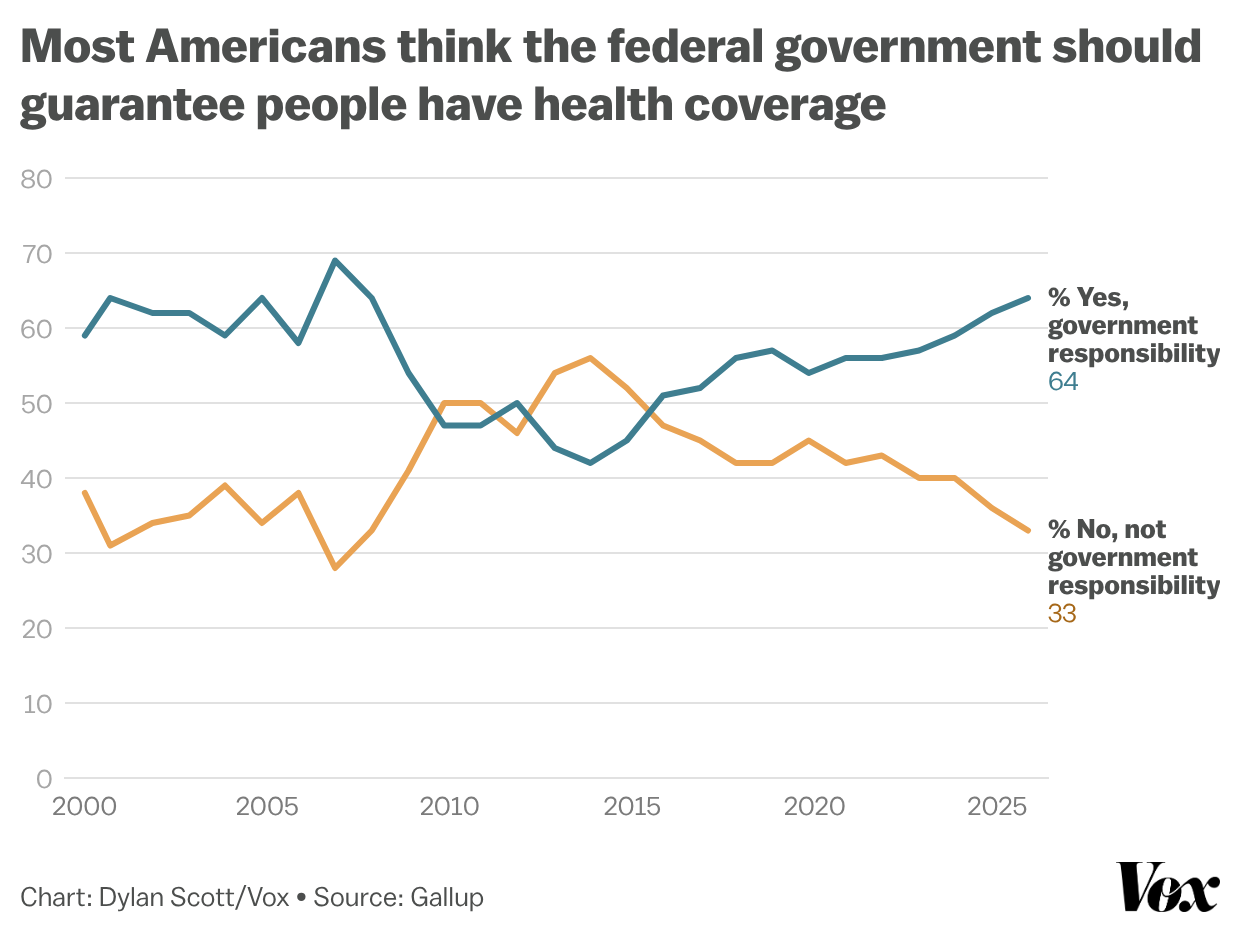
Now, take a closer look at that chart.
The last time Americans were this unified around the idea of the government guaranteeing health coverage was around 2008 — shortly before our last major health reform law, the Affordable Care Act, passed. The politics of health care are cyclical. It goes something like this:
A problem becomes impossible for politicians to ignore, and lawmakers pass (or try to pass) an imperfect plan to address it — and then…
Voters become incensed over that specific plan — and then… The backlash leaves lawmakers too afraid to try to pass any more significant reforms until the public becomes so fed up again that our leaders feel compelled to act.
Paul Starr, the preeminent historian of American health care, coined a term for this cycle: remedy and reaction.
For the past 16 years, we have been in a period of reaction to the ACA: Democrats sought to reduce the persistently high uninsured rates among the working class and people in poverty, they came up with the ACA to achieve that goal, voters initially rejected the law after campaigning from Republicans and some corner of the business industry, and the lingering bruises from that backlash made many Democrats reluctant to propose major changes in 2016, 2020 and 2024.
But now the wheel may finally be coming back around.
The time is ripe for another big health care swing
You need a few things to make a big health care push: that critical mass of political support, serious policy chops, and buy-in from at least some of the major health care business interests. The ACA, for example, resulted from Barack Obama's massive electoral mandate, decades of policy planning dating back to at least the early Clinton years, and acquiescence from hospitals and Big Pharma that opted not to mount a major resistance.
All three factors are starting to align again.
We've covered the public's attitude on health care already. The ACA subsidy cliff and Republicans' Medicaid cuts could deepen their anger and their desire for change. The shift to direct-to-consumer health care sales — like people paying cash for Ozempic at Costco — will further heighten the inequities in our system while squeezing many people's wallets.
On policymaking, below the surface, the gears have been slowly churning, setting the stage once again for future action.
This is a key part of the cycle: Momentum builds slowly, imperceptibly except to those paying close attention, before short windows open that allow for bursts of policymaking.
Democrats went through a robust debate around what their next health care overhaul might look like during the 2020 presidential primary: Medicare-for-all, Medicare for all who want it, more targeted reforms to private insurance. They have been vetting and finetuning these concepts for a decade at this point. More recently, state-level public insurance options have gotten off the ground in states like Washington and started to show promising results; those experiences could be valuable when lawmakers are crafting a national plan, just as an existing Massachusetts health care reform law informed the ACA's development.
Right now, there is a new bipartisan group of lawmakers trying to deliver a deal on reforms for pharmacy benefits managers and more. In another sign of the shifting winds, the Trump administration has made moves to reduce drug prices, taking steps — such as trying to align US prices with international prices — that would have been unthinkable for a Republican a decade ago.
On our third point, some major special interest groups are having their own moments of crisis — and they're in the mood to consider serious reforms. The American Medical Association, long an opponent of single-payer health care, has been gradually softening its stance; it has also advocated for restoring the ACA financial assistance and building upon the law. Even if a true, single-payer system remains a tough sell in the US, these are notable signals that the nation's most powerful physician lobbying group may not oppose a more muscular government role in providing health insurance and trying to limit costs.
And as I have reported, some companies are starting to seriously ponder the future of employer-sponsored insurance as the cost of providing it continues to grow. Those employer-sponsored plans, which insure about half the US, have long been considered untouchable because they offer tax-free health benefits — a major value for the private sector. And some companies say they still see that value. But if more firms decide they want to stop playing the role of health insurance administrator, that would be a massive political shift that could open up all kinds of new possibilities.
So what comes next?
National politics will be important: Democrats seem more likely than Republicans to mount a major health care reform effort. But even there, you can argue that the stars are aligning more than it might seem: President Donald Trump is so unpopular right now that the Democrats winning the Senate is plausible. Then they only need to take the presidency in 2028, and the window will, at least in theory, be open. Health care is a top priority for voters. That won't change.