A Revolutionary Broad-Spectrum Antiviral Platform Gears Up to Disrupt Multi-Billion-Dollar Markets in Biodefense, Infectious Disease, and Global Health….
Greetings All,
NanoViricides, Inc. (NYSE: NNVC) is emerging as one of the most exciting small-cap biotech stories heading into 2026. With its lead drug candidate, NV-387, now preparing for Phase 2 human trials, NNVC is redefining the boundaries of antiviral therapy with a bold mission — to deliver the world's first broad-spectrum antiviral that destroys viruses before they infect cells.
As measles outbreaks sweep the U.S., and the orthopoxvirus family (MPox/Smallpox) resurfaces as a global concern, NV-387 is stepping into the spotlight as a clinically validated, ready-for-action therapy.
This innovative nanomedicine could become the defining biotech success story of the decade — and Wall Street is beginning to take notice.
According to Zacks Small Cap Research, NanoViricides (NYSE: NNVC) is entering a pivotal valuation phase as it prepares for Phase 2 clinical trials of NV-387.
The firm has issued a valuation of $7 on NNVC which can be seen HERE.
Zacks analysts highlight that the company's lead candidate could unlock significant value through multiple commercial pathways — including MPox treatment, U.S. biodefense stockpile procurement for smallpox, and broad respiratory virus indications.
NNVC's proven safety data, broad antiviral efficacy in multiple animal models, and advanced regulatory positioning set it apart from typical early-stage peers.
Financially, the company exited fiscal year 2025 with approximately $1.6 million in cash, later raising an additional $1.25 million through its at-the-market facility to strengthen its runway.
Zacks emphasizes that positive data from the upcoming MPox Phase 2 trial could rapidly transformNNVC'svaluation profile — positioning the company for strategic partnerships, non-dilutive government funding via BARDA, and potential inclusion in the U.S. Strategic National Stockpile.
In short, Zacks sees NV-387 as a catalyst capable of redefining NanoViricides' market potential.
The U.S. faces its most severe measles resurgence in over three decades — with outbreaks expanding across South Carolina, Arizona, Utah, and Nevada. Globally, nations like Canada, Israel, and New Zealand are bracing for renewed epidemics. As vaccination coverage declines, the world needs an immediate therapeutic solution — and NanoViricides' NV-387 may be that solution.
NV-387's mechanism is simple yet revolutionary: it binds, traps, and neutralizes viruses in the bloodstream, preventing them from infecting human cells. In preclinical studies, it boosted survival by 130% in measles models while protecting lungs from immune-mediated damage — a major leap in antiviral science!
Built on TheraCour® nanomedicine technology, NV-387 uses nano-polymer micelles to mimic human cell receptors (heparan-sulfate proteoglycans). When viruses attempt to attach, they instead bind to NV-387, which engulfs and destroys them.
This "decoy-and-destroy" process makes NV-387 resistance-proof, mutation-resistant, and universally effective against a wide range of viruses — from measles and RSV to influenza, COVID-19, MPox, and even smallpox.
Unlike vaccines or antibody treatments, NV-387 acts independently of the immune system — making it an ideal defense for immunocompromised and high-risk populations.
NNVC is set to launch a Phase 2 clinical trial for MPox in late 2025 or early 2026 in the Democratic Republic of Congo — the epicenter of recent MPox outbreaks.
The upcoming study will evaluate 80 hospitalized patients and compare NV-387 in combination with the standard of care versus standard treatment alone. The trial is already approved by the regional regulatory ethics committee (ACOREP) and backed by a leading Contract Research Organization (CRO).
Positive results could have immediate implications for FDA approval under the Animal Rule for Smallpox, unlocking a $1 billion market via the U.S. Strategic National Stockpile and potential BARDA funding — a major milestone for shareholder value!
NNVC is executing an aggressive two-track development strategy:
Track 1 – MPox/Smallpox Biodefense Pathway:
The Phase 2 MPox trial could pave the way for U.S. biodefense contracts and inclusion in the Strategic National Stockpile. NV-387's demonstrated activity against orthopoxviruses positions NNVC as a top candidate for BARDA support — non-dilutive government funding that has historically accelerated major biotech winners.
Track 2 – Empiric Therapy for Respiratory Viruses:
A "basket-type" Phase 2 trial is also planned to evaluate NV-387 as a front-line empiric therapy for multiple viral respiratory infections — a first-of-its-kind approach that mirrors how antibiotics are prescribed. Positive data could establish NV-387 as the world's first universal antiviral, treating infections before the specific virus is even identified.
NV-387 has already cleared Phase 1 safety testing with zero adverse events. Its oral gummies and syrup formulations provide easy patient use, particularly for children and those with severe rashes.
NanoViricides, Inc. (NYSE: NNVC) isn't just another antiviral developer — it's pioneering a new class of medicine designed to neutralize viruses before infection even begins.
With Phase 2 trials imminent, BARDA partnerships possible, and orphan drug designations pending, NNVC could soon redefine the antiviral landscape. And with a $7 valuation, the future looks bright.
Should Traders Bid on D.R. Horton's (DHI) Upcoming Earnings Report?
Posted On Jan 19, 2026 by Joshua Enomoto
D.R. Horton(NYSE: DHI) will almost certainly attract significant attention when it releases its fiscal fourth-quarter earnings results, scheduled for Jan. 20 before the opening bell. In the prior quarter, the homebuilder posted sales of $9.68 billion, beating out the consensus target by 2.7%. However, adjusted operating income and EBITDA fell well short of expectations, sparking a downturn in DHI stock.
Table of Contents
For the upcoming disclosure, analysts expect revenue to decline 12.4% year-over-year to $6.67 billion. On the bottom line, Wall Street experts are forecasting a print of $1.92 per share. Given the current economic challenges — particularly stubbornly high inflation relative to the pre-pandemic paradigm and the impact of tariffs — investors don't exactly have high hopes for the homebuilding industry.
That said, the reduced expectations could be a blessing in disguise. Essentially, the market doesn't price facts themselves; it prices changes in facts or shifting expectations of facts. Therefore, if investors collectively believe that circumstances are better than previously advertised, it wouldn't be surprising if DHI stock were to swing higher.
Keep in mind that since the close of the Sept. 8 session, D.R. Horton stock is down more than 15%. In order for shares to continue dropping further, there needs to be fresh justification. A garden-variety poor print might not do the trick, as analysts are already expecting a deterioration in the top line.
If we're looking at the canvas from a naïve probabilistic perspective, there appears to be a higher risk of DHI stock not falling further. In fact, the structural case appears to support the bullish narrative.
First-Order Expectations for DHI Stock
With D.R. Horton set to release earnings results shortly, it's no surprise that implied volatility (IV) for the next weekly options chain (expiring Jan. 23) has witnessed a spike to 63.44%, which is higher than other nearby chains. A residual metric stemming from actual order flows, IV is one of the strongest expectational metrics you'll use as a trader.
Imagine that you're standing next to the roadway. As cars zip past you, you'll hear the "whoosh" as the passing vehicles disrupt the surrounding air. While you obviously don't know the ultimate destination of these cars, you can estimate by the aural quality of the sound how fast they're driving. That estimation is basically IV.
In the equities market, when IV is elevated relative to historical norms, that's a signal that options traders anticipate a large kinetic movement. A massive IV figure doesn't mean bullish or bearish; it just means that traders are betting on (and hedging against) an outsized performance.
By taking the IV figure and plugging it into the Black-Scholes formula, traders are able to estimate a forward dispersion for a selected options chain. For example, the IV for the March 20 options chain comes in at 39.44%. When plugging this volatility figure into the aforementioned framework, the expected move would be a high-low spread of 11.8%.
Based on the current market price, DHI stock would be expected to land between $137.40 and $174.17. This is the basis of the so-called "expected move calculator" and there are several financial outlets that are selling this insight for a premium subscription.
If you want my advice? Save your money. The expected move calculator is the question, not the answer.
It's not that the calculator is wrong. Again, IV is a real residual metric. So, when the market is expecting a range between $137.40 and $174.17 for the March 20 options chain, that's a legitimate target. The issue is that the total gap between these two price points is nearly 27%.
I'm sorry, but that's a massive cavern, which means that trading straddle-type strategies would entail unnecessary cost or risk exposure. In other words, there's no point in betting on an outcome if we have a reasonable likelihood to believe that it won't materialize.
That's where the Markov property enters the arena.
Narrowing the List of Possibilities for D.R. Horton Stock
Calculating forward probabilities should never be an exercise done in isolation because everything is contextual. Under the Markov property, a system's future (behavioral) state depends only on the current state. To use a simple sports analogy, the chance of you winning a game could be 50/50. However, if you have a massive lead late in the game, the odds could be 90/10 in your favor.
One of the critical vulnerabilities of the Black-Scholes model is that the underlying math isn't integrated with the capability of carrying over prior context. So, whether a stock is on a winning streak or a losing streak, it doesn't matter. The probabilities that are spit out in this model are largely dependent on IV.
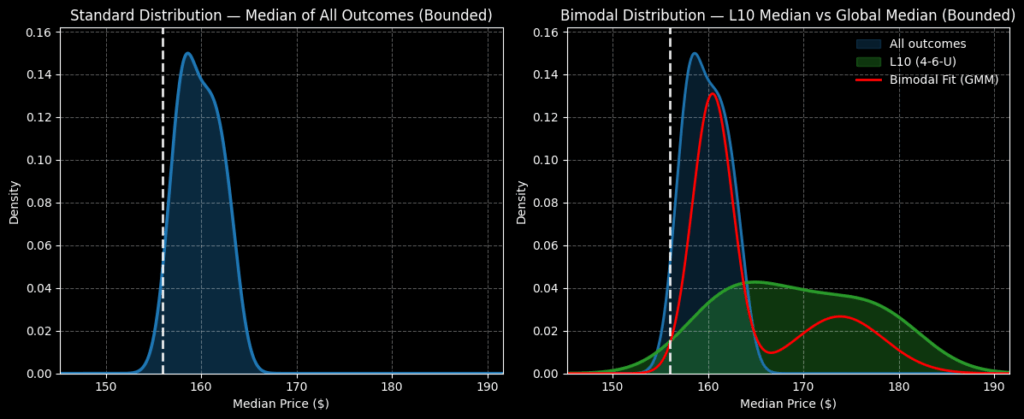
With Markov frameworks, we always take into account prior context. In the case of DHI stock, in the last 10 weeks, it printed only four up weeks but with an overall upward slope. This rare contrarian signal tends to resolve even higher over the next 10 weeks. Specifically, if we assume a spot price of $155.96 (Friday's close), DHI should land between $145 and $192.
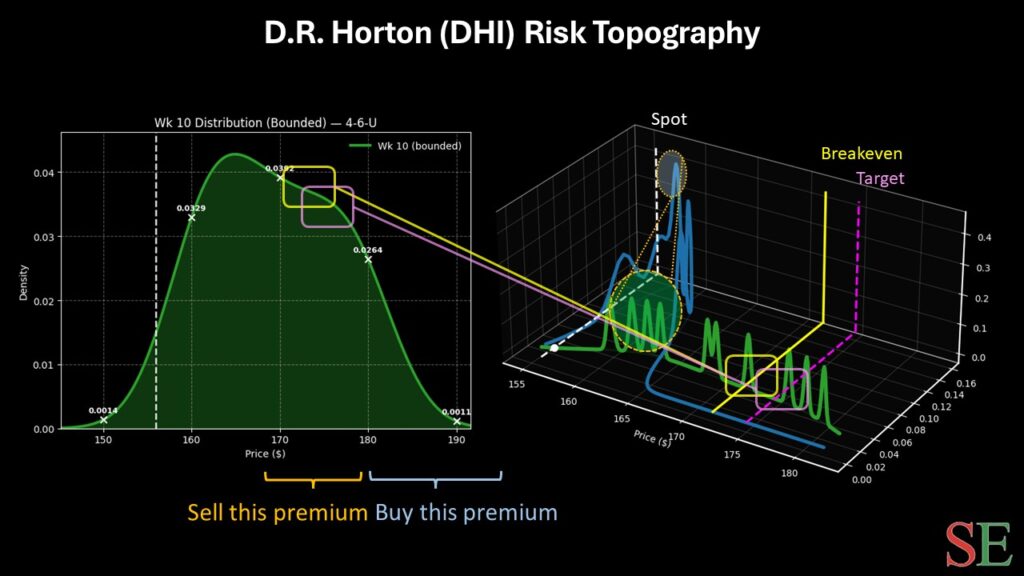
However, the real second-order analysis comes in the form of probability density. Over many trials of the 4-6-U sequence, probability density would likely peak between $159 and $179. That's a much narrower range of likely outcomes than the Black-Scholes-calculated range between $137.40 and $174.17.
Given this market intelligence, I'm liking the 170/175 bull call spread expiring March 20, 2026. This wager involves two simultaneous transactions: buy the $170 call and sell the $175 call, for a net debit paid of $200 (the most that can be lost).
Should DHI stock rise through the second-leg strike ($175) at expiration, the maximum profit would be $300, a payout of 150%. Further, breakeven would land at $172, thereby enhancing the trade's probabilistic credibility.
This message is a PAID ADVERTISEMENT for NanoViricides, Inc (NYSE:NNVC) from Interactive Offers. StockEarnings, Inc. has received a fixed fee of $8000 from Interactive Offers for multiple Dedicated Email Sends, Newsletter Sponsorships and SMS Sends between Jan 23, 2026 and Jan 29, 2026. Other than the compensation received for this advertisement sent to subscribers, StockEarnings and its principals are not affiliated with either NanoViricides, Inc (NYSE:NNVC) or Interactive Offers. StockEarnings and its principals do not own any of the stocks mentioned in this email or in the article that this email links to. Neither StockEarnings nor its principals are FINRA-registered broker-dealers or investment advisers. The content of this email should not be taken as advice, an endorsement, or a recommendation from StockEarnings to buy or sell any security. StockEarnings has not evaluated the accuracy of any claims made in this advertisement. StockEarnings recommends that investors do their own independent research and consult with a qualified investment professional before buying or selling any security. Investing is inherently risky. Past-performance is not indicative of future results. Please see the disclaimer regarding NanoViricides, Inc (NYSE:NNVC) on EQUISCREEN website for additional information about the relationship between Interactive Offers and NanoViricides, Inc (NYSE:NNVC).
Your privacy is very important to us, if you wish to be excluded from future notices, do not reply to this message. Instead, please click Unsubscribe.
StockEarnings, Inc 33 SE 4th St, Suite 100, Boca Raton, FL 33432 USA W: 877.6.STOCKS StockEarnings.com