
For decades, Wall Street and financial advisors have pushed the same message:
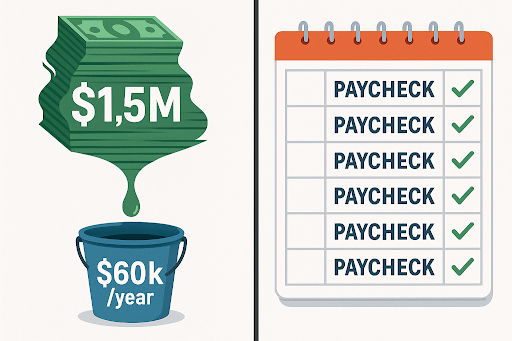
“If you want to retire, you’ll need at least $1.5 million saved.”
On paper, that sounds like security. But let’s do the math…
- $1.5M at a 4% withdrawal rate = ~$60,000/year
- Subtract taxes → maybe $45,000 in your pocket
- Factor in inflation → that “nest egg” buys less every year
And that’s assuming you ever reach $1.5M — which most hardworking Americans never do.
It’s a broken model. One that keeps people chasing a number, instead of chasing a skill.
The alternative is to build an income stream you can rely on now — without needing millions stashed away.
That’s what my Method is designed to do:
- Simple, structured trades
- Placed once a week
- With the goal of generating consistent weekly income, regardless of market direction
Instead of hoping a giant nest egg carries you through, this approach is about creating ongoing paychecks — income you can count on, week after week.
[See why weekly income beats the $1.5M myth →]
3 Smart Defensive Stocks for an Uneasy Market
Written by Chris Markoch. Published 11/18/2025.

Key Points
- Despite new market highs, recession risks remain elevated due to weakening consumer credit and signs of job market stress.
- Procter & Gamble and Johnson & Johnson offer stable dividends, strong balance sheets, and catalysts that could provide upside in a downturn.
- A rotation away from AI and into Dow components could make the DIA ETF a compelling defensive play for 2025.
At one point in early November, the Dow Jones Industrial Average (DJIA) briefly topped 48,000 for the first time ever. At different times in 2025, the NASDAQ and S&P 500 have made new all-time highs (ATHs). Despite sharp price swings, it's been a solid year to own stocks.
Yet many economists, analysts, and investors remain uneasy. The market appears priced for perfection—but recession risks are not priced in.
Wall Street rigged the game… (Ad)
Wall Street has convinced millions that options are the only path to big gains — all while quietly stacking the deck with decay, timing pressure, and built-in failure triggers. Jeffry Turnmire says there's a better way: a little-known class of "Supercharged Tickers" that trade like normal stocks but can deliver option-like returns without the hidden time bombs that drain most traders' accounts. He's now revealing exactly what they are, how they work, and the #1 ticker he's watching right now.
Click here to see how Supercharged Tickers can amplify returns without trading optionsEven with broad gains, skepticism persists. The Magnificent 7 trade may have cooled, but the market is still being driven by a narrow group of names, most tied to the AI boom.
The K-Shaped Economy Concern
Current commentary increasingly points to a K-shaped recovery: higher-income consumers have been navigating inflation of around 3%—still above the Federal Reserve's informal 2% target but manageable for affluent households.
Lower-income consumers, however, have been under pressure for several years. Rising credit defaults, delinquent auto loans, and a recent uptick in foreclosures suggest this problem is worsening. The labor market had been the economy's strongest pillar, but even that is starting to show signs of strain.
JPMorgan Chase & Co. (NYSE: JPM) recently lowered its estimate of the probability of a recession from 60% to 40% because of the recent de-escalation of trade tensions. That's still a meaningful risk.
Market Breadth Remains Narrow as Investors Chase Mega-Caps
Recent data from Charles Schwab shows the percentage of S&P 500, NASDAQ, and Russell 2000 stocks trading above their 200-day moving average was slightly above 50%. That's historically low market breadth, which adds to investors' concerns.
This isn't a redux of 2021, when investors piled into unprofitable SPACs hoping for big windfalls. Today's froth is concentrated in mega-cap stocks that often have substantial cash on their balance sheets. Still, many investors feel these names look overvalued.
So what's an investor to do? Here are three stocks (and one ETF) that provide the potential for asymmetric returns in the current uneasy market.
Procter & Gamble Has More Than a Dividend to Like
Procter & Gamble Co. (NYSE: PG) is part of the exclusive Dividend Kings club, meaning the company has increased its dividend for at least 50 consecutive years—70 years in PG's case—making it a staple for income-oriented investors.
The 2.8% dividend yield could look more attractive if interest rates fall. Analysts' $171.53 price target implies roughly 17% upside from current levels, offering both income and potential capital appreciation.
It's unclear how PG's proposed acquisition of Kenvue (NYSE: KVUE) would affect earnings. If the deal goes through and the Tylenol controversy abates, the company might see modest EPS dilution in the first year, followed by potential EPS accretion from cost synergies.
Johnson & Johnson Doubles Down on Medtech and Oncology Growth
The next company on the list is Johnson & Johnson (NYSE: JNJ), which spun off Kenvue in 2023 to focus on medtech and pharmaceuticals.
Its recent $3.5 billion acquisition of Halda Therapeutics illustrates that strategy. The all-cash deal gives JNJ access to the clinical-stage company's HLD-0915 drug candidate.
HLD-0915 is a once-daily oral prostate cancer medication that received fast-track designation from the U.S. Food & Drug Administration (FDA). This will be a meaningful addition to JNJ's oncology pipeline and should make the stock more appealing to growth-oriented investors.
The DIA ETF Could Benefit From a Flight to Safety
Over the past five years, many investors embraced a passive "SPY and chill" strategy, investing in the SPDR S&P 500 ETF Trust (NYSEARCA: SPY). SPY may still be a solid choice, but with potential AI overexuberance, it may be prudent to consider alternatives like the SPDR Dow Jones Industrial Average ETF Trust (NYSEARCA: DIA).
If concerns about an AI bubble intensify, investors could rotate into the Dow 30's more established, diversified names. That would make DIA a logical asymmetric play to capture a flight-to-safety rotation.
As of this writing, DIA has roughly 37% institutional ownership. It has seen net buying in seven of the last eight quarters, suggesting institutions may be gradually building a hedge against a possible slowdown in the tech trade.
This email communication is a sponsored email provided by Traders Edge Network, a third-party advertiser of DividendStocks.com and MarketBeat.
If you have questions about your subscription, please feel free to email our U.S. based support team at contact@marketbeat.com.
If you no longer wish to receive email from DividendStocks.com, you can unsubscribe.
© 2006-2025 MarketBeat Media, LLC. All rights protected.
345 N Reid Pl. #620, Sioux Falls, SD 57103. USA..