

Ticker Reports for November 25th

Missed the AI Boom? These 2 Crushed Stocks Could Be Your Second Chance
Last month, when concerns about an AI bubble spilled over and sparked a sell-off, stocks spent several weeks in a pullback. However, the fallout adversely affected some equities more than others—even those that have no direct ties to the AI industry.
While a stock being oversold doesn’t imply that it’s undervalued, statistical principles do suggest that a reversion to the mean is increasingly probable, especially for companies with well-established track records, strong income statements and balance sheets, and competitive moats.
And while the term “oversold” can be subjective, technical indicators like the Relative Strength Index (RSI) can paint a better picture of when to expect a potential turnaround from a stock that has seen a runup in price—or, in the case of this article, a sell-off that has resulted in prices being driven down beyond what some would perceive to be fair market value.
As a momentum indicator, RSI helps investors gauge the speed and direction of price movements. Specifically, it uses data points to produce a reading between 0 and 100. Anything above 70 is considered overbought and likely to experience a bearish reversal.
Conversely, an RSI below 30 is considered oversold, indicating that a stock may experience a bullish reversal in the near term. That’s precisely the case with Oracle (NYSE: ORCL) and Super Micro Computer (NASDAQ: SMCI), both of which present substantial potential upside based on analysts’ 12-month price targets.
Oracle’s Price Correction Was Overdue but Overdone
While known foremost as a cloud software and database company, Oracle has been positioning itself as a major player in the AI industry.
In September, MarketBeat noted that the company—which has been leveraging its cloud infrastructure and enterprise software to provide tailored AI services and hardware for large-scale AI applications—could be at risk of a sizable correction.
Specific concerns centered around the tech stock’s short-term performance, given that earnings slowed by nearly 15% between the past two quarters. Additionally, despite its annual EPS increasing from the prior year, Oracle’s substantial capital expenditures led to a negative investing cash flow in Q1 2026. That same quarter, the company’s net change in cash and equivalents declined significantly.
From the start of the year through Sept. 15, when MarketBeat cautioned investors of a potential correction, shares of ORCL had gained around 85% year-to-date (YTD). Since then, they have droppednearly 34%. Institutional ownership has fallen to almost 42%.
However, after the recent sell-off, short interest has decreased to just 1.22% of the float, suggesting that the bears have backed off. While the correction was warranted, the result is that it pushed the stock firmly into oversold territory, with its current RSI reading on a one-year chart at 26.19, hinting that a bullish turnaround could be around the corner.
Furthering that argument, 30 of 40 analysts covering ORCL assign it a Buy rating, with the average 12-month price target of $322.26 representing nearly 61% potential upside. Oracle’s earnings are expected to grow 12.20% next year, from $5.00 to $5.61 per share.
Super Micro Has Fallen Alongside Data Centers
Super Micro Computer doesn’t own or operate AI data centers. The company designs, develops, and manufactures high-performance server, storage, and networking solutions for enterprise, cloud, data center, high-performance computing, and edge computing customers.
However, because it’s AI-related, the stock was dragged down along with other leading tech names over the past month. After gaining more than 95% YTD, SMCI has corrected by over 43% since Oct. 8.
The short interest of 15.44% of the float remains relatively elevated, but institutional ownership, at more than 84%, is higher than average. The smart money has been buying far more than selling. Institutional inflows of $6.68 billion over the past 12 months have dramatically exceeded institutional outflows of just $654.44 million.
The stock’s current RSI reading on a one-year chart is 29.51, indicating it is oversold. Meanwhile, only three of 19 analysts covering the stock assign it a Sell rating, and SMCI’s average 12-month price target of $48.38 represents more than 45% potential upside.
When the company reported Q1 2026 earnings on Nov. 4, it missed on the top and bottom lines. But quarterly reports are rear-facing, and lost among the misses was news of $13 billion in new NVIDIA GB300/B300 orders, including SMCI’s largest deal ever.
Super Micro Computer raised fiscal 2026 guidance to at least $36 billion, with Q2 sales forecast between $10 billion and $11 billion. Importantly, SMCI's earnings are expected to grow 19.35% over the next year, from $1.86 to $2.22 per share.

Blood in the streets = wealth in the bank
Blood in the streets = wealth in the bank

Are These 3 Under-the-Radar AI Stocks the Next Big Growth Stories?
The close of 2025 has been somewhat of a trying time for AI bulls, as voices calling the artificial intelligence boom a bubble are growing louder.
NVIDIA Corp. (NASDAQ: NVDA), the world's largest company and a major bellwether for the AI industry more broadly, has experienced a share decline of nearly 14% since late October. While some risk-averse investors will take the first sign of a pullback as confirmation that AI is too dangerous a space, others might see an opportunity to buy in.
Outside of firms like NVIDIA—major players in the manufacturing of hardware related to AI, providers of infrastructure, data center operators, and others—the field of off-the-beaten-path AI firms is growing rapidly. Of course, these latter companies are riskier, both due to their small size (many are small- or micro-caps) and their lack of a proven track record in a rapidly shifting space. Still, the three companies below may appeal to risk-tolerant investors, who see an opportunity to capitalize on volatility in the AI world.
WhiteFiber: Expands Data Center Footprint While Managing Losses
WhiteFiber Inc. (NASDAQ: WYFI) operates high-performance computing data center infrastructure and makes graphics processing units (GPUs).
The company's Montreal data center is projected to see a full-quarter revenue run rate of roughly $1 million per month, which could be transformational for the young firm.
Meanwhile, WhiteFiber's next data center, located in North Carolina as NC-1, is on track for deployment in the first quarter of 2026 and has already received numerous proposals from strong counterparties.
With third-quarter revenue topping $20 million—an increase of almost two-thirds year-over-year (YOY)—and gross margin of 63%, there is much to be excited about with WhiteFiber. However, investors should note that revenue didn't climb by quite as much as analysts had expected, and, perhaps more concerningly, booming general and administrative expenses contributed to operating losses that widened to $14.5 million.
Regardless, Wall Street is optimistic about this company, with two new Outperform ratings in the last month, meaning that eight out of 10 analysts call WYFI a Buy. With an upside potential of 108%, the growth path is clear, albeit risky.
AudioEye: Grows Recurring Revenue but Faces Customer Volatility
Unique in the AI space, AudioEye Inc. (NASDAQ: AEYE) leverages this technology to deliver digital accessibility services and ensure compliance with the Americans with Disabilities Act and similar regulations.
With business expanding in both the United States and the European Union, AudioEye reported annual recurring revenue (ARR) of nearly $39 million for the latest quarter.
Overall, quarterly revenue was pretty strong at $10.2 million, and adjusted EBITDA reached a record of $2.5 million.
Still, AudioEye is a small company—its market capitalization is just over $143 million—and a partner renegotiation in the last quarter resulted in a 3,000 customer count decrease to around 123,000, demonstrating just how susceptible the firm is to client change. On the other hand, AudioEye is rapidly developing its platform and already has a significant advantage over its peers in the niche AI accessibility space.
With limited analyst attention (there are only four recent ratings, though three are Buy recommendations), AudioEye could be an underappreciated AI growth prospect. It does enjoy a consensus price target of $22, more than 90% above its current price.
Red Violet: Delivers Record Revenue and Strong Client Retention
Red Violet Inc. (NASDAQ: RDVT) uses AI to enhance its financial crime mitigation tools.
With record revenue of more than $23 million in the third quarter, an adjusted gross margin of 84%, a solid EPS beat, and its best-ever free cash flow, the company has plenty of forward momentum.
Additionally, it is attracting new customers from both the enterprise and public sectors, and gross retention is strong, at approximately 96%.
With much of its business tied to the real estate market, Red Violet is exposed to volatility in this sector. The end of the year may also be a soft season for that reason as well. Still, all three analysts reviewing RDVT shares recommend a Buy, and the consensus estimate suggests the company's stock could rise by 16%.

NEW LAW: Congress Approves Setup For Digital Dollar?
NEW LAW: Congress Approves Setup For Digital Dollar?

These 3 Housing Stocks Are Laying the Foundation for a Comeback
The housing market is still in rough shape, impacting performance for all companies in the sector—from homebuilders to home improvement companies. However, it may be on track for a recovery, as easing interest rates and home prices have triggered a slow trickle of improvement that is expected to strengthen in 2026.
With priced-in risks and reliable capital returns, companies such as D.R. Horton (NYSE: DHI), Lowe’s (NYSE: LOW), and Whirlpool (NYSE: WHR) are well-positioned to benefit from improving housing market trends. 2026 may be a pivotal year for their stock price action, which is likely to trend higher in the long term as the underlying businesses grow, sustain cash flow, and drive capital returns for their investors.
D.R. Horton: The Nation’s Largest Homebuilder at a 25% Discount
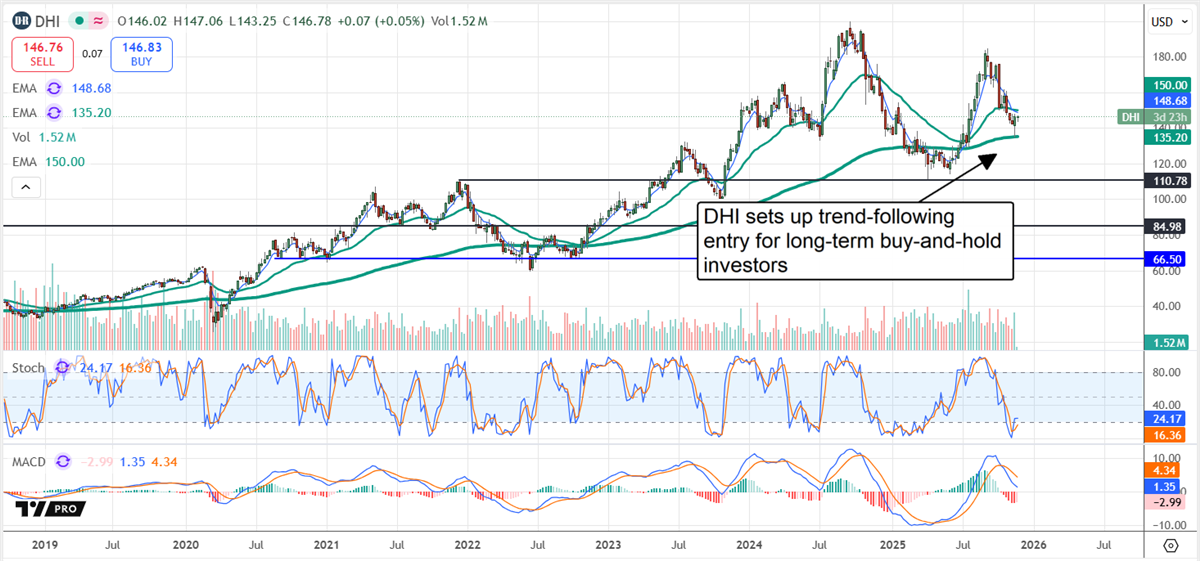
D.R. Horton, the largest homebuilder in the United States, faces pressure in 2025 as falling home prices weigh on revenue, despite ongoing volume growth. However, volume increases are key—they help sustain the company’s cash flow and capital return program, including buybacks and dividends.
Although the company's guidance includes a reduced forecast for share buybacks, buybacks are expected to remain robust at approximately 5.8% of the late-November market cap.
This is in addition to the nearly 10% decline posted in FY2025 and will likely be sustained if not increased in the subsequent year as the housing recovery strengthens.
The DHI dividend is average, yielding about 1.25% while trading near $145, but it is reliable and growing at triple the pace of inflation.
The payout ratio is below 15% of earnings, and share buybacks help support per-share metrics by offsetting the impact of annual dividend increases.
The latest was worth 13% for investors, and another substantial increase is likely in 2026.
Analyst sentiment is mixed, with a few price target reductions offsetting increases, but ultimately bullish because the revisions fall within a range around the consensus, and institutions are buying. The consensus offers a small, single-digit upside in 2025, but is likely to trend higher over time. Institutional activity is more robust, with them owning more than 90% of the stock and buying at a pace of more than $2 for every $1 sold in the first half of Q4.
Lowe’s Poised to Trend Higher in 2026 on Expanding Pro Exposure
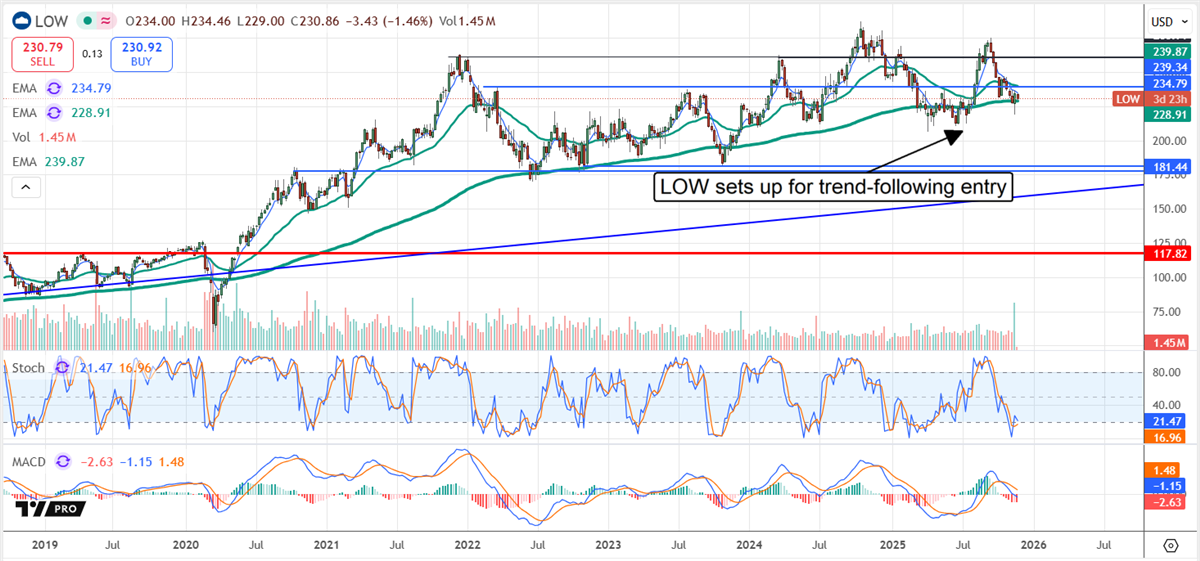
Lowe’s fiscal Q3 release highlighted resilience compared to Home Depot, largely because of lower exposure to storm-related disruptions.
The key highlight was growth in its professional contractor market, supported by the strategic acquisition of Foundation Building Materials.
While no buybacks occurred in Q3 due to capital preservation during the acquisition, share repurchases earlier in fiscal 2025 reduced the share count by roughly 1%. Buybacks are expected to resume in 2026 as free cash flow improves.
Lowe's also offers an attractive dividend yield of over 2% which is expected to grow at a low single-digit pace annually.
Whirlpool: A 5% Yield and Stock Price That Can Double
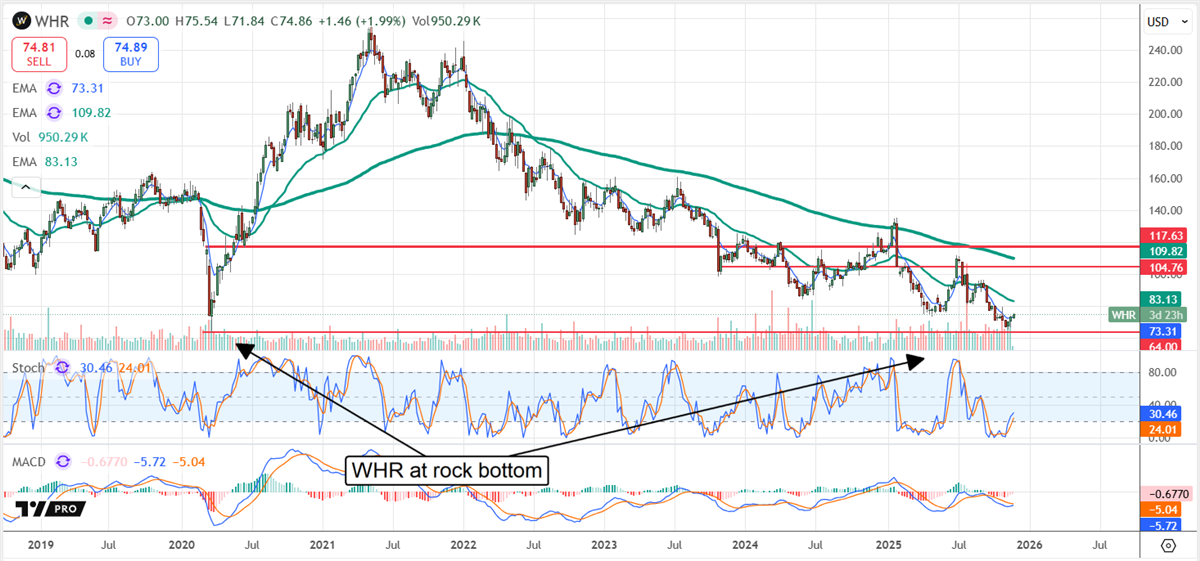
Whirlpool’s (NYSE: WHR) stock price is trading near long-term lows due to struggles with tariffs, competition, and a dividend cut. However, the sell-off has overextended, and a rebound may be coming for this appliance manufacturer.
Although cut, the dividend yield is still solid at nearly 5% and the payout ratio is below 65%, making it reasonably in line with other blue-chips of its size.
Earnings growth is forecasted to resume in FY2026 and accelerate in FY2027 demand for appliances.
Analyst coverage is tepid, but aligns with a stock price rebound, forecasting a 15% upside at the consensus.
The more telling indicator is the institutional activity, which has netted approximately $3 in shares for each $1 sold in 2025.
By owning more than 90% of the stock, institutions provide a solid base that is likely to remain solid in 2026. The stock now trades near levels not seen since the COVID-19 crash of 2020, suggesting significant upside potential from here.

The window for preparation isn't just closing — it's slamming shut.
The window for preparation isn't just closing — it's slamming shut.

MarketBeat Media, LLC dba TickerReport
345 N Reid Place, Suite 620, Sioux Falls, SD 57103.