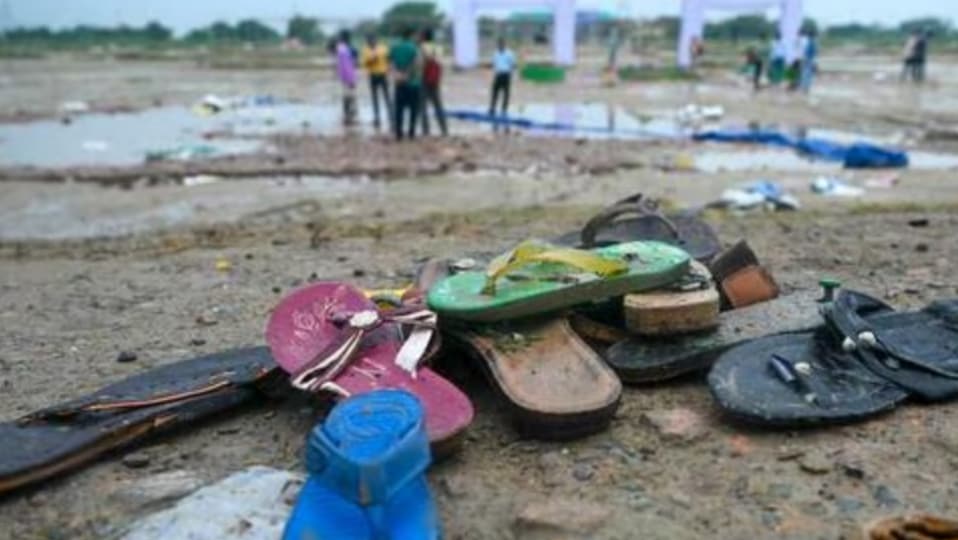
| ONE India has a surfeit of Gods, and strangely — for one would have thought that would suffice — a surfeit of Godmen. There is one to suit every audience profile — hipster, stoner-philosopher, yoga fanatic, herbal enthusiast — budget, and need. The last because Godmen, like good consumer products, emerge because there is a market. Across north and northwest India, for instance, in regions where the caste system successfully othered some sections of society, they have built huge franchises of these others. Punjab’s Dera Sacha Sauda built a huge following among Dalit Sikhs marginalised by the mainstream. The man that few people who are not his followers had heard of, Bhole Baba, until earlier this week when tragedy struck at a congregation in Hathras, Uttar Pradesh, where a reported 150,000 people gathered to listen to him, has done the same. His real name is Suraj Pal, a former constable in Uttar Pradesh Police, and he has, in his new white-suited avatar, built a huge following, especially among the poor and the underprivileged, with a mixture of lofty preachings about universal brotherhood and humanity coupled with the never-fails-to-work promises of miracle cures to such ailments as cancer. As HT’s reporters wrote in a profile of the man, “… his catchment grew and grew, branching out in Rajasthan and Madhya Pradesh, with most devotees either Dalits or from the backward classes. They saw him as a living embodiment of sacred virtues — a Godman who came from within them at a time when they often felt unheard.” It is not surprising that politicians have tread lightly — like several other Godmen, Pal has numbers behind him, and no party can afford to offend or alienate an entire flock. He has relationships across parties, perhaps explaining why he has not been named in the first police complaint, and also why he will likely never really be made accountable. As for the stampede itself, it was caused by all the usual suspects — excessive crowds, poor crowd management (compounded, according to reports and eye witnesses by Pal asking his followers to pick up a piece of earth he had walked on, promising that this would work miracles, resulting in a scramble), poor planning, a bad venue with no proper exits or ventilation, and panic. There is, unfortunately, a science to stampedes. As the HT newsroom’s resident expert in all things geeky, Kabir Firaque, writes: “The study of stampedes, which has picked up in recent decades, involves a lot more than the psychology of people moving haphazardly in a panic. More precisely, it is the study of crowd dynamics, of which stampede events are an inevitable part, that has become a diverse field today with lessons to offer, partly because of the modern tools available to computer modelling, and largely because understanding crowd behaviour can lead to preventive measures against high-risk events, particularly stampedes.” |
| TWO Some analysts believe what’s happening in the Indian stock markets is not very different from a stampede. I don’t agree for two reasons. One, while people can get hurt in stock markets, it’s unfair to compare financial transactions with a matter of life and death. Two, while the Sensex may seem overvalued, the last milestone at which the price earnings multiple (the price of a stock expressed as a multiple of the earnings per share; a measure of how expensive or inexpensive a stock is) was lower than it was at 80,000 was 30,000. There is also another dimension on which Indian stocks need to be measured — and perhaps why blindly using standard benchmarks for PE multiples will not do. This is growth. The Sensex companies are expected to grow their profits by 15-20% this financial year, and by the same amount in 2025-26 as well. Once you factor growth into the equation — some analysts use the PEG or price-earnings multiple to growth ratio — Indian stocks don’t look all that expensive. |
| FOUR There’s a lot that has been written about the first few sittings of the 18th Lok Sabha and the new session of Parliament. Things promise to be interesting in both Houses. The NDA has a clear majority in the Lok Sabha although the BJP doesn’t, and the Opposition has enough numbers to create noise, if not carry debates. And the NDA is in a minority in the Rajya Sabha, although it is accustomed to getting its way in this House despite not having the numbers on its side. That things have changed is evident in the new seating arrangement in the Lok Sabha, where the Opposition is to get eight prized first row seats (the BJP alone will have eight), my colleague Saubhadra Chatterji, the best reporter on all things related to Parliament and parliamentary procedure, wrote this week. While on the subject of new faces in Parliament (in the front row or elsewhere), do not miss our ongoing series on first-time MPs, a series we ran for the first time in 2019. This time, 52% of the representatives in the Lok Sabha are first-time MPs. Earlier this week, we profiled Sanjna Jatav, one of the youngest members of Parliament (she is 26). “We are ordinary people. Our friends are ordinary. Our relatives are ordinary. We didn’t have a single important person in our phone books,” she told HT. “But you know, such ordinary people are 90% of the country… that’s why we won.” |
FIVE The most shocking piece I read recently was a submission by our columnist Mridula Ramesh on a dangerous family of chemicals called Dioxins — Agent Orange was one of them— and how “they are being made in your city and mine”. As she writes, “Dioxins are formed when carbon, hydrogen, oxygen and chlorine are burned together, at relatively low temperatures, with poor air flow, lots of moisture, and catalysts such as copper and iron. These conditions are met perfectly within burning piles of waste at landfills, on street corners, and in empty lots across India.” That’s one more thing to worry about. |