To support our work please consider becoming a paid subscriber to EconVue+ Healthy EconomicsA strategic rethinking of US-China relations to foster global growth and public health
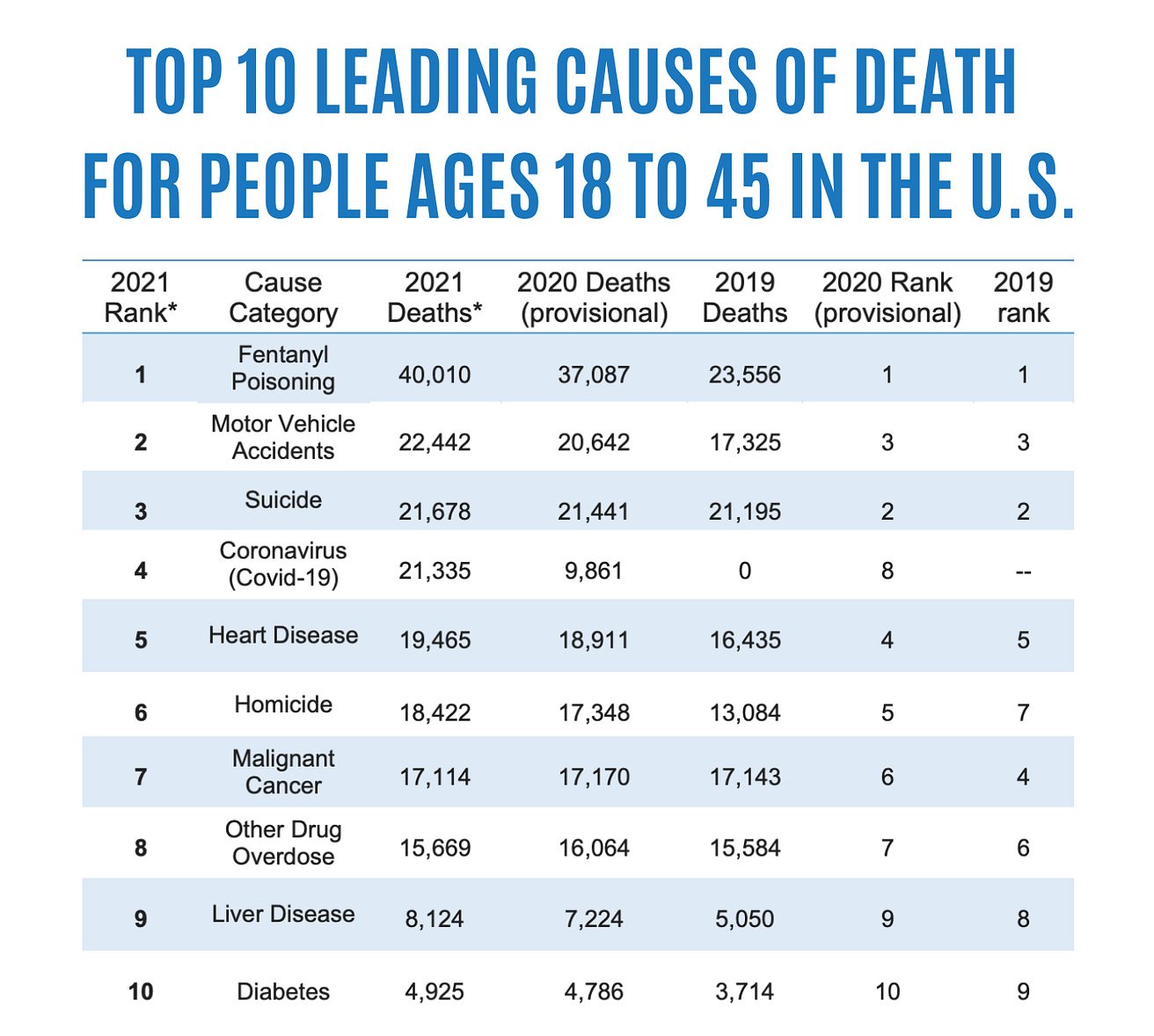
Healthy citizens are the greatest asset any country can have." – Winston S. Churchill Xi & Biden at APEC 23It was just over a week ago that President Joe Biden and China’s leader Xi Jinping met in San Francisco, at the annual meeting of APEC, the Asia Pacific Economic Cooperation Forum. Although it is difficult to point to a specific outcome, what was noticeable was the willingness of both sides to talk to one another, absent the bluster of wolf warrior diplomacy. Rebuilding trust is as hard to do as it is necessary. Diplomatic relations have improved over the past year, but 58% of Americans view China as a critical threat to US interests according to a recent survey by the Chicago Council on Foreign Relations. (There were some anti-CCP protests during APEC, but they were dwarfed by other demonstrations related to the conflict in Gaza.) Now that US jobs are no longer threatened by China, and the Chinese economy has itself slowed, what is the source of American animosity? Perhaps Taiwan, technological competition, or China’s form of government is to blame, but I believe public health concerns including Covid-19 and the fentanyl crisis are major contributors. Did Biden’s meeting with Xi help to create strong guardrails to deal with the import of synthetic opioids from China, and the next pandemic? According to Yanzhong Huang, senior global health fellow at the Council on Foreign Relations in New York, the outbreak has been going on since August and is not just confined to Beijing as has been reported. Unfortunately, global public health did not make it on to the Biden-Xi agenda. “I am disappointed that public health was not mentioned…still no sample sharing while we're preparing for the next pandemic.” The international exchange of biological samples is key to diagnosis of diseases across borders, but is currently outlawed in China. China’s Role in US Public HealthThe Chicago survey also found that 70% of Americans do not trust China to deal responsibly with global issues, transcending deep political divides on other issues. In fact, APEC produced no solution to illicit fentanyl, no promise by the Chinese government to prevent the export of precursors manufactured there. What Xi and Biden agreed to was cooperation, but details are lacking. This is wholly inadequate when compared to the scale of the threat. Unintentional fentanyl overdose is the leading cause of death for 18-45 year olds in the US, a 50-fold increase since 2010 according to a UCLA study. This chart is from 2021; current fatalities are even higher, estimated at 77,000 for the latest 12-month period in this age group. It vastly exceeded deaths from Covid-19, even at the height of the pandemic.
China and Global HealthWhat policymakers are missing, or more probably avoiding, is China’s central role in global public health. I recently attended a day-long program Global Health Security and Diplomacy in the 21st Century. Participants included Secretary of State Antony Blinken, Anthony Fauci, and WHO Director-General Tedros Adhanom Ghebreyesus. Although the focus was on global cooperation to prevent the next pandemic, China was significant by its omission from the discussion, which was instead dominated by concerns for access to health care in poor nations. On a positive note, the US and China are each other’s most important collaborators for biological research, including major projects related to cancer treatments. The journal Nature notes however that cooperation seems to be leveling off. US concerns about technology transfers, and Chinese prohibitions on data transfer, could create headwinds that could cause an actual decline. The US-China Science & Technology Agreement first signed in 1979 was set to lapse in August, but the Biden Administration extended it for an additional six months. Further extensions are uncertain. A Pediatric Epidemic: The Long Tail of China’s Lockdown EconomyChina is caught between a slowing economy that has reached the limit of its policy alternatives, and a raft of social problems including inadequate health care and high youth unemployment. The country has literally mortgaged its future to the hilt. It is fortunate to still have fiscal space, but if that is used to avoid reforms as its population ages and declines, it will only prolong the misery.
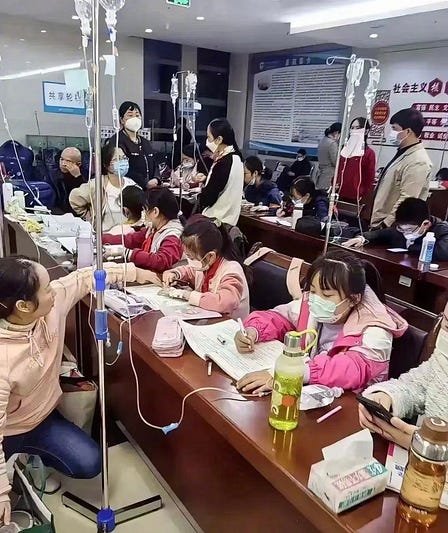
The WHO published a statement last week about the surge in respiratory illnesses in children in China last week. Yesterday, Taiwan’s CDC issued a warning for travel to China in the light of the recent pneumonia outbreak. The extreme reaction of children to what might or not be benign seasonable bugs could have been exacerbated by isolation from their peers in previous winters. We don’t really know what years of isolation means for the human body when it is reintroduced into the sea of pathogens of everyday life—especially in children whose immune systems are still developing. (Note to the above photo-IV drips are widely used to treat influenza in Chinese hospitals that also provide desks to students.) An article published just last week in Lancet: Mycoplasma pneumoniae: delayed re-emergence after COVID-19 pandemic restrictions provides a possible explanation. It says that mycoplasma pneumonia is a possible delayed (2-3 yrs) reaction to lockdown in other countries. China emerged from a more severe, longer lockdown less than a year ago. So it would not be surprising to see this level of disease continue for several seasons. This is important research. It could mean that we do not need to fear another Covid-like pandemic since lockdowns in the rest of the world ended long before China’s. But it doesn’t mean that antibiotic resistant disease is no longer a threat. Covid and the Global EconomyTrying to hold back Mother Nature might have had unintended biological consequences. The same can be said for China’s increasing efforts to stop market forces from performing their function of creative destruction. When economic forces are disrupted in the world’s second largest economy, the spillover effects could be consequential. Economists are now in full swing, studying the effects of Covid-19 on the global economy. It is in some ways it was the greatest natural experiment of all times, a sudden stop of the entire global economy like no other. There will be many things we learn, and many surprises. For example, economist Claudia Sahm says that there is no doubt that American consumers are better off than they were before the pandemic, even with inflation. The same is not true of Chinese consumers, who are feeling the negative wealth effect of stock market and real estate losses, due to disastrous policy choices. Global linkages in the post-pandemic world were discussed in a meeting I attended at the San Francisco Federal Reserve last week. When the papers we discussed are finalized, I will write about them more in depth, but just to share three broad impressions:
Inflation remains a drag on recovery in many countries. According to a recent Ipsos survey, it has remained the number one concern for 4 out of 10 people from 29 countries for the past twenty months. They may get the lower prices they wish for. Of concern is China’s return to an emphasis on manufacturing, at the same time that decoupling efforts are leading to a resurgence of manufacturing support by the governments of the EU, Europe, and Japan. Industrial policy almost always leads to oversupply of what is no longer in demand. ConclusionsChinese policies have an undue impact on global public health while US monetary policy has had a significant impact on economies in the rest of the world. Coordination and collaboration are critical to containing biological and financial contagion is a world that is highly, highly connected, but international organizations seem to be weakening. Moreover, the Ipsos survey found that China, the United States, and Russia are the three countries viewed as least likely to comply with any new international agreements and institutions. Our very own wolf warrior, former Chicago major, now US Ambassador to Japan Rahm Emmanuel is saying the quiet part out loud:
The WHO has called on China to provide data on its recent outbreak within 24 hours, and China complied. The US should light up its newfound communications channels immediately to ensure that the current epidemic in China does not evolve into a pandemic. Just anecdotally, every Thanksgiving get together throughout my extended family was smaller than usual, due to a number of people who became ill recently. Some tested positive for Covid. Future Prospects for DevelopmentIt is still early days after the end of the Covid emergency, but the post-Covid economy is ongoing. We are now trying to assess the full effect of a devastating disease on people and on the global economy. Not only international cooperation, but specifically cooperation between the US and China is essential. Just to add a hopeful note, from Science Magazine:
As if on cue, as I finish writing I received an alert from my pharmacy about increased flu activity in my area… I hope you had a wonderful and healthy Thanksgiving. You're currently a free subscriber to econVue + . For the full experience, upgrade your subscription.
|