
Worst News for Stocks in 50 Years
Wall Street’s declared what could be the worst news for the U.S. stock market in 50 years.
If Goldman Sachs and Morgan Stanley are right... this won't be like the crashes we're used to. What's about to hit America next could keep your portfolio in the red for 10 years or longer - unless you make a big change now.
To hear about this decade-long crisis now being predicted by multiple Wall Street banks...
And to see what you can do to prepare your wealth before this hits...
Click here to learn how to defend your portfolio.
Regards,
Keith Kaplan
CEO, TradeSmith
P.S. You may have noticed we see "surprise" crashes every year now. Think about it: rate spikes in 2022... the bank crisis in 2023... $8 trillion wiped out in 2024... $11 trillion wiped out during the tariff crash in 2025... and, this year, $12 trillion was wiped out in 30 days during the Iran War. Something is off and Wall Street suggests this could continue (and worsen) well into the 2030s. Click here to learn the truth about this market and see what you must do now to prepare.
2 Quantum Stocks That Could Challenge IonQ’s Leadership
By Nathan Reiff. First Published: 7/15/2026.

Key Points
- IonQ shares have fallen about 35% in a month despite strong Q1 2026 results, with widening losses per share and a high price-to-sales ratio.
- Quantinuum, backed by a major NVIDIA investment, trades at a steep valuation with minimal revenue but carries a bullish analyst consensus and notable price target upside.
- Quantum Computing Inc. is pursuing acquisitions to scale production, but rising operating expenses and thin core revenue keep its shares highly speculative despite analyst-predicted upside.
- Special Report: SpaceX is offering you shares. Don't take them.
Despite its status as the largest pure-play quantum computing company by market capitalization, IonQ Inc. (NYSE: IONQ) has not been the most stable bet in recent weeks. Shares have fallen about 35% over the past month, and although the company delivered a strong Q1 2026 in many respects, losses per share are widening. Add in a sky-high price-to-sales (P/S) ratio of 113.3, and it's clear that, despite its wins, IonQ could be ripe for disruption.
While investors may be tempted by other flashy names like D-Wave Quantum Inc. (NYSE: QBTS) and Rigetti Computing (NASDAQ: RGTI)—both of which have strengths but also challenges—there is another group of often-overlooked challengers that may warrant closer examination. At the top of this list are Quantinuum (NASDAQ: QNT) and Quantum Computing Inc. (NASDAQ: QUBT).
Quantinuum: Brand New and Highly Speculative
Elon’s big $266,000 per second purchase (Ad)
Elon Musk bought Super Bowl ad time at $266,000 per second - something he has never done before. 125 million Americans watched, but Whitney Tilson, former manager of a $200 million hedge fund, says most investors missed what it actually means.
With 1 in 3 Super Bowl viewers using buy-now-pay-later services and 40% of Americans carrying more credit card debt than savings, Tilson believes Elon's message reveals a major economic current - and a clear signal for where smart money should be positioned.
Watch Tilson's free presentation to see what he thinks you should do nowTwo months after its IPO, shares of Quantinuum are up about 18%. The company drew attention from insiders in the quantum computing space long before it went public, however—NVIDIA's (NASDAQ: NVDA) major investment last September infused hundreds of millions of dollars, helping lift the firm's valuation to $10 billion.
As a very new public company, Quantinuum faces a crowded field of competitors that are generally more established. But the firm's momentum, including a recently announced partnership with Rolls-Royce (OTCMKTS: RYCEY), the University of Edinburgh, and others, may be accelerating.
Add to that the fact that Quantinuum has demonstrated success with its hardware in terms of fidelity and qubit ratio, and that—thanks in part to NVIDIA's support—the company has several years' worth of cash runway, and Quantinuum becomes a competitor to watch.
Of course, there is still a long way to go before the products Quantinuum is developing see commercial adoption, which means there are plenty of potential hiccups ahead. Its revenue remains minuscule at under $31 million across all of 2025, despite a market capitalization approaching $18 billion. That puts its price-to-sales ratio at an eye-popping 1,010. Even with all of its cash on hand, the company is quickly burning through capital to fund its ambitious R&D programs, putting it at even greater risk of catastrophe.
In a quantum landscape known for highly speculative plays, Quantinuum is one of the riskiest ventures at this early stage. Conversely, it may have tremendous potential for investors willing to take the risk. Wall Street analysts certainly seem to think so, based on 12 Buy ratings and just two Holds, as well as a consensus price target of nearly $99, about 48% above where QNT currently trades.
Quantum Computing: Buying Spree Could Turbocharge Production, But Risks Are High
Larger rival D-Wave has made headlines for its major acquisitions, including a $550-million purchase of Quantum Circuits earlier in 2026, but Quantum Computing has been on a buying spree of its own. The firm completed acquisitions of Luminar Semiconductor and NuCrypt, both photonics or quantum optics companies, in the first quarter of the year. It more recently announced the completed purchase of NHanced Semiconductors, which it called a key step toward "scalable commercial production."
The firm is able to do this thanks to its strong cash position and backlog, as it ended Q1 2026 with almost $1 billion in cash and investments and a growing backlog of $16 million. Quantum Computing appears to be on the verge of shifting from a research-focused firm to one attempting to scale production, and it is buying smaller companies to fast-track that process.
This may be a positive sign for Quantum Computing, but the proof will be in whether the company can rein in operating expenses and generate non-investment income. In Q1, operating expenses climbed 123% year over year to almost $20 million, leading to a net loss of $4.1 million. All of the added headcount and other M&A-related expenses contributed to compressed margins and anticipated cash burn.
The bigger issue may be that Quantum Computing has yet to fully articulate its commercialization thesis through its revenue performance. With under $4 million in revenue from core operations last quarter, the firm is still relying on its investments to generate the bulk of its top line. Thus, like QNT above, QUBT shares are highly speculative at this stage. Analysts are a bit more cautious about this firm, assigning it four Buy ratings, two Holds, and one Sell. Shares have shed 19% of their value so far this year but still have about 120% in analyst-predicted upside potential.
Why Johnson & Johnson’s Earnings Dip Looks Like a Buying Opportunity
By Thomas Hughes. First Published: 7/15/2026.

Key Points
- Johnson & Johnson's post-earnings pullback of nearly 10% is viewed as a buying opportunity given strong fundamentals and rising analyst price targets.
- The company posted $25.31 billion in quarterly revenue and raised full-year guidance, projecting revenue will surpass $100 billion for the first time.
- Key risks include ongoing talc litigation and the patent cliff, though analysts believe the pipeline and planned orthopedics spin-off support continued growth.
- Special Report: SpaceX is offering you shares. Don't take them.
Johnson & Johnson (NYSE: JNJ) is an elite income investment because of its Dividend King status, healthy balance sheet, and exceptionally strong defensive business model. Key advantages include its product portfolio and pipeline, which are generating multiple catalysts at once in 2026.
A wave of approvals, expanded uses, and pipeline advances points to sustained growth, robust cash flow, and capital return safety well into the future. That is why the mid-July price pullback, triggered by earnings results and guidance, looks like a textbook entry point.
JNJ Pulls Back to Buy Zone
Elon’s big $266,000 per second purchase (Ad)
Elon Musk bought Super Bowl ad time at $266,000 per second - something he has never done before. 125 million Americans watched, but Whitney Tilson, former manager of a $200 million hedge fund, says most investors missed what it actually means.
With 1 in 3 Super Bowl viewers using buy-now-pay-later services and 40% of Americans carrying more credit card debt than savings, Tilson believes Elon's message reveals a major economic current - and a clear signal for where smart money should be positioned.
Watch Tilson's free presentation to see what he thinks you should do nowJNJ hit a peak ahead of the earnings release, indicating room for a pullback. Down approximately 2% following the release, the stock is on pace for nearly a 10% retreat. That would represent a meaningful discount from the recent high, though lower lows appear unlikely.
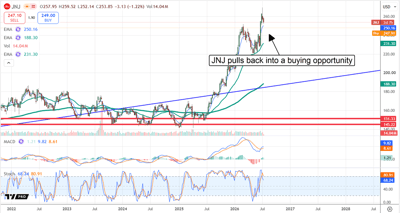
Likely buyers on the dip include institutions, which own more than 60% of the stock and have been accumulating shares, as well as analysts, whose trends reflect growing confidence in an already fundamentally stable company.
Analyst trends include increased coverage versus last year, firmer sentiment, a 74% Buy-side bias within the Moderate Buy rating, and an uptrend in price targets. Consensus remains a sticking point, with fair value near the early-July highs, but the trend matters. The high end now points to $300 and fresh all-time highs. A move to new highs would be significant for chart watchers, as it would suggest the trend is continuing, with near-term targets at $300 and longer-term targets in the $350 range.
Analyst commentary following the release focused on the beat relative to the high bar that had been set. Strength in the pharmaceutical pipeline and underlying health in MedTech were also highlighted. Importantly, the market now sees JNJ as having moved past its patent cliff and as being on track for sustainable growth, cash flow, and capital returns.
Capital returns include buybacks, but those are opportunistic and often not enough to offset dilution. The dividend is far more important. It yields an above-average 2.1% and has grown at a mid-single-digit compound annual growth rate in recent years. The likely outcome is that JNJ will continue raising its dividend annually well into the future.
Johnson & Johnson’s Strength Driven by Diversified Portfolio
Johnson & Johnson had a strong quarter, underscoring the strength of its repositioning efforts and portfolio. The company’s $25.31 billion in net revenue rose 6.8% year-over-year (YOY), 100 basis points (bps) better than expected, on strength in U.S. and international markets across the Innovative Medicine and MedTech portfolios. There were uneven spots within each segment tied to legacy products, but each was offset by strength elsewhere. Key details include half a dozen new approvals and roughly a dozen positive pipeline updates.
Margin news was also encouraging. The company experienced margin pressures but offset them to a large degree. Bottom-line results included $2.90 in adjusted earnings per share (EPS), up 4.7% YOY and a nickel ahead of consensus, and $8.7 billion in free cash flow (FCF), more than enough to support balance sheet health while investing and returning capital to investors.
Looking ahead, the company expects those strengths to continue and has raised guidance accordingly. The new full-year targets were increased by 30 bps at the midpoint, pointing to 7.3% top-line growth and $11.68 in adjusted earnings, well above the consensus estimate. Investors should also note that JNJ expects revenue to surpass the $100 billion mark for the first time in its history, a psychological threshold for institutional investors.
JNJ: Low Risk, High Reward
Johnson & Johnson’s primary risks include its patent cliff and ongoing talc litigation. The talc litigation stems from decades of lawsuits alleging that the company's talc-based products—most notably its baby powder—were contaminated with asbestos and caused ovarian cancer and mesothelioma.
The patent cliff appears to be easing, with approvals and pipeline momentum building, leaving talc as the primary hurdle for investors. The company continues to face thousands of individual claims despite its attempts to settle. That leaves it exposed to cash-draining adverse decisions that can reduce investment capital and capacity for capital returns. What the market gets wrong is that talc is not a company-ending threat, but rather a slow drain on capital that may or may not worsen.
Catalysts also include the planned spin-off of the company's orthopedics business. Analysts view it as a move that could unlock valuation multiples by trimming lower-margin, lower-growth businesses in favor of higher-performing ones. The resulting company will be a pharma and medtech powerhouse with strong franchises in oncology, cardiology, and potentially robotics. The OTTAVA robotic system is on track for approval as soon as later this year, setting the stage for it to gain share versus competitors like Intuitive Surgical (NASDAQ: ISRG).
This email message is a sponsored email provided by TradeSmith, a third-party advertiser of MarketBeat. Why did I get this message?.
This ad is sent on behalf of TradeSmith at 1125 N. Charles Street, Baltimore, Maryland 21201. If you’re not interested in this opportunity, please click here.
If you have questions about your subscription, feel free to email our U.S. based support team at contact@marketbeat.com.
If you would no longer like to receive promotional emails from MarketBeat advertisers, you can unsubscribe or manage your mailing preferences here.
© 2006-2026 MarketBeat Media, LLC. All rights protected.
345 North Reid Place #620, Sioux Falls, South Dakota 57103. U.S.A..