Thanks for signing up for DividendStocks.com! It's the daily newsletter built for dividend and income investors. Before we can begin sending your daily updates, there’s one quick step left. Please confirm your subscription using the link below so our emails reach your inbox. Click Here to Confirm Your Subscription to DividendStocks.com Here’s a small glimpse of what you’ll get access to: Dividend Stock Ideas — Each newsletter features dividend stocks with high yields, sustainable payouts, and strong growth potential. Ex-Dividend Stocks — Want to capture upcoming dividend payouts? Find out which stocks are going ex-dividend this week. Market News and Events — Stay in the loop on the latest developments impacting popular dividend names like AT&T, Exxon Mobil, IBM, Procter & Gamble, and Verizon. Bonus: As a thank-you for confirming, you’ll also receive a free PDF copy of Automatic Income, our popular guide to building wealth through dividend investing. Let’s get your dividend journey started! Discover Top Income-Generating Stocks Here See you in your inbox soon,
The DividendStocks.com Team P.S. Don’t miss out click here to verify your subscription and secure your daily dividend insights and your free investing guide!
Bonus Content from MarketBeat Media
Lowe's Finds Support at $215 After Q1 Earnings Sell-OffAuthor: Thomas Hughes. Article Posted: 5/22/2026. 
Key Points
- Lowe's stock price decline is over; what comes next includes capital returns and eventual price recovery.
- Cash flow enables balance sheet improvements and capital returns in 2026: share buybacks are a catalyst for future quarters.
- Analysts set the floor for this market and indicate a 20% upside potential.
- Special Report: Elon Musk’s $1 Quadrillion AI IPO
While Lowe’s Corporation (NYSE: LOW) and competitors like Home Depot (NYSE: HD) face headwinds and hurdles in 2026, the technical setup is beginning to point toward a rebound in the back half of the year. Q1 earnings results were solid, but soft guidance led to post-release weakness in the stock, which is the key factor now. The post-release weakness in LOW shares pushed the price below $215 and triggered a strong response. The response? Buying. Whether it came from bottom-seekers, value hunters, or income investors doesn’t matter. What matters is that support was confirmed at a level that has been in play for years.
Behind a hidden government lab in Tennessee, 40,000 scientists are reportedly finishing work on an AI system described as 283 trillion times more powerful than today's data centers - spanning over 700 miles.
Called 'Golden Dawn,' this project could leapfrog ChatGPT, Gemini, and Grok upon launch and potentially trigger a $100 trillion reset of AI markets. Louis Navellier is naming the one stock at the center of it, down to the ticker, free through May 5th. Click here to get the ticker and full details before May 5th
First reached in the wake of the COVID-19 scare and the subsequent market rally, $215 is now a critical pivot point for this market. The question now is whether Lowe’s can sustain its business and grow from its 2026 levels, or whether it is facing a contraction. The likely outcome, based on store-count growth and positive Q1 comps, is that Lowe’s can continue to expand from this level, generating ample cash flow and paying investors along the way. Growth is unlikely to be robust, but there is always hope that the housing market thaws. As it stands, Lowe’s growth is centered on market share gains, digital initiatives, and its pro segment. Lowe’s Outperforms in Q1: Cautious Guidance Overshadowed Financial StrengthLowe’s had a decent Q1, with revenue of $23.10, up 10.4%. The growth was driven in large part by the FBM acquisition, but organic strength was also present. Comps increased by 0.6%, supported by growth pillars including Home Services, Pro, and appliances. Digital was another important contributor, rising 15.5% as consumers lean into same-day delivery and pickup. The company’s efforts to improve fulfillment, marketing, and customer experience are paying off. Margin news was also positive. The company experienced margin pressure, but less than expected, leaving gross, operating, and net profit above consensus forecasts. Adjusted earnings outpaced consensus by approximately 200 bps, outpacing top-line strength by 100 bps, and led to faster balance sheet improvement. Balance sheet highlights continue to reflect a high-debt position resulting from aggressive share count reduction, but improvements were recorded, including increases in retained earnings and equity. Catalysts for the share price include the company’s cash flow and potential to reduce debt in the coming quarters. The downside is that share buybacks have been put on hold; the upside is that debt reduction will enable future, sustainable buybacks and improve shareholder leverage. Until then, the dividend is reliable. Lowe’s is a Dividend King, has increased its payout for more than 60 years, and pays less than 40% of its annualized earnings forecast. The distribution growth rate may moderate in the coming years, but increases are not expected to end anytime soon. Analysts Set Floor for Lowe’s Stock: Aligns With Technical SupportAnalysts’ trends have contributed to Lowe’s stock price decline in 2025 and 2026, as they have steadily reduced price targets over that period. However, the post-release activity suggests that trend may be ending. The first revisions to show up include reaffirmed ratings and price targets that align with a bullish consensus. MarketBeat tracks 35 analysts rating Lowe’s as a consensus Moderate Buy; they have a 63% Buy-side bias and see the stock advancing 20% from the critical support target. Looking ahead, forward earnings forecasts suggest this stock can rise by 100% within the next five to 10 years. Institutions present a risk, but that may be passing given the stock’s price action. Institutional investors own 75% of Lowe’s stock and were net sellers in early Q2. If that persists, Lowe’s stock will struggle to recover from its floor. The offsetting detail is the trailing 12-month balance, which is greater than $2-to-$1 in favor of bulls. With this in play, the likely outcome is that early Q2 sellers revert to buying, and institutional activity underpins the late May price action. Late May price action is more bullish than it appears. The guidance update triggered a sell-off, but the floor was reached, an intraday rebound followed, and a doji candle formed. The doji is a sign of indecision and, in this case, marks the end of a downtrend but not necessarily an immediate rebound. 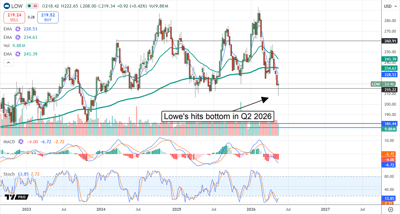
The market is still below its moving averages, which remain the first hurdle for price action. No sustained rally will form until those levels are crossed and confirmed as support. |

