
Worst News for Stocks in 50 Years
Wall Street’s declared what could be the worst news for the U.S. stock market in 50 years.
If Goldman Sachs and Morgan Stanley are right... this won't be like the crashes we're used to. What's about to hit America next could keep your portfolio in the red for 10 years or longer - unless you make a big change now.
To hear about this decade-long crisis now being predicted by multiple Wall Street banks...
And to see what you can do to prepare your wealth before this hits...
Click here to learn how to defend your portfolio.
Regards,
Keith Kaplan
CEO, TradeSmith
P.S. You may have noticed we see "surprise" crashes every year now. Think about it: rate spikes in 2022... the bank crisis in 2023... $8 trillion wiped out in 2024... $11 trillion wiped out during the tariff crash in 2025... and, this year, $12 trillion was wiped out in 30 days during the Iran War. Something is off and Wall Street suggests this could continue (and worsen) well into the 2030s. Click here to learn the truth about this market and see what you must do now to prepare.
Target Shows Strengths, But Analysts Want to See More
By Thomas Hughes. First Published: 5/21/2026.
Key Points
- Target posted a strong Q1, with revenue growing 6.7%, adjusted EPS rising 31.5%, and guidance raised above consensus estimates.
- Analysts maintained a Hold consensus despite the beat, with institutions owning nearly 80% of shares and selling in early Q2 posing a key risk.
- Target's biggest long-term threat is continued market share loss to Walmart, Costco, Sam's Club, and BJ's Wholesale Club.
- Special Report: Elon’s “Hidden” Company
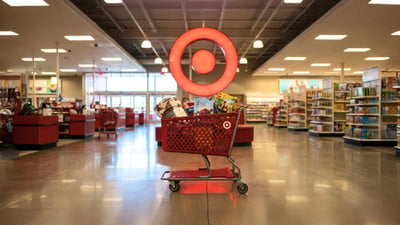
Analysts responded to Target's (NASDAQ: TGT) May 20 earnings release with mixed sentiment, overshadowing the strengths revealed. The company beat expectations and raised guidance, but that was not enough to move sentiment or price targets meaningfully, which is what the market wanted to see.
The critical takeaway, however, is that Target’s results show it is on the right track in its turnaround and recovery. The analyst group maintained a bullish, albeit wait-and-see, posture.
NOT buy any SpaceX IPO shares until you read THIS (Ad)
SpaceX has confidentially filed for an IPO with the SEC, targeting a June 2026 listing at a valuation exceeding $1.75 trillion - potentially the largest IPO in history.
But one expert says buying shares directly may not be the smartest move. There is a lesser-known way to tap into this windfall that most investors haven't considered.
Discover the overlooked SpaceX IPO strategy before the June listingWhat analysts are waiting to see is whether Target can sustain its same-store sales strength. They see risk in tough comparisons, consumer headwinds, and the fading impact of tax returns, which are at best near-term headwinds.
A key strength of Target is that, quite simply, it isn’t Walmart (NYSE: WMT). That is no slight against Walmart, but Target offers a different shopping experience: less noise, less crowding, and a more comfortable atmosphere that can make consumers more likely to return. Reasons shoppers choose Target over other retailers include its stronger brand image and more inviting in-store environment.
Target Outperforms in Q1 and Raises Guidance: Analysts Yawn
Target had a solid quarter in Q1, growing revenue by 6.7% and outperforming the consensus by 300 basis points (bps). The strength was broad-based, driven by 4.7% in-store and 8.9% digital comps, with growth across all categories and channels. Margin news was also favorable, reflecting the impact of improving store traffic and operational improvements. Operating margin improved by 70 basis points, accelerating the earnings recovery. Adjusted operating income, the measure of core profitability, grew by nearly 30% and adjusted earnings per share (EPS) by 31.5%, including the impact of share buybacks.
Guidance is equally strong and should have merited a more bullish response from the market. The company raised its revenue and earnings forecasts above the reported consensus, which is likely to prove conservative. The upshot is that this sets the stock up with a bullish catalyst that may be revealed as soon as the next quarterly release. Either way, Target is forecasting growth and margin strength sufficient to sustain its capital return and improve its balance sheet.
Capital returns are a critical factor in 2026, and Target’s story is that returns are reliable while the balance sheet continues to improve. Highlights include increased cash and assets, reduced inventory and long-term debt, improved equity, and low leverage. Equity increased by 9.6% despite capital returns, including share buybacks, and should continue to improve as the year progresses.
Share buybacks are not aggressive, but they do gradually reduce the share count and provide investors with additional leverage. The dividend is more substantial, yielding approximately 3.7% with shares near $120, and is reliable based on cash flow and payout history.
Analysts and Institutions Underpin Target’s Rebound
As tepid as the analysts’ response to Target’s release is, their activity still aligns with the bullish trend. MarketBeat tracks 32 analysts with current ratings, and although sentiment remains pegged at Hold, it has been steady and price targets are moving higher.
The price target increases were not large ahead of the Q1 release, but they were meaningful because they ended the downtrend that had been dominating the market. The likely outcome is that analysts continue to support Target’s stock in the near term, if not help push it higher. Assuming Target follows through on its turnaround and produces solid reports in the coming quarters, analyst forecasts should strengthen as well.
Institutions will be the deciding factor. They own nearly 80% of the stock and were selling in early Q2. If that continues, TGT shares are more likely to move lower, potentially retesting support in the $100 to $115 range. However, a move below that level appears unlikely given the value-and-yield combination and the outlook for business recovery. Critical resistance is near $125, compounded by long-term moving averages, and may not be broken until Target proves it is truly in recovery. That could take more than a single quarter, even after the Q1 strength.
The biggest risk for Target is the loss of market share. Not only has it lost traction to Walmart, but Sam’s Club, Costco (NYSE: COST), and, to a lesser degree, BJ’s Wholesale Club (NYSE: BJ) have also weighed on business. If Target can’t regain its premier status among consumers, it risks a protracted decline and eventual bankruptcy, akin to Sears, Toys 'R' Us, and Kmart. This year’s catalysts include increased spending on store remodels, improved merchandise selection, and loyalty programs. All are intended to improve the customer experience and drive return traffic, including through digital channels.
Lowe's Finds Support at $215 After Q1 Earnings Sell-Off
By Thomas Hughes. First Published: 5/22/2026.
Key Points
- Lowe's stock price decline is over; what comes next includes capital returns and eventual price recovery.
- Cash flow enables balance sheet improvements and capital returns in 2026: share buybacks are a catalyst for future quarters.
- Analysts set the floor for this market and indicate a 20% upside potential.
- Special Report: Elon’s “Hidden” Company
While Lowe’s Corporation (NYSE: LOW) and competitors like Home Depot (NYSE: HD) face headwinds and hurdles in 2026, the technical setup is pointing toward a rebound in the back half of the year. Although Q1 earnings results were solid, soft guidance led to post-release market weakness, which is the operative factor.
The post-release weakness in LOW shares pushed the price below $215 and triggered a robust response: buying. Whether it was bottom-seekers, value hunters, or income investors doesn’t matter. What matters is that support was confirmed at a level that has been in play for years.
NOT buy any SpaceX IPO shares until you read THIS (Ad)
SpaceX has confidentially filed for an IPO with the SEC, targeting a June 2026 listing at a valuation exceeding $1.75 trillion - potentially the largest IPO in history.
But one expert says buying shares directly may not be the smartest move. There is a lesser-known way to tap into this windfall that most investors haven't considered.
Discover the overlooked SpaceX IPO strategy before the June listingFirst reached in the wake of the COVID-19 scare and subsequent market explosion, $215 is now a critical pivot point for this market. The question now is whether Lowe’s can sustain its business and grow from its 2026 levels, or whether it is facing a contraction. Based on store-count growth and positive Q1 comps, the likely outcome is that Lowe’s can continue to grow from this level, generating ample cash flow and paying investors while it does so. Growth is unlikely to be robust, but there is always hope that the housing market thaws. As it stands, Lowe’s growth is centered on market share gains, digital, and its pro segment.
Lowe’s Outperforms in Q1: Cautious Guidance Overshadows Financial Strength
Lowe’s had a decent Q1, with revenue of $23.10 billion, up 10.4%. The growth was driven in large part by the FBM acquisition, but organic strength was also present. Comps increased by 0.6%, underpinned by growth pillars including Home Services, Pro, and appliances. Digital was also a key driver, increasing by 15.5% as consumers lean into same-day delivery and pickup. The company’s efforts to improve fulfillment, marketing, and customer experience are paying off.
Margin news was positive. The company experienced margin pressures, but less than expected, leaving gross, operating, and net profit above consensus forecasts. Adjusted earnings outpaced consensus by approximately 200 bps, ahead of top-line strength by 100 bps, and led to accelerated balance sheet improvement. Balance sheet highlights continue to reflect a high-debt position resulting from aggressive share count reduction, but improvements were logged, including increases in retained earnings and equity.
Catalysts for the share price include the company’s cash flow and potential to reduce debt in the coming quarters. The downside is that share buybacks have been put on hold; the upside is that debt reduction will enable future, sustainable buybacks and improve shareholder leverage. Until then, the dividend is reliable. Lowe’s is a Dividend King, has increased its payout for more than 60 years, and pays out less than 40% of its annualized earnings forecast. The distribution growth rate may moderate in the coming years, but increases are not expected to end anytime soon.
Analysts Set Floor for Lowe’s Stock: Aligns With Technical Support
Analysts’ trends have contributed to Lowe’s stock price decline in 2025 and 2026, as they have steadily reduced price targets over that period. However, the post-release activity suggests that trend is ending. The first revisions to appear include reaffirmed ratings and price targets aligning with a bullish consensus.
MarketBeat tracks 35 analysts rating Lowe’s as a consensus Moderate Buy; they have a 63% Buy-side bias and see the stock advancing 20% from the critical support target. Looking ahead, forward earnings forecasts suggest this stock can rise by 100% within the next five to 10 years.
Institutions present a risk, but that may be passing, given the stock price action. The institutional group owns 75% of Lowe’s stock and sold on balance in early Q2. If this persists, Lowe’s stock will struggle to recover from its floor. The offsetting detail is the trailing 12-month balance, which is greater than $2-to-$1 in favor of bulls. With this in play, the likely outcome is that early Q2 sellers revert to buying, and institutional activity underpins the late May price action.
Late May price action is more bullish than it appears. The guidance update triggered a sell-off, but the floor was reached, an intraday rebound followed, and a doji candle formed. The doji is a sign of indecision and, in this case, marks the end of a downtrend but not necessarily an immediate rebound.
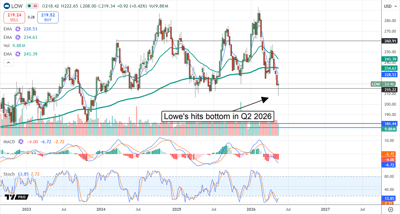
The market is still below its moving averages, which are the first hurdle for price action. No sustained rally will form until these levels are crossed and confirmed as support.
This email communication is a paid advertisement from TradeSmith, a third-party advertiser of InsiderTrades.com and MarketBeat.
This ad is sent on behalf of TradeSmith at 1125 N. Charles Street, Baltimore, Maryland 21201. If you’re not interested in this opportunity, please click here.
If you need help with your account, please don't hesitate to email our U.S. based support team at contact@marketbeat.com.
If you no longer wish to receive email from InsiderTrades.com, you can unsubscribe.
Copyright 2006-2026 MarketBeat Media, LLC. All rights reserved.
345 North Reid Place, Sixth Floor, Sioux Falls, South Dakota 57103-7078. USA..