
On May 4, 2026, the agency responsible for keeping the lights on across North America issued only the third alert of its kind in history.
The agency: the North American Electric Reliability Corporation – NERC.
The alert: a Level 3 warning, the highest grade short of an emergency already in progress.
Data centers built for AI have grown so large that when one trips offline, more than 1,000 megawatts of demand vanishes from the grid in seconds. The rest of the system has to absorb the shock – and when it can't, blackouts cascade across whole regions.
Grid operators have until August 3 to file their mitigation plans.
Almost no one in the financial media is writing about this.
[But I have documented everything you need to know right now, here.]
Because here is the underreported truth of the AI buildout: it is not constrained by chips.
It’s constrained by electrons.
Look at the numbers.
ERCOT – the Texas grid – projects approximately 14% load growth in 2026 alone, with peak demand on a long-term trajectory toward roughly 368 gigawatts by 2032.
MISO – the Midwest grid – is bringing 8 to 14 GW of new data-center load online in 2026–2027 and projects 35% peak-load growth by 2035.
In January, Vistra signed two 20-year power purchase agreements with Meta totaling 2,609 MW from PJM nuclear plants – Perry, Davis-Besse, and Beaver Valley.
Williams Companies is building "Socrates" in Ohio – a roughly 500-megawatt behind-the-meter gas generation facility supplying 440 MW to Meta under a 10-year fixed-price PPA.
And on May 13, two stories broke: Blackstone-owned QTS was caught siphoning 29 million gallons of water through unmetered connections at its Fayetteville, GA facility; a Tucson contractor was caught hauling unauthorized water to "Project Blue."
Per Data Center Watch's tracker, 69 US jurisdictions now have moratoriums on new data-center builds. Four are designated permanent.
This is what the financial press is missing.
The AI revolution is not going to fail because OpenAI loses to Anthropic. It is not going to fail because Nvidia loses to AMD. It is going to encounter – is already encountering – a physical limit.
The substations cannot be built fast enough. The water cannot be allocated fast enough. The voters in sixty-nine jurisdictions have said no.
In the next five years, this will either be the single biggest investment opportunity in the United States, or one of the biggest disasters.
The companies that own the electrons – the regulated utilities, the independent power producers with nuclear capacity, the gas-turbine specialists, the cooling infrastructure plays – are about to be repriced like nothing we've seen since the railroad consolidation of the 1880s.
I name the regulated utilities, the nuclear IPPs, the gas-turbine specialists, and the cooling plays poised to be repriced – by name, with the math – in my new documentary, The Final Displacement.
Good investing,
Porter Stansberry
Salesforce Stock Finds Support as AI Momentum Builds
Written by Thomas Hughes. Posted: 5/29/2026.

Key Points
- Salesforce reported FQ1 net revenue of $11.31 billion, up 13.2% year-over-year, with adjusted earnings of $3.88 beating consensus by 75 cents.
- Agentforce, Salesforce's agentic AI platform, posted annual recurring revenue growth of more than 200%, signaling strong AI-driven business momentum.
- Institutions own more than 80% of CRM shares and have bought on balance for 10 consecutive quarters, reflecting sustained long-term confidence in the stock.
- Special Report: Elon Musk’s $1 Quadrillion AI IPO
It has taken time, but Salesforce's (NYSE: CRM) bottom appears to have been reached, and the stage is set for a robust rebound. The SaaS apocalypse is not happening. Salesforce continues to gain traction, and its Q1 earnings results suggest that the virtuous cycle of AI is gaining momentum.
The virtuous cycle, driven by the bullish impact of AI spending, is reflected in results from NVIDIA (NASDAQ: NVDA) across the datacenter supply chain and into the service realm. When companies spend money on AI, it generates revenue and increases demand for more AI.
Your book is inside (Ad)
The "Sucker's Bet" Most New Options Traders Fall For
Most people who try options lose money the same way.
They don't know the rules. They don't know what to avoid. And they hand their account to Wall Street on a silver platter.
Normally $29.97. Free today.
Download your copy now.New spend equals new demand in an as-yet unending cycle. Because we are in the early phases of AI’s rollout, we can expect this cycle to sustain Salesforce's long-term growth.
Mixed Response Overshadows Bullish Outlook for CRM
Analysts had a mixed response to the Q1 results, with numerous negative price target revisions offset by reaffirmations and target increases. The net result, however, was bullish, as the 39 analysts MarketBeat tracks carry a 72% Buy-side bias, and revisions are clustered around the consensus. While some estimates push toward the lower end, many remain in the high end, with the average of $240 just below the broader 12-month consensus price target. The consensus assumes nearly 50% upside from the critical support target, which, coincidentally, aligns with the lowest analyst targets. The consensus of fresh targets implies 35% upside and a five-month high.
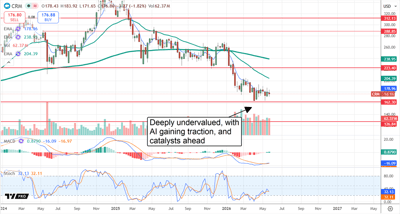
Technical stock price action and institutional trends also align with the critical support target around $160, which reflects the high set in 2019, prior to the COVID-19 pandemic. Price action since then has been volatile, driven by stimulus spending and accelerated digitization, but the stock has continued to find support at this level, as it does in late May. Support is visible in the weekly price candles and indicators, which suggest bears are losing control and bulls are regaining it.
Institutional trends reveal high ownership and aggressive accumulation. The group owns more than 80% of the stock, has bought on balance for 10 consecutive quarters, and has ramped up activity as the stock price has fallen. Bullish activity persisted into early Q2 2026 and will likely continue as the year progresses. The stock trades at a remarkably low 12X current-year earnings, with growth accelerating under the influence of AI. Assuming the forecasts are right, the company can rise 200% in the near term and then double again over time, given the right catalysts.
Salesforce Posts Tepid Results, But Versus a High Bar
Salesforce’s Q1 results and guidance were tepid relative to analysts' forecasts, but the bar was set high, and the results were strong. The company’s $11.31 billion in net revenue rose 13.2% year-over-year, accelerating both quarter over quarter and versus the prior year, with growth the strongest it's been in three years. Results were underpinned by Agentforce, the agentic platform, which saw annual recurring revenue grow by more than 200%. Consumption, a critical factor, was also strong, rising by more than 110% sequentially, and Data 360 handled a 136% increase in records.
Margin news was also solid. The company reported gains across the board, with adjusted earnings rising 50% year over year (YOY) to $3.88, topping the consensus by 75 cents. More importantly, guidance was also solid, with the company forecasting another quarter of strength. Growth is expected to slow to just over 10%, but guidance is likely cautious. The more critical detail is that earnings are expected to outpace expectations by a wide margin and may also reflect a cautious outlook.
Among the factors highlighting the company’s strength is its financial position and capacity for capital returns. The company initiated an accelerated $25 billion repurchase agreement, which is largely complete. The impact was a 10% YOY decline in the diluted share count, with expectations for continued aggressive capital returns. Dividends are also part of the equation, yielding almost 1% as of late May, with annual distribution increases expected. As it stands, the balance sheet remains fortress-like, with ample cash and low leverage, enabling the company to execute its strategy and deliver results.
Analysts waiting to “see more” from Salesforce’s results may be missing the point. The company’s primary catalysts are AI integration, margin improvement, and capital returns, and it delivered on all three. With this in play, CRM’s stock price may struggle to move higher, but that is unlikely. The more likely outcome is that upcoming results turn more naysayers into supporters, helping to firm market sentiment. Until then, this stock may continue to wallow near its current lows but is not expected to fall below them.
Why BJ’s Wholesale Club Stock Could Be Ready for a Rebound
Written by Thomas Hughes. Posted: 5/26/2026.
Key Points
- BJ's Wholesale Club is trading at rock-bottom prices and is setting up for a sustained rally that could begin early in the second half of 2026.
- Cash flow and capital return provide ample incentive for investors to buy in.
- Institutions limit risk, providing support at the low end of BJ's year-to-date trading range.
- Special Report: Elon Musk’s $1 Quadrillion AI IPO
BJ’s Wholesale Club (NYSE: BJ) is a compelling buy with substantial upside and limited downside. As a high-quality retailer, BJ's is firing on all cylinders—aggressively expanding its footprint, growing its membership base, generating strong cash flow, and returning capital to shareholders through buybacks. What makes the risk-reward profile particularly attractive? Three powerful signals all point in the same direction: bullish technical chart action, heavy institutional conviction, and a rock-solid earnings track record.
While Q1 results and 2026 guidance left something to be desired, the report aligns with trends in cash flow and capital returns, which are the primary drivers of institutional interest.
The #1 stock to buy BEFORE the June 12th filing (Ad)
When the SpaceX IPO launches, most retail investors will be locked out. The banks, funds, and insiders get in early - while everyone else waits on the sidelines.
But one small infrastructure supplier - a critical piece Musk can't scale the Colossus network without - is still trading well under institutional radar. A new briefing reveals the name and ticker at no cost.
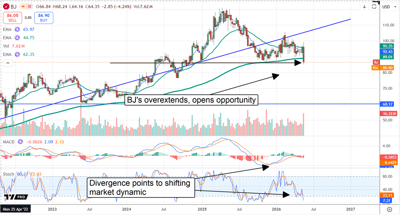
Get the SpaceX infrastructure stock name and ticker hereThe chart is where this investment thesis begins. BJ’s stock price has been under pressure since early 2025, due in part to margin compression, consumer headwinds, and weakening analyst sentiment. However, a bottom was reached late last year and remains in place as of mid-Q2 2026. Signs that the bottom is holding include converging support levels such as the long-term EMA, a range bottom, and visible divergences in the MACD and stochastic oscillators. Together, they suggest shifting market dynamics and a market in which bulls are regaining control. The likely outcome is that BJ’s stock price rebounds from late-May lows, remaining range-bound until later in the year, when additional catalysts emerge.
Institutional activity aligns with strong support at the low end of the range. Not only do institutions own approximately 99% of the stock, but they have also accumulated shares on a trailing 12-month (TTM) basis. The pattern is not bullish in every quarter, but it was clearly positive in Q3 and Q4 2025, when the bottom was established and support was reinforced. The likely outcome is that institutions take advantage of the post-Q1 price dip and reaffirm support at this level.
Analysts present a near-term headwind that could limit upside. MarketBeat tracks 19 ratings on the stock, with a consensus Hold, and price targets are trending lower. The caveats include the rating mix, which is 50% Hold and 45% Buy, and the target range, which puts the floor at $90 and the consensus near $107. The $90 price floor coincides with critical support near the lower end of the trading range, while the consensus implies approximately 25% upside.
BJ Wholesale Club’s Underwhelming Guidance: No Cause for Alarm
BJ’s Wholesale Club’s fiscal Q1 results were solid, with revenue growing 9.9% to just over $5.5 billion. The top line exceeded the consensus estimate by 180 basis points, underpinned by new stores, strong comparable-store sales, and higher gasoline prices. Comps increased 6.3%, or 1.5% excluding fuel, with digital and fee income standing out. Digital sales increased 28% year over year and 63% on a two-year stack, while fee growth remained strong. Membership revenue, up 9.9%, is growing in line with systemwide performance, indicating sustained momentum in the coming quarters.
Margin news was mixed, with margins pressured at every level. However, the cause was increased investment in digital and stores, along with pricing actions designed to drive value. The key takeaway is that margin pressure was expected, and the Q1 result was better than forecast. Adjusted earnings per share (EPS) declined only 3.5%, outperforming the consensus estimate by 6 cents, or more than 500 bps.
Guidance is why BJ’s stock price declined by nearly 10% after the release. The company expects margin pressure to persist, as anticipated, placing the adjusted EPS target in line with consensus. Analysts forecast $4.52 in annual adjusted EPS, approximately 3% higher than last year and sufficient to support capital returns, reinvestment, and balance sheet maintenance.
The balance sheet and capital return profile are other factors underpinning support for BJ’s stock price. The company has a fortress-like balance sheet with low long-term debt leverage, enabling aggressive share buybacks. Q1 activity reduced the share count by 2.5% year over year, a pace expected to continue in the coming quarters. The clearest sign of BJ’s cash flow strength and financial health, however, lies in equity, which increased 7.85% despite higher spending and share repurchases.
BJ’s Catalysts Set the Stage for a Robust Share Price Rebound
BJ’s catalysts include store-count expansion, strength in membership fees, and its value proposition. The company’s fees support growth and profitability by expanding the consumer base and driving margins through upgrades and premiumization. Store-count growth is also critical, especially the move into Texas. Texas represents a significant growth hub, and the company is focused on the state. The initial expansion includes plans for as many as five stores in the Dallas-Fort Worth area this year. Part of the strategy is a value proposition that uses generally lower prices as bait and lower membership fees as the hook to lure consumers away from competitors like Sam’s Club and Costco (NASDAQ: COST).
This email communication is a sponsored message provided by Porter & Company, a third-party advertiser of InsiderTrades.com and MarketBeat.
If you need help with your subscription, feel free to contact our South Dakota based support team at contact@marketbeat.com.
If you no longer wish to receive email from InsiderTrades.com, you can unsubscribe.
Copyright 2006-2026 MarketBeat Media, LLC. All rights reserved.
345 N Reid Pl., Suite 620, Sioux Falls, S.D. 57103-7078. United States..