Hello everyone and welcome to this week’s edition of Receipts. I’ve been trying to keep track of all the companies Trump has undermined or outright killed via his agenda of tariffs, mass deportations, DOJ probes, and wars. This week’s newsletter compiles a few of the highlights, with a focus on the sectors he’s hurt (mostly) by accident through his ill-conceived economic agenda. Are there major victims I’ve left out? Or other examples of harmful policies I should dig into? Drop me a note in the comments. And if you’re not already a Bulwark+ member, I hope you’ll consider joining. You can do that right here, with a fourteen-day FREE trial period: –Catherine P.S. – I’ll be going live again with JVL tomorrow for Receipts Live. Look for us at 12:30 p.m. in the East on Substack and YouTube. See you then! The ‘America First’ Corporate GraveyardAn (economic) serial killer is on the loose, and he’s murdering U.S firms left and right.
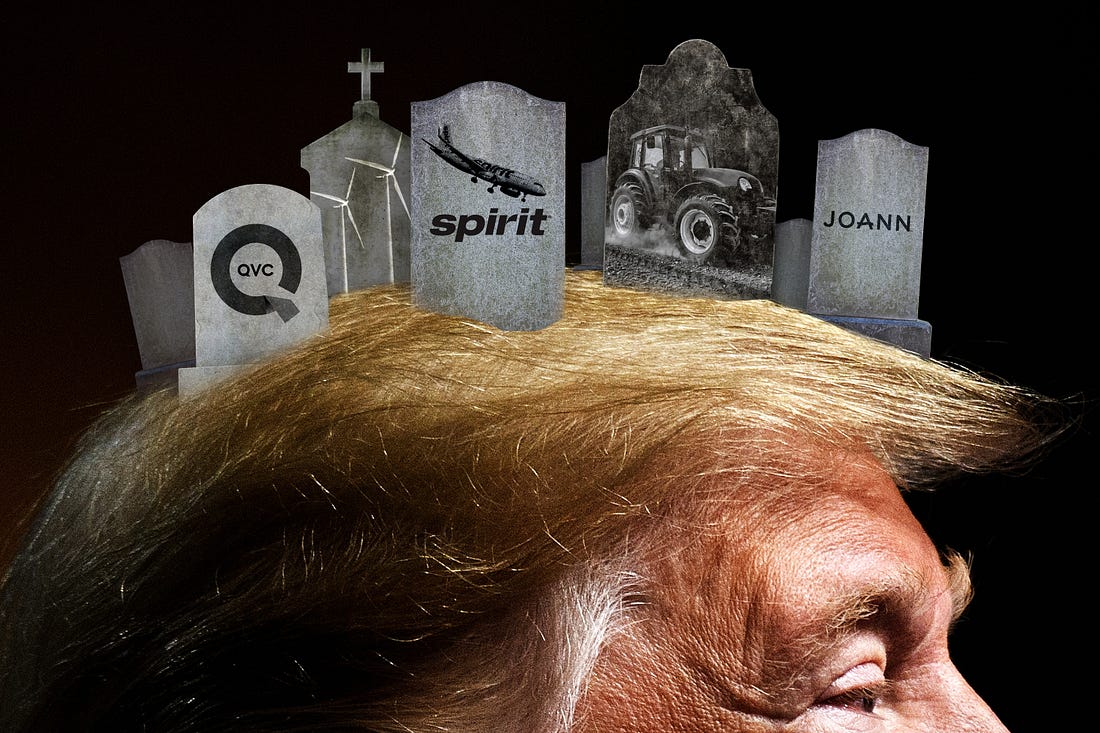
IN THE MIDST OF AN ENERGY CRISIS, the Trump administration is paying companies to not build more energy infrastructure. You read that correctly. The Trump administration is proudly shelling out almost $2 billion in exchange for agreements from developers to halt wind projects that were already in the works. These projects—wind farms off the coasts of New Jersey, New York, North Carolina, and California—would have generated enough electricity to power roughly 3-4 million households once they came online. What pot of taxpayer money this payoff comes from, and whether the payoffs are even legal, remain open questions. Even lawmakers don’t know the answers. But these companies should probably count themselves lucky. They got paid to shut down, after all.¹ Dozens of other renewable energy projects around the country have not received the same—forgive me—windfall. Instead, they’ve been canceled, stalled, or quietly snuffed out, with zero compensation. The list includes a gargantuan solar project in Nevada and more than 150 wind developments around the country, which collectively could have powered around 15 million homes.² As a Heatmap headline declared: “Trump is getting away with murdering an American industry.” Renewables are hardly Trump’s only victim. Our president is basically an economic serial killer, whacking firms left and right. In addition to the intentional corporate executions—like the deliberate, gleeful “murders” of these wind projects—there are a great many Trump casualties that look more like manslaughter: companies the president is killing by accident, as with the recently departed Spirit Airlines (R.I.P.). The president simply doesn’t understand how his economic agenda of trade wars and hot wars might accidentally kill off already-weakened individual companies—or, in some cases, entire industries. Just over a year into his second term, the economic landscape is littered with victims mangled by Trump’s agenda. Corporate bankruptcies last year rose to their highest level in over a decade. So join me, friends, for a stroll through the ‘America First’ Corporate Graveyard. Not already a Bulwark+ member? Give it a try for a two-week trial period at no cost: Time to Sell the FarmTrump often boasts about how terrific he is for farmers. The data show otherwise. Farm bankruptcies rose 46 percent in 2025 from a year prior, and this year the number is expected to be even worse thanks to the Iran war. Farmers have already lost core markets for staples like soybeans, as China stopped buying from America and turned instead to Brazil and Argentina. And now, U.S. farmers are having to absorb higher costs for diesel, fertilizer, and other key inputs thanks to the war. So their margins are getting hammered thin from both sides. Mass deportations and the cancellation of both domestic and foreign food aid programs have done the same. Persistently high interest rates, necessitated in part by Trump’s inflationary policies, have weighed on farmers, too. As with Spirit, Trump has attempted a bailout for farmers harmed by his own policies (euphemized as “unfair market disruptions”). So far this hasn’t done much to staunch the bleeding, though Trump has solicited their gratitude all the same.
Manufacturing a RecessionThroughout each of his presidential campaigns, Trump promised a manufacturing renaissance. This was never likely to happen, despite bipartisan nostalgia for a bygone U.S. manufacturing era. That’s largely because we are now a services-based economy. But a resurgence was especially unlikely given Trump’s specific brand of America First policies, which includes raising costs of the inputs that U.S. manufacturers buy while also closing off export markets where these same U.S. manufacturers hope to sell their products. The result: There are approximately 80,000 fewer manufacturing jobs today than there were when Trump took office last year.³ Not coincidentally, steel prices here in the United States are about 40 percent higher than those in Western Europe. The increase in corporate bankruptcies last year was driven largely by industrial firms grappling with tariffs. The sweeping Trump tariffs have been painful enough. But lately, they have been coupled with new stressors resulting from his war with Iran. For example, aluminum prices are nearly double what they were a year ago, thanks to a combination of Trump’s tariffs; a shutdown at a U.S. aluminum supplier; and the closure of one of the world’s largest aluminum smelters, located near Abu Dhabi, which was struck by an Iranian missile. This has hit auto companies especially hard. In an earnings call last week, Ford said it expected its commodity costs this year to reach $2 billion, twice its previous projection, primarily because of rising aluminum prices. Other manufacturers are feeling the pinch, too: In its own earnings filing today, Whirlpool warned that the Iran war had “resulted in recession-level industry decline in the U.S.” As trade nerds may recall: Whirlpool was one of the very first beneficiaries of Trump’s trade wars in his first term, through his global washing-machine tariffs. The company and its workers initially celebrated—but then they were beset by a series of other “America First” policies (including those metal tariffs). The Supreme Court’s decision in February striking down Trump’s separate, “national emergency” tariffs has provided little comfort to most U.S. manufacturers. That’s not only because the administration has dragged its feet on issuing rebates for those now-invalidated tariffs. The problem is also that many companies were permanently scarred by the business they lost from the tariffs in the first place, and the goodwill Trump frittered away with their customers abroad. As Pamela Rees, the owner of a small, U.S.-based harp manufacturing company (and a loyal Bulwark reader), shared recently:
The Final Nail in the CoffinBesides Spirit, several other big consumer-facing firms have also gone under during the Trump II era, such as QVC, Joann Fabrics, and Design Group Americas (a Joann supplier). As with Spirit, these business failures were not due solely to Trump’s actions; bankruptcies are rarely monocausal, and in these cases, the companies were weak to begin with. But Trump policies were the final nail in the coffin. Spirit was already struggling, and then could not survive jet fuel prices that rose to double its prior projections, swamping its margins. QVC and Joann were both weak before Trump took office, having been displaced by newer online competitors. But higher costs from tariffs put even more pressure on their margins.⁴ It is, of course, hardly unprecedented for economic policy to kill companies. Republicans have (often accurately) described Democrats as doing this many times over the years, typically by overregulating disfavored firms or entire industries out of business. Again, sometimes this happens deliberately, and sometimes by accident. Renewable projects, for instance, have faced plenty of permitting issues in blue jurisdictions, too. Either way, Republicans have not always been wrong when they accused Democrats of “picking winners and losers.” But now, they themselves have adopted the same tactic. It’s unfortunate—especially when they so often struggle to keep their chosen winners and losers straight. Ramparts— Speaking of tariffs: The very first tariff refunds are supposed to be issued in a few days, per Customs and Border Protection. But no, sorry, you’re probably not going to see any of that money, at least if you’re a regular consumer. These refunds are for the “trade community.” And on Thursday, a federal trade court struck down yet another set of tariffs that the administration had put in place after SCOTUS smacked down the initial batch. — The Department of Justice and the Commodity Futures Trading Commission are reportedly investigating a series of suspiciously timed trades in the oil market, per ABC News. What happens if the call is coming from inside the house (as it, uhh, appears to be)? — Speaking of the DOJ: The New York City Bar Association is holding its annual White Collar Crime Conference next week. Every attorney from U.S. attorneys’ offices abruptly pulled out yesterday, without explanation. It’s not like they’re too busy prosecuting white-collar crime to attend. Federal white-collar criminal prosecutions fell to their lowest level on record last fiscal year. — Sen. Thom Tillis (R-N.C.) recently ended his blockade of Trump’s Fed appointees because he said the politically motivated investigation of outgoing chair Jerome Powell was over. Tillis even bragged that he had saved the integrity of the Fed by preventing Trump from further using the DOJ to take over the central bank so he could control interest rates. “The reason I decided to stand in the way of this bogus prosecution of Chairman Powell is not for the one position, but how they could systematically use that if they succeeded with the chair to take out enough Fed voting members . . . to where they could actually control the board outcome.” Well, he may wish to consult with Bill Pulte, the director of the Federal Housing Finance Agency, who said this week that he expects Federal Reserve Board governor Lisa Cook to be indicted, and that this indictment alone (with or without a conviction) would be sufficient to successfully remove her from office before her term ends. (Hat-tip to Wall Street Journal Fed reporter Nick Timiraos for catching.) this. — Eli Lilly’s blockbuster diabetes drug Mounjaro just surpassed Merck’s cancer therapy Keytruda as the world’s best-selling medication. It’s a new era, boys and girls.
1
In some cases they agreed to cancel their wind projects in exchange for touting investments in oil and gas projects that they’d already announced. As Grist recently put it: “The government is paying TotalEnergies to halt a wind farm it isn’t building, in exchange for fossil fuel investments it’s already making.”
2
Not all of the Trump administration’s efforts to put the kibosh on these projects have been successful. My Bulwark colleague Jonathan Cohn reported last September on the administration’s attempts to halt work on an internationally owned wind-farm project off Rhode Island. A federal judge ruled that the administration had acted unlawfully, construction work resumed, and the wind farm began delivering power this March.
3
We will get new jobs data tomorrow; watch for how these figures move.
4
Joann Fabrics filed for bankruptcy multiple times before liquidating last year. In an earlier bankruptcy filing, it had cited tariffs from Trump’s first term as a stressor. You’re a free subscriber to The Bulwark—the largest pro-democracy news and analysis bundle on Substack. For unfettered access to all our newsletters and to access ad-free and member-only shows, become a paying subscriber.We’re going to send you a lot of content—newsletters and alerts for shows so you can read and watch on your schedule. Don’t care for so much email? You can update your personal email preferences as often as you like. To update the list of newsletters or alerts you received from The Bulwark, click here. Having trouble with something related to your account? Check out our constantly-updated FAQ, which likely has an answer for you.
|