
Below is an important message from one of our highly valued sponsors. Please read it carefully as they have some special information to share with you.
Dear Reader,
In this short 3-min. video, legendary investor James Altucher reveals the name and ticker symbol of a company he believes will skyrocket as soon as June 9th…
100% FREE of charge.
No tricks.
No gimmicks.
Free.
The company he reveals here is directly tied to the hotly anticipated IPO of Elon Musk’s Starlink…
Which is estimated to be worth $100 BILLION when it finally goes public.
That would make it the biggest IPO in history!
And right now – today…
You can get a “pre-IPO” recommendation on Starlink before it goes public…
From one of the most successful investors in the world – completely FREE of charge.
Click here to watch the video now.
It’s only 3 minutes long…
And it could give you an early stake in one of the biggest profit opportunities of all time.
Click here to check it out before it’s too late.
Best,
Matt Insley
Publisher, Paradigm Press
P.S. Starlink could go public as soon as June 9th. So for your chance at the biggest possible gains…
Make sure you act on this ASAP.
Click here to watch James’ urgent 3 min. video now.
Banks Are Buying Back Stock Hand Over Fist, Including These 3 Names
Authored by Leo Miller. Date Posted: 5/26/2026.
Key Points
- Banking stocks have put up strong performance over the past year and a half, with a key ETF beating the S&P 500.
- Buybacks have been central to the strategy of many banks, and several top names just increased their capacity greatly.
- The Trump administration's policies have been a notable driver of increased buyback activity.
- Special Report: Elon’s “Hidden” Company
While many investors have focused heavily on the artificial intelligence trade lately, the banking industry has also performed well. One commonly used proxy for the industry’s performance is the Invesco KBW Bank ETF (NASDAQ: KBWB). Over the last 12 months, the fund has delivered a total return of about 35%, outpacing the S&P 500’s roughly 27% return over the same period.
Notably, large-scale share buybacks have been a common theme among many bank stocks. After spending heavily on repurchases over the past several quarters, these three names are loading up again. All have substantial buyback capacity equal to more than 10% of their market capitalizations. That gives these firms continued room to reduce outstanding shares, adding a tailwind to per-share metrics.
Citigroup’s Buyback Capacity Hits 14% Amid Turnaround Success
NOT buy any SpaceX IPO shares until you read THIS (Ad)
SpaceX has confidentially filed for an IPO with the SEC, targeting a June 2026 listing at a valuation exceeding $1.75 trillion - potentially the largest IPO in history.
But one expert says buying shares directly may not be the smartest move. There is a lesser-known way to tap into this windfall that most investors haven't considered.
Discover the overlooked SpaceX IPO strategy before the June listingFirst up is one of the most recognizable banking institutions in the world, Citigroup (NYSE: C). The stock has had an extremely strong run, delivering a total return of more than 70% over the last 12 months. That rally reflects the progress Citi has made with its turnaround plan. In 2025, Citi saw record revenues across all five of its main business lines, and four of the five posted double-digit growth in Q1 2026. Overall, 2025 revenue hit a record $86.4 billion.
Citi has also made judicious use of buybacks recently, spending $13 billion on repurchases in 2025, or about four times what it spent in 2024. The company’s buyback pace continues to accelerate, with $6.3 billion of repurchases in Q1 2026 alone, nearly half of its 2025 spending in just one quarter.
Now, the company has filled its buyback chest to the brim, authorizing a new $30 billion repurchase program. The firm noted, “This reflects both our earnings power and our confidence in the trajectory of our business.” The size of this program is significant, equal to 14% of Citi’s market capitalization near $210 billion.
This gives the firm substantial ability to continue lowering its share count, which it has already reduced by more than 15% over the past five years.
KeyCorp Announces $3B Buyback Plan as Investment Banking Shows Out
KeyCorp (NYSE: KEY) shares have also performed well, though to a lesser extent than Citi. Shares have delivered a total return of about 40% over the last year. Notably, KeyCorp's investment banking business had its second-best year ever in 2025 and ended the year saying that its pipelines were at historically elevated levels. In Q1 2026, the company reiterated that message, saying that pipelines were up 5% from year-end and that merger-and-acquisition pipelines were at record levels.
The company’s buyback spending has also been higher than expected. KeyCorp spent $200 million on repurchases in Q4 2025, double what it had anticipated.
In Q1 2026, KeyCorp spent nearly $400 million, well above the $300 million it had planned. The company currently expects to spend $1.3 billion on buybacks in 2026, but it specifically notes that this is a floor estimate.
Pursuant to this, the company recently added $3 billion in buyback capacity. This buyback program is also very large, equal to just under 13% of KeyCorp’s market capitalization near $23.5 billion.
Notably, KeyCorp also returns a significant amount of capital through its dividend program. Overall, the company’s indicated dividend yield sits near 3.8%.
M&T Makes Strong Progress on Improving Loan Quality, Spends Big on Buybacks
Last up is M&T Bank (NYSE: MTB), which has delivered decent but not outstanding performance over the last 12 months, up about 20%. Gains have accelerated over the past six months as M&T has made strong progress in reducing its criticized loan balance. These are loans where the risk has increased relative to original expectations, putting the lender in an unfavorable position.
Notably, M&T reduced its criticized commercial loans by 27% in 2025. Progress continued in Q1 2026, with its criticized loan balance falling by $700 million to $6.6 billion.
Buybacks have also been a key part of M&T’s strategy, with the firm noting that it repurchased 9% of its outstanding shares in 2025. As part of its $5 billion buyback authorization, the company recorded $1.25 billion in repurchases during Q1 2026. That was equal to 3.5% of its outstanding shares versus the end of 2025. With this, the company now has around $3.75 billion in buyback capacity remaining.
Despite already undertaking big-time repurchases, its buyback firepower remains substantial. Overall, M&T’s capacity is equal to around 12% of its approximately $31 billion market capitalization.
Trump Policies Help Big-Bank Buybacks Hit Historic Levels
Notably, elevated buyback activity isn’t confined to these three names; it is characteristic of much of the banking industry. In Q1, the largest U.S. banks hit a quarterly record for buyback spending at $33 billion. Analysts note that the Trump administration’s deregulatory stance has been a boon for buybacks, as companies have to set aside less capital.
Salesforce Stock Finds Support as AI Momentum Builds
Authored by Thomas Hughes. Date Posted: 5/29/2026.
Key Points
- Salesforce reported FQ1 net revenue of $11.31 billion, up 13.2% year-over-year, with adjusted earnings of $3.88 beating consensus by 75 cents.
- Agentforce, Salesforce's agentic AI platform, posted annual recurring revenue growth of more than 200%, signaling strong AI-driven business momentum.
- Institutions own more than 80% of CRM shares and have bought on balance for 10 consecutive quarters, reflecting sustained long-term confidence in the stock.
- Special Report: Elon’s “Hidden” Company
It has taken time, but Salesforce's (NYSE: CRM) bottom may be in, and the stage could be set for a robust rebound. The SaaS apocalypse is not happening; Salesforce continues to gain traction, and its Q1 earnings results suggest the virtuous cycle of AI is gaining momentum.
The virtuous cycle, driven by the bullish impact of AI spending, is reflected in results from NVIDIA (NASDAQ: NVDA) across the datacenter supply chain and into the services realm. When companies spend money on AI, it generates revenue and increases AI demand.
NOT buy any SpaceX IPO shares until you read THIS (Ad)
SpaceX has confidentially filed for an IPO with the SEC, targeting a June 2026 listing at a valuation exceeding $1.75 trillion - potentially the largest IPO in history.
But one expert says buying shares directly may not be the smartest move. There is a lesser-known way to tap into this windfall that most investors haven't considered.
Discover the overlooked SpaceX IPO strategy before the June listingNew spending creates new demand in an as-yet unending cycle. Because we are in the early phases of AI’s rollout, we can expect this cycle to sustain Salesforce's long-term growth.
Mixed Response Overshadows Bullish Outlook for CRM
Analysts had a mixed response to the Q1 results, with numerous negative price target revisions offset by reaffirmations and target increases. The net result, however, was bullish, as the 39 analysts MarketBeat tracks carry a 72% Buy-side bias, and revisions are clustered around the consensus. While some targets are pushing the lower end, many remain near the high end, with the average of $240 just below the broader 12-month consensus price target. The consensus assumes nearly 50% upside from the critical support target, which, coincidentally, aligns with the lowest analyst targets. The consensus of fresh targets implies 35% upside and a five-month high.
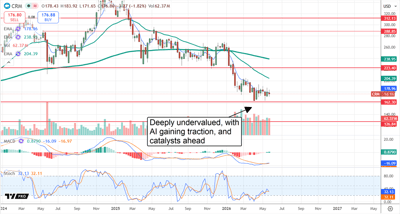
Technical stock price action and institutional trends also align with the critical support target around $160, which reflects a high set in 2019 before the COVID-19 pandemic. Price action since then has been volatile, driven by stimulus spending and accelerated digitization, but the stock has continued to show support at this level, as it does in late May. Support is visible in the weekly price candles and indicators, which reflect bears losing control and bulls regaining it.
Institutional trends reveal high ownership and aggressive accumulation. The group owns more than 80% of the stock, has bought on balance for 10 consecutive quarters, and has ramped up activity as the stock price has fallen. Bullish activity persisted into early Q2 2026 and will likely continue as the year progresses. The stock trades at a remarkably low 12x current-year earnings, with growth accelerating under the influence of AI. Assuming the forecasts are right, the company can rise 200% in the near term and then double again over time, given the right catalysts.
Salesforce Posts Tepid Results, But Versus a High Bar
Salesforce’s Q1 results and guidance were tepid relative to analysts' forecasts, but the bar was high, and the results were strong. The company’s $11.31 billion in net revenue rose 13.2% year over year, accelerating both sequentially and versus the prior year, with growth the strongest it has been in three years. Results were underpinned by Agentforce, the agentic platform, which saw annual recurring revenue grow by more than 200%. Consumption, a critical factor, was also strong, rising more than 110% sequentially, and Data 360 handled a 136% increase in records.
Margin news was also solid. The company reported gains across the board, with adjusted earnings rising 50% year over year to $3.88, topping the consensus by 75 cents. More importantly, guidance was also solid, with the company forecasting another quarter of strength. Growth is expected to slow to just over 10%, but guidance is likely cautious. The more critical detail is that earnings are expected to outpace expectations by a wide margin, and management may be taking a conservative approach.
Among the factors highlighting the company’s strength is its financial position and capacity for capital return. The company initiated an accelerated $25 billion repurchase agreement, which is largely complete. The impact was a 10% year-over-year decline in diluted shares outstanding, with expectations for continued aggressive capital returns. Dividends are also part of the equation, yielding almost 1% as of late May, with annual distribution increases expected. As it stands, the balance sheet remains fortress-like, with ample cash and low leverage, supporting the execution of strategy and delivery of results.
Analysts waiting to “see more” from Salesforce may be missing the point. The company’s primary catalysts are AI integration, margin improvement, and capital returns, and it delivered on all three. With that in play, CRM’s stock price may struggle to move higher, but that is unlikely. The more likely outcome is that upcoming results turn more naysayers into supporters, helping to firm market sentiment. Until then, this stock may remain near its current lows but is not expected to fall below them.
This email communication is a paid advertisement from Paradigm Press, a third-party advertiser of MarketBeat. Why was I sent this message?.
If you have questions about your subscription, please don't hesitate to contact our U.S. based support team at contact@marketbeat.com.
If you would no longer like to receive promotional emails from MarketBeat advertisers, you can unsubscribe or manage your mailing preferences here.
Copyright 2006-2026 MarketBeat Media, LLC. All rights protected.
345 N Reid Place #620, Sioux Falls, South Dakota 57103-7078. United States of America..