Welcome to The Early Bird! Every weekday morning at 7:00 AM Eastern, we send one quick email that answers a simple question before the market opens: What actually matters today? You’ll see the biggest stories, earnings, economic events, and market-moving headlines, boiled down so you can scan it in a minute and start the day informed instead of scrambling. Before we can send your first issue, there’s one quick step left. Just confirm your subscription below so it lands in your inbox, not your spam folder. Confirm Your Subscription Confirming now means you’ll get tomorrow morning’s Early Bird right on time. Glad to have you with us,
The Early Bird Team 🐤
*Confirm Your Subscription to The Early Bird P.S. Changed your mind? You can unsubscribe using this link.
Just For You Matador's Results Were Better Than Feared, But 2026 Headwinds Still MatterBy Thomas Hughes. Originally Published: 2/27/2026. 
Key Points - Matador is positioned as a quality Permian operator with a midstream cushion, steady cash flow, and ongoing capital returns despite a softer 2026 oil tape.
- Q4 2025 results and 2026 guidance are framed as better than feared, with production growth and lower spending supporting dividends and buybacks.
- The main near-term risk is institutional flow and technical resistance, which could cap upside and pressure shares before a longer-term rebound.
- Special Report: [Sponsorship-Ad-6-Format3]
Matador Resources (NYSE: MTDR) faces headwinds in 2026, including weak oil prices and softer market sentiment, but it remains a buy for long-term investors. This high-quality play on unconventional oil in West Texas and New Mexico continues to grow its acreage, proven reserves, operating wells, and production, while generating positive cash flow and returning capital to shareholders. The key takeaway: Matador is improving quality, positioning itself for long-term success at current oil-price levels and is set for an accelerated earnings rebound if (when) oil recovers. Insider activity is among the indicators of this company's quality. Insiders own nearly 6% of the stock and have been buying aggressively since the 2020 lows, when COVID-19 fears pushed many stocks to depressed levels. While no purchases have been logged in 2026 as of late February, MarketBeat data shows insider activity ramped up in 2025, reaching record levels in Q4 2025. Matador Reports Strength in Q4 2025, Issues Guidance for 2026 Matador posted solid results for Q4 2025, despite lower oil prices. The company generated nearly $850 million in net revenue, down 12.6% year over year, which nonetheless outpaced the consensus estimate. Production volumes rose both year over year and sequentially, and midstream operations performed well. The midstream business is important because it generates stable, fee-based cash flow tied to throughput rather than commodity prices. Margins were resilient. Operational execution supported positive cash flow on the production side, while midstream contributions were stronger than anticipated. The company reported $0.87 in adjusted earnings per share—down more than 50% year over year but 11 cents better than analysts expected—supporting healthy cash flow, capital returns, and balance-sheet improvements. Guidance balances growth with shareholder returns. Matador forecasts about 3% production growth and an 11% reduction in capital spending for 2026, which should create room for dividends and share buybacks. Matador's dividend is meaningful, yielding roughly 3% at current share prices in the high-$40s, and is covered by the 2026 earnings outlook (the payout represents about 25% of forecasted 2026 earnings). The company has raised its distribution seven times in the past five years and appears positioned to increase it again. Buybacks remain a material return-of-capital tool as well; Matador reduced its share count by 0.9% year over year in Q4 and is likely to continue repurchasing shares. 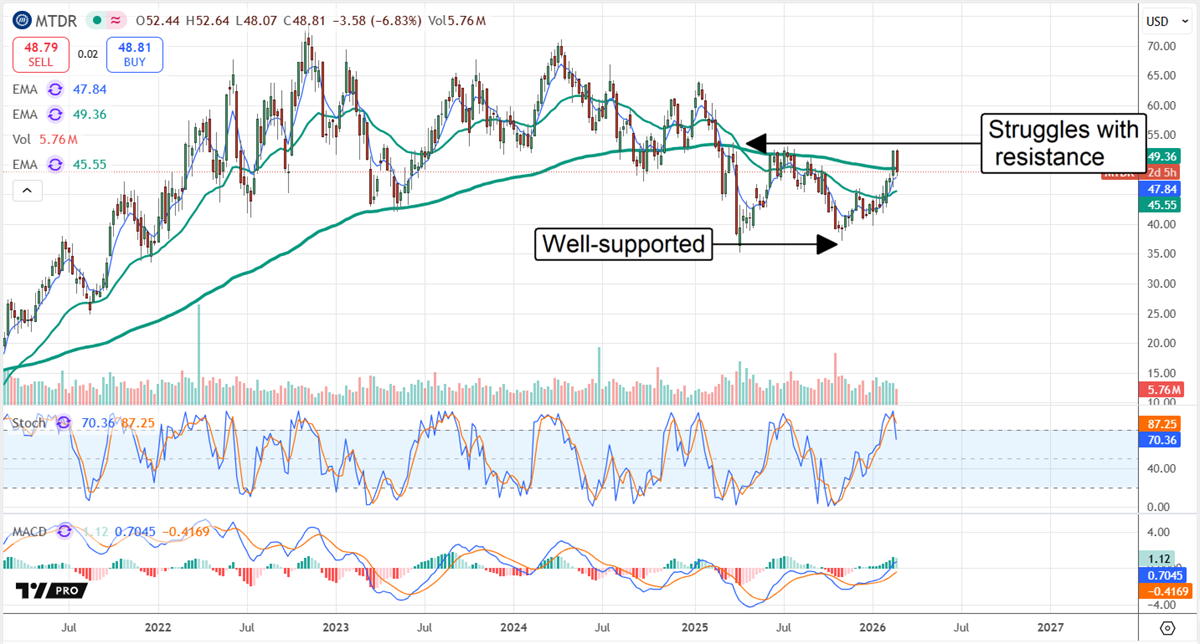
Analysts and Institutions Cap Gains for MTDR in Early 2026 Analyst and institutional trends are generally positive, but caution in early 2026 has capped share-price gains. Fifteen analysts tracked by MarketBeat rate the stock a Moderate Buy with a 73% buy-side bias, though many have trimmed price targets. Recent reductions have pushed consensus toward the lower end of the range—around $47—which may act as a near-term floor; the consensus implies roughly 20% upside from current levels. Institutional ownership is a double-edged sword. Institutions collectively own about 92% of the stock and accumulated positions through 2025. However, selling in Q1 2026 has outpaced buying, creating headwinds for the share price. If that trend continues, MTDR could struggle to hold current levels and might revisit recent lows. Price action reflects these headwinds. While a bottom appears to have formed, the early-2026 rebound stalled below the midpoint of the long-term trading range, meeting resistance near long-term exponential moving averages. That technical setup suggests continued pressure and raises the possibility of slipping toward the $40 area by midyear. The key question is whether institutions will return to buying as the price approaches critical support levels or whether selling will push the stock into deeper weakness. In a severe downside scenario, the shares could move much lower, though that outcome is considered unlikely. Trading at roughly 5X long-term earnings forecasts, the stock appears deeply undervalued relative to its potential if management executes its strategy. A near-term catalyst is Energy Transfer's (NYSE: ET) soon-to-be-opened Hugh Brinson pipeline, which should connect Matador to the higher-paying Henry Hub market and improve pricing realization. Bottom line: Despite near-term pressure from weak oil prices and institutional selling, Matador Resources remains a buy for long-term investors who can tolerate commodity-cycle risk. The company's growing production base, fee-based midstream cash flows, consistent capital returns, and insider ownership support the long-term thesis, with upside if oil prices recover.
| 

