

Gold's Big Move Could Be Opening the Next Phase
Gold has pushed through levels few expected just a year ago.
Major institutions are adjusting forecasts upward.
In cycles like this, attention often shifts from bullion to the companies positioned to benefit most from rising prices.
Early-stage explorers in proven districts tend to see renewed interest - particularly when they're actively drilling.
One such junior still trades under $1.
Gold has already moved.
This phase of the story is still developing.
See the company positioned for the next leg >
Synopsys: Long-Term Opportunity Outweighs Near-Term Headwinds
Authored by Leo Miller. First Published: 2/27/2026.
Key Points
- NVIDIA-backed Synopsys has struggled as of late, but still maintains a dominant position in a key part of the semiconductor industry.
- The firm's Ansys acquisition is progressing, with new product monetization set for 2027.
- Synopsys' long-term outlook remains positive, with the stock trading at depressed valuation multiples compared to its history.
- Special Report: [Sponsorship-Ad-6-Format3]
Electronic design automation (EDA) stock Synopsys (NASDAQ: SNPS) has struggled in recent months. While EDA revenue growth remains healthy, the firm's design intellectual property (IP) revenue is sliding. That weakness is partly tied to challenges at one of Synopsys's largest semiconductor foundry customers, Intel (NASDAQ: INTC). In addition, the company's $35 billion acquisition of Ansys has been a near-term drag on profitability.
Still, reasons for optimism remain. Synopsys is a dominant player in EDA, a technology essential to semiconductor design. The Ansys acquisition expands the company's total addressable market from chip design to full-system development, and NVIDIA (NASDAQ: NVDA) has shown confidence by investing $2 billion in the firm.
Trump Can't Stop What's Coming (Ad)
Ticker reveale - the ONE stock to buy today
After analyzing over 3,000 stocks and a staggering 40,169 data points... NYSE:???? is the No. 1 stock my team recommends buying today. In fact, according to our research, we believe this is one stock Warren Buffett himself would buy today - if he could.
Below, we review Synopsys's latest financial results and the impact of the Ansys deal to assess the company's outlook.
SNPS Posts Beats, But Shares Falter on Lackluster Guidance Increase
In its fiscal Q1 2026 report, Synopsys posted revenue of $2.41 billion, slightly above consensus of $2.39 billion. (The company's fiscal reporting period differs from the calendar year.) Overall revenue rose 66%, but that jump was largely driven by the Ansys acquisition.
Adjusted earnings per share (EPS) rose 24% to $3.77, topping management's guidance and outpacing the $3.56 expected by analysts (about 17% growth). Organically, EDA sales grew 12% — a solid but not spectacular result — while Design IP sales fell 6%. Management has characterized 2026 as a "transition year" for Design IP; despite the decline, this was the segment's best result in five quarters. In three of the last five quarters, Design IP sales declined by 15% or more.
Despite beating estimates, Synopsys shares fell roughly 5% after the release. Two main factors likely contributed. First, although Q1 included an over $0.20 adjusted EPS beat, management increased the midpoint of full-year EPS guidance by only $0.06, implying the company doesn't expect the Q1 tailwinds to persist. Second, NVIDIA reported on the same day and experienced its own sell-off; given NVIDIA's role in the semiconductor ecosystem, that likely pressured sentiment for peers including Synopsys.
Ansys: Near-Term Profitability Headwind
The Ansys acquisition has weighed on Synopsys's GAAP profitability since closing. In fiscal Q2 2025, Synopsys's GAAP operating margin was 23.5%; by fiscal Q4 2025 it had fallen to 5.4% as Ansys's costs were consolidated before cost and revenue synergies could be realized.
There was some improvement in the latest quarter: GAAP operating margin increased by 300 basis points to 8.4%, suggesting the profitability rebound may be beginning. But the main benefits from the acquisition are expected over the medium to long term. Synopsys plans to realize $400 million in cost synergies by year three of the merger and $400 million in revenue synergies by year four. Achieving those targets will require streamlining operations, reducing headcount where appropriate, and developing combined products. Synopsys expects to launch joint products in 2026 and begin monetizing them in fiscal 2027.
Ansys: Major Long-Term Addressable Market Tailwind
Higher revenues and lower costs from the merger would materially support Synopsys's profitability recovery. Beyond that, the strategic rationale for the deal is compelling.
Synopsys's EDA tools focus on designing chips — the "brains" of computing systems. Increasingly, those brains are integrated into complex machines such as autonomous vehicles, drones and robots. These systems have physical constraints — size, power consumption and heat dissipation — that interact with chip performance. Synopsys argues it no longer makes sense to design the "brain" and the "body" separately.
By combining Ansys's physics simulation software with Synopsys's EDA tools, engineers can evaluate how physical limitations will affect a system before building it. That reduces the risk of discovering late-stage incompatibilities between chips and their supporting systems, lowering development costs. As systems grow more complex, the ability to design complete systems gives Synopsys a clear pathway to expand its addressable market.
SNPS: A Long-Term Tech Winner
Although Synopsys's near-term performance has been mixed, its long-term outlook remains attractive. The stock now trades at a forward price-to-earnings ratio near 28x, below its three-year average of about 36x.
This historical discount makes the long-term opportunity more appealing, provided Synopsys executes on merger integration, product development and its synergy targets. For long-term investors willing to look past near-term integration headwinds, Synopsys appears well positioned in an increasingly complex tech landscape.
Workday, Seriously, It's Time to Buy This SaaS Leader
Written by Thomas Hughes. Posted: 2/26/2026.
Key Points
- Workday is on track to hit multiyear lows amid a fear-driven sell-off; its stock oversold to deep value territory.
- AI disruption fears are overblown; this company is growing and cementing itself as an AI automation leader.
- Institutions buy as price action declines, and even analyst trends reveal the value.
- Special Report: [Sponsorship-Ad-6-Format3]
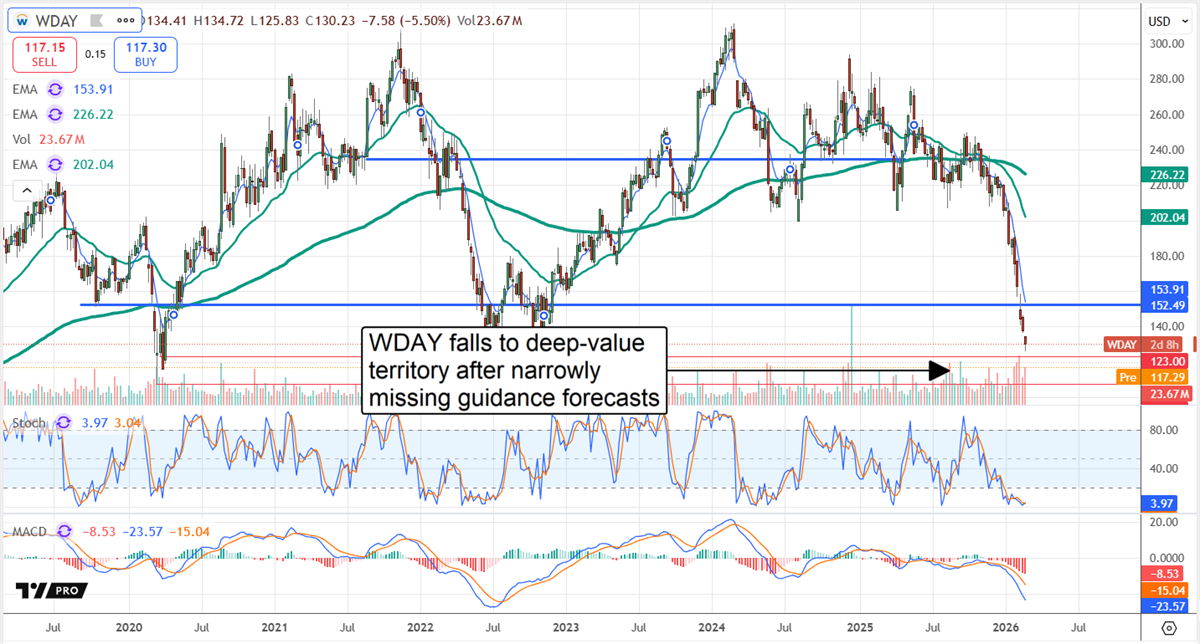
Workday's (NASDAQ: WDAY) decline didn't end with its Q4 2025 earnings report; the stock continued falling to long-term lows, creating an even more compelling opportunity for investors. While guidance missed consensus and AI disruption concerns persist, the miss was modest, guidance remains solid, and disruption may not unfold the way the market expects.
AI-first entrants may try to move into Workday's territory by turning models into full HR and finance solutions. But incumbents like Workday are embedding AI into their existing platforms. Because they're already deeply integrated into enterprise workflows and data, they could be harder to displace than the market fears.
Trump Can't Stop What's Coming (Ad)
Ticker reveale - the ONE stock to buy today
After analyzing over 3,000 stocks and a staggering 40,169 data points... NYSE:???? is the No. 1 stock my team recommends buying today. In fact, according to our research, we believe this is one stock Warren Buffett himself would buy today - if he could.
The analyst response to the earnings release was unfavorable. Jefferies downgraded the stock to Hold and several price targets were trimmed, with commentary highlighting the abrupt CEO change: co‑founder and Executive Chairman Aneel Bhusri is returning to the helm to navigate the company's next phase.
Workday Accelerates Growth and Profitability in Q4 2025
Workday delivered a solid quarter, with revenue growth accelerating sequentially to 14.5%. Revenue of $2.53 billion exceeded MarketBeat's reported consensus by about 40 basis points, driven by subscription strength, which rose 15.7% year-over-year, and that strength carried through to the bottom line.
Margin metrics were also strong: GAAP and adjusted operating margins widened by several hundred basis points. Adjusted operating margin improved about 420 bps, contributing to a 32% increase in operating income and a 28% increase in adjusted earnings — results that beat expectations materially.
Guidance was the main disappointment, with Q1 and full-year 2026 revenue forecasts below consensus. Still, the company is forecasting roughly 13% topline growth in Q1 and about 12.5% for the year, while maintaining a healthy adjusted operating margin. That combination could reset price action in the short term but is unlikely to keep the stock down for long. WDAY's consensus target sits roughly 100% above key support levels, and even the low end of the range implies upside.
Institutional Support and Share Buybacks Underpin WDAY Rebound Outlook
Two factors that support a potential rebound are capital returns and institutional ownership. Capital returns currently consist entirely of share repurchases, which are reliable and reduce the share count over time. Repurchases in 2025 lowered the share count by roughly 0.4%, a meaningful improvement to per‑share metrics, and institutions are buying into the story.
Institutional holders own more than 90% of the stock and have been accumulating on a quarterly basis for seven consecutive quarters, including the first two months of Q1 2026. Net flows in Q1 2026 show about $1.15 bought for every $1 sold — a modest but constructive trend. The pickup in buying to offset selling suggests institutions will continue to be supportive despite the "tepid" guidance.
Workday's balance sheet reflects capital returns, acquisitions and growth investments, but raises no immediate red flags. Cash is healthy and roughly flat year‑over‑year. While current assets declined, that was offset by an increase in noncurrent assets, and liabilities are up, causing equity to contract. Leverage remains light — roughly two times cash and under 0.5 times equity — leaving room to reduce debt and improve equity metrics as 2026 progresses.
Catalyst for Workday Stock: Yes, They Exist
Potential catalysts for Workday in 2026 include continued revenue growth, improving cash flow, and the likelihood of outperforming conservative quarterly guidance. The company signaled caution in its outlook, citing macro uncertainty and a longer timeline to close deals. A plausible scenario is that Workday beats quarterly expectations through the year, prompting guidance upgrades and a rebound in analyst and market sentiment.
The more immediate question is whether the stock will recover from these new lows — and that appears likely. Trading near $115, WDAY sits in a price zone not seen since the depths of the COVID‑19 panic, leaving significant upside if fundamentals hold and sentiment improves.
This email content is a paid sponsorship sent on behalf of i2i Marketing Group, LLC, a third-party advertiser of MarketBeat. Why did I get this email?.
We are not securities dealers or brokers, investment advisers or financial advisers, and you should not rely on the information herein as investment advice. Any investment should be made only after consulting a professional investment advisor and only after reviewing the financial statements and other pertinent corporate information. Further, readers are advised to read and carefully consider the Risk Factors identified and discussed in the profiled company's SEC and/or other government filings. Investing in securities, particularly microcap securities, is speculative and carries a high degree of risk.
If you have questions about your account, don't hesitate to contact our U.S. based support team at contact@marketbeat.com.
If you would no longer like to receive promotional emails from MarketBeat advertisers, you can unsubscribe or manage your mailing preferences here.
© 2006-2026 MarketBeat Media, LLC. All rights reserved.
345 N Reid Place #620, Sioux Falls, South Dakota 57103. United States..