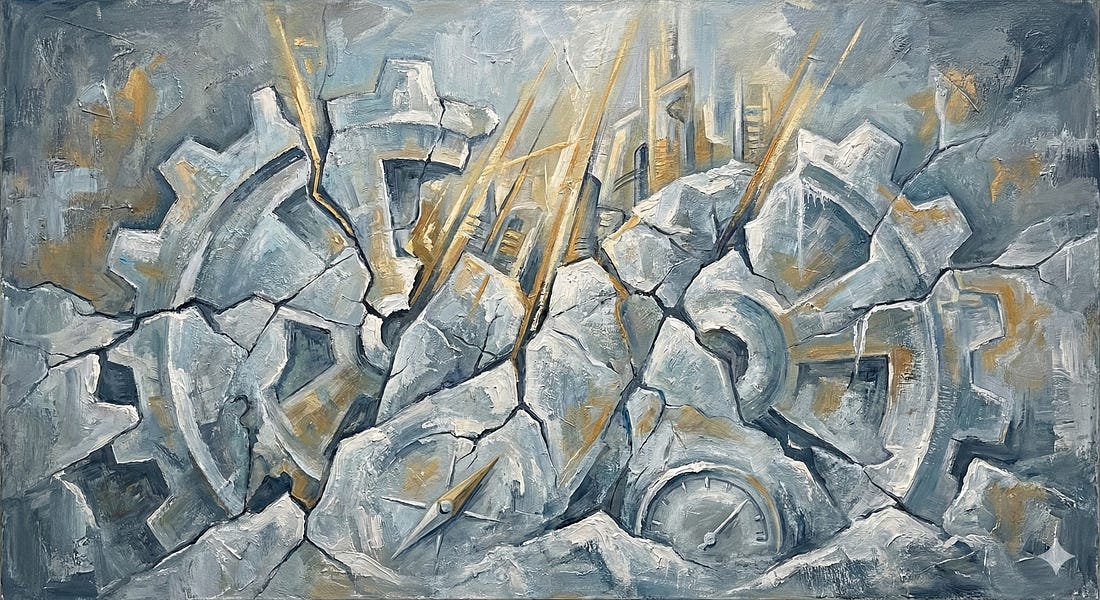
Stand on a balcony in Gurugram, and you are witnessing the metaphor for modern India. In the foreground, world-class glass towers house Fortune 500 companies, fuelled by the intellect of global engineers and the capital of international investors. It is a scene of frantic capitalism. But lift your eyes, and the illusion shatters. The air is a toxic grey haze. The roads below, termed “world-class” in election manifestos, are crumbling. The rule of law feels less like a solid foundation and more like a negotiated suggestion. This jarring contrast is not merely “growing pains”, as the optimists would have us believe. It is the visible symptom of a nation running on auto-pilot. While the headlines scream “Superpower” and “Vishwaguru”, the dashboard in the cockpit is flashing red. We are not heading toward a sudden, dramatic collapse—nations rarely just “stop” overnight—but we are drifting into a dangerous, suffocating stagnation. We are entering a “middle-income trap” where the old engines of growth are dying, the new ones haven’t started, and the pilot is too busy thumping his chest to notice the fuel gauge. The Illusion of InevitabilityWe suffer from a collective delusion about time and progress. We often mistake potential for destiny. We look at our massive population and assume that because we have the “fertile land” (our youth), a “harvest” of wealth is inevitable. We believe that simply because time passes, a developing nation naturally matures into a developed one. But history disagrees. It is a graveyard of nations that “almost” made it. For every South Korea or Taiwan that successfully leaped from poverty to prosperity, there are a dozen Argentinas, Brazils, and South Africas that stalled. In the early 20th century, Argentina was as rich as France. It had the resources, the people, and the ambition. Yet, it collapsed into decades of populism and institutional decay. It didn’t freeze because of a lack of resources; it froze because it broke its own internal thermostat. Entropy is the default state of nations. Disorder is natural. Building a functioning, wealthy democracy is an act of defying gravity. It requires constant, exhausting maintenance of institutions, infrastructure, and social trust. When a government stops doing this maintenance—when it switches to “auto-pilot” and focuses on identity politics instead of governance—the backsliding begins. We are not inevitably moving toward an endless summer of growth; we are just one or two government terms away from a permanent economic winter. The End of the Sugar Rush: From 1991 to StagnationFor twenty years, India surfed on the “sugar rush” of the 1991 reforms. Let us be honest about what happened then: we didn’t build a new engine; we simply cut the ropes that were holding the old one down. We had run out of foreign currency to buy oil and barely had enough to run the country for three weeks. To avoid a sovereign default, the Reserve Bank had to physically airlift 47 tonnes of gold to the Bank of England as collateral. It was a moment of profound national shame, but it forced our hand. We opened our doors not out of wisdom, but out of desperation. We allowed our entrepreneurs to breathe. That liberalization released the pent-up energy of a billion people, giving us a magnificent 20-year run of growth. But that momentum is now exhausted. We are discovering the hard way that you cannot build a First World economy on Third World institutions. The economic model that lifted millions out of poverty—cheap labour and IT services—is becoming obsolete. The “China path” of factory-led growth, where peasants moved to cities to make T-shirts and toys, is closing. Robots are now cheaper than humans. A factory in Ohio with ten robots is more efficient than a factory in Manesar with a thousand workers. Simultaneously, the “India path” of IT services is being dismantled by Artificial Intelligence. For two decades, we thrived on a “rental model” of intellect. We rented out smart, English-speaking engineers to American companies to maintain their code and manage their back offices. We didn’t own the Intellectual Property; we just billed by the hour. Today, AI can write code, summarize documents, and handle customer service for a fraction of the cost. The “mass employment” engine of the Indian middle class is sputtering. We are left in a terrifying limbo: too expensive to be the world’s sweatshop, but not educated enough to be its laboratory. The Demographic Nightmare: The 2046 ScenarioThis economic stalling creates a ticking time bomb: our youth. We celebrate our “Demographic Dividend”, the statistical fact that we have more working-age people than dependents. But demography is not destiny; it is just potential energy. Without investment in health, education, and skills, that potential turns destructive. The most frightening projection for India isn’t a war with a neighbour or a stock market crash; it is the Unemployable 40-Year-Old of 2046. Consider a 20-year-old man today. He has a degree, perhaps, but in a world of AI, he is functionally illiterate. He has no transferable skills. If the economy cannot absorb him, he will spend his 20s and 30s in low-end gig work or disguised unemployment. By 2046, he will be 40. He will have aging parents to support, no pension, no savings, and no career progression. A generation of angry, unemployable men is not a “dividend”; it is a recipe for social combustion. And this brings us to the sociology of the vigilante. When the formal market denies a young man value—when it tells him he is worthless—he finds value elsewhere. This is the dark economic logic behind the rise of “Gorakshaks” and street-level religious enforcers. It is naive to think this is purely about religion. It is about employment disguised as purpose. Joining a vigilante group gives a powerless young man exactly what the economy denied him: authority to stop trucks on the highway, an identity as a “protector” rather than a failure, and an income extracted through local extortion. By failing to create real jobs, the state is actively recruiting an army of instability. We are militarizing our own unemployment crisis. The Ice Age of Institutions: The Albedo EffectWhy isn’t the state fixing this? Why do we feel this “bleakness” despite the shiny G20 summits? Because we have entered a phase of aggressive “anti-intellectualism”. In a healthy system, expertise is the immune system. Doctors, economists, statisticians, and scientists warn the state when things are going wrong. Today, the state suspects expertise. The governments delays, denies, or suppresses the data that contradicts its “superpower” narrative. A government that refuses to listen to environmental scientists about pollution or economists about joblessness is like a pilot taping over the altimeter because he finds the altitude reading “anti-national”. This leads to what we can call the “Institutional Ice Age”. In climate science, the Albedo effect describes a feedback loop: ice reflects heat, making the planet colder, which creates more ice. A similar feedback loop destroys nations.
The cycle feeds itself. Consider the moral clarity we once possessed. When Ajmal Kasab was captured alive after the 26/11 attacks—a man who waged war on our sovereignty and slaughtered our citizens in plain sight—we did not lynch him on the street. We gave him a lawyer. We gave him a fair trial. We followed the due process of law all the way to the Supreme Court before hanging him. We did this not for his sake, but for ours. We understood then that the legitimacy of the Indian state comes from its unshakeable adherence to the law, even when dealing with a monster. That process was not a weakness; it was a declaration of our strength as a civilized republic. Contrast that confidence with today’s insecurity. When you weaponize the police to use “bulldozers” without due process, you don’t just punish a specific community; you break the machine itself. You teach the constable and the bureaucrat that the “rule book” is irrelevant and that “power” is the only law. You are admitting that the state no longer trusts its own laws. The danger is that you cannot train a system to be lawless only for “specific” targets. Once a bureaucracy learns it can ignore the law for the “right” reasons(nationalism), it eventually ignores it for any reason—bribes, laziness, or personal vendettas. By trading the difficult path of due process for the easy path of the bulldozer, the state loses the capacity to govern, leaving only the capacity to punish. The Secession of the Successful: The Gurugram ParadoxThe ultimate casualty of this decay is the Social Contract. A society functions on a shared agreement: “I pay my taxes, I follow the rules, and the state provides me with safety, infrastructure, and justice”. For the honest, tax-paying Indian middle class, this contract lies in tatters. You look at your tax slip, comparable to European rates, and then you look at the services you receive. You pay for private schools because public education is broken. You pay for private hospitals because public health is absent. You pay for private security because the police are unreliable. You buy air purifiers because the government cannot manage industrial waste and crop burning. You effectively live in a private republic within a failing public state. This leads to the “Secession of the Successful”. The elite and the upper-middle class don’t riot; they quietly check out. They retreat into their gated communities, disconnected emotionally from the nation’s problems. Or, increasingly, they leave. The “brain drain” and the exodus of High Net Worth Individuals (HNWIs) is not just about better tax rates in Dubai or London. It is a vote of no confidence. It is people saying, “I have succeeded despite this system, and I no longer wish to carry the burden of its failures”. When the most productive members of a society stop believing in the future of that society, the “Ice Age” has truly begun. The Slippery SlopeThis view is bleak, yes. But it is bleak because the stakes are existential. We are currently sliding down a slippery slope where the “Auto-Pilot” mode is no longer sufficient to keep the plane in the air. The “New India” feels like a country caught in a trap of its own making. We have the aspirations of a superpower but the administrative capacity of a feudal state. We want to be a $5 Trillion economy, but we are terrified of the intellectual freedom and institutional robustness required to sustain it. We want the world’s respect, but we tolerate a domestic environment where “social harmony” is sacrificed for short-term electoral gains. India is not doomed. We have survived crises before—the wars of the 60s, the Emergency of the 70s, the bankruptcy of the 90s. But those were acute crises, like heart attacks. They forced immediate action. What we face today is chronic, like a slow-moving cancer. It is easier to ignore. We have enough foreign reserves to avoid bankruptcy, and enough political distraction to avoid accountability. But the laws of entropy do not care about our foreign reserves. If we do not stop the decay of our institutions, if we do not pivot from “chest-thumping” to the boring, difficult work of repairing our schools, courts, and cities, the ice will continue to spread. The “Amrit Kaal” runs the risk of becoming a long, frozen winter of missed opportunities. India may or may not collapse—history is full of surprises, and nations are resilient. But on our current path, it will definitely fail to rise. And the horror is that amidst the noise of our own applause, we won’t even hear the crash. Thanks for reading Twisted Biryani! Subscribe for free to receive new posts and support my work.
|