

Ticker Reports for February 19th

REITs Set for a 2026 Rebound? 7 Top Picks as Rate Cuts Approach
Real Estate Investment Trusts—or REITs—were left for dead in 2025. After two straight years of underperformance, the group became one of the market’s most widely avoided corners—largely because rising interest rates are kryptonite for a sector built on leverage and access to capital.
In a recent conversation with Brad Thomas of Wide Moat Research, the tone was noticeably different. The setup for 2026 is starting to look like the mirror image of what punished REIT investors in 2024 and 2025.
As Thomas put it, “So now that we’re seeing this rates decline… we’re seeing the REIT rally finally underway in 2026.”
That’s already showing up in the scoreboard. Certain property sectors are leading early in the year—farmland REITs are up roughly 24% year to date, data centers around 22%, net lease about 15%, and self-storage about 14%. The point isn’t that everything is back. It’s that the rotation is starting, and investors who wait for “all clear” often wind up paying higher multiples for the same cash flows.
Thomas shared seven REITs he likes most for 2026. The first five fall into the “sleep well at night” bucket—steady businesses with durable moats. The final two are higher-risk ideas with bigger rebound potential if their catalysts play out.
Realty Income: The Monthly Dividend Machine With Scale to Spare
Realty Income (NYSE: O) is one of the most recognizable names in REIT land—and for Thomas, it’s a foundational holding in net lease.
The company owns more than 15,500 freestanding properties across all 50 states and Europe, and it collects rent from roughly 1,600 customers across 92 industries. Tenants include familiar brands like 7-Eleven, Dollar General (NYSE: DG), Walgreens and FedEx (NYSE: FDX), which helps reinforce the stability investors look for in a core REIT position.
Scale matters here, but so does balance sheet strength. Realty Income carries an A credit rating and has increased its dividend for 27 consecutive years, making it a Dividend Aristocrat. That streak includes the Global Financial Crisis and COVID-19.
Even after a strong start to 2026, Thomas still sees value. Shares trade near 15.3x price-to-AFFO (adjusted funds from operations), below the company’s longer-term average around 17x, with a dividend yield around 4.9%.
Equinix: The Data Center REIT Where the Network Is the Moat
When the conversation shifted to growth, Thomas went straight to data centers—and specifically Equinix (NASDAQ: EQIX), one of the sector’s dominant global landlords.
Equinix operates 273 data centers across 36 countries and 77 markets. But the key point Thomas emphasized is that the advantage isn’t just real estate. It’s the ecosystem.
As he explained, “The real moat is not the building… it’s the network inside of that building.”
That “network effect” creates stickiness—moving equipment is expensive, and connectivity relationships aren’t easily replicated. It also supports pricing power in major metro markets where demand remains intense. Equinix recently delivered a 10% dividend increase and is guiding to strong AI-fueled growth.
The balance sheet is solid (BBB+), leverage remains manageable, and the shares trade around 24x AFFO—slightly below the company’s typical range. The yield is lower at roughly 2.6%, but the growth runway is longer.
Public Storage: The Sticky Self-Storage Giant With Pricing Power
Self-storage is one of those property types that tends to surprise investors—until they’ve used it. Thomas described it as “sticky,” and it’s easy to see why.
Public Storage (NYSE: PSA) is the category leader with approximately 3,500 U.S. facilities and a 35% stake in European operator Shurgard. The industry remains fragmented, giving Public Storage ample room to consolidate over time.
The company’s edge isn’t only scale. Technology has become a competitive weapon in self-storage, and Public Storage’s digital operating platform helps optimize pricing and operations at the local level.
Financially, it’s built to endure: A-rated credit, strong liquidity, and substantial retained cash flow. Shares trade near 19x AFFO versus the historical average, 22x.
The yield sits around 4%, with expectations that declining rates could improve the broader return profile.
Equity LifeStyle Properties: A “Silver Tsunami” Play in Manufactured Housing and RV Resorts
Equity LifeStyle Properties (NYSE: ELS) isn’t the first real estate name many investors think of—and that’s part of what makes it interesting.
The company owns and operates 455 properties across 35 states and Canada, focused on manufactured housing communities, RV resorts, campgrounds and marinas. Many are in retirement and vacation destinations, and a large portion of its manufactured housing portfolio skews age-qualified.
Thomas framed ELS as a beneficiary of the “silver tsunami”—the demographic wave created as baby boomers age into retirement.
With demand rising and supply constrained in key Sunbelt markets, ELS has been able to lean into pricing power and occupancy durability.
The company recently raised its dividend by 5.3% and has increased payouts for 22 straight years. The dividend yield is around 3.2%, and the setup implies mid-teen total return potential if growth and valuation cooperate.
EastGroup Properties: Sunbelt Flex Warehouses Built for Growth
Industrial real estate has been a market favorite for years, but EastGroup Properties (NYSE: EGP) plays a slightly different game than the mega warehouse landlords.
EastGroup targets “flex” distribution properties—typically 20,000 to 100,000 square feet—in fast-growing Sunbelt markets such as Texas, Florida, Arizona and North Carolina. That niche serves expanding regional businesses that may need to scale space over time.
Operational metrics have been strong: occupancy around 96.5%, solid same-store NOI growth, and funds from operations up 8.8% in the latest quarter. Leverage is low, with debt to total market cap around 14.7%.
Shares trade near 27x AFFO versus a historical norm around 30x.
With analysts projecting growth accelerating into 2027 and 2028, EastGroup offers a blend of quality and upside that fits squarely in a “SWAN” framework.
Americold Realty Trust: A Deep-Value Cold Storage Turnaround With a Big Yield
After covering the high-quality core names, Thomas pivoted to two beaten-down ideas where the payoff depends more on execution and catalysts.
Americold Realty Trust (NYSE: COLD) is a cold storage REIT operating temperature-controlled warehouses across North America, Europe, Asia-Pacific and South America. The company has about 230 facilities and roughly 1.5 billion refrigerated cubic feet of storage capacity.
Its customer list includes household names like Walmart (NASDAQ: WMT), Conagra (NYSE: CAG), Kraft Heinz (NASDAQ: KHC), General Mills (NYSE: GIS) and Smithfield (NASDAQ: SFD). In other words: demand isn’t the question.
The stock is down sharply because investors have been skeptical about the business’s cyclicality and the service component layered on top of the real estate.
Now, the story is shifting. A new CEO is in place, an activist investor has pushed for a review of strategic alternatives, and management is looking at asset sales and cost reductions. Thomas pointed to potential SG&A and indirect cost savings in 2026.
The valuation reflects the fear: shares trade around 8.9x AFFO versus a historical multiple above 25x, and the dividend yield is roughly 6.65% with a payout ratio near 65%. It’s not risk-free—but if execution improves, the rebound potential is meaningful.
Healthpeak Properties: A Healthcare REIT Catalyst With a Spin-Off on Deck
Healthpeak Properties (NYSE: DOC) is the other higher-risk idea Thomas highlighted, and the catalyst is more corporate-structure than macro.
Healthpeak owns a mix of outpatient medical office buildings, life science properties and senior housing.
The company recently announced plans to spin off its senior housing assets into a new REIT (Janus Living), with Healthpeak retaining a majority ownership stake and the remaining shares expected to trade publicly.
The logic is straightforward: pure-play senior housing REITs have commanded premium multiples, while Healthpeak’s blended portfolio has not. A spinoff could help the market value each segment more appropriately. The complication is life science.
Industry overbuilding coming out of COVID and reduced venture capital funding have pressured occupancy.
Healthpeak did see life science occupancy decline in the most recent quarter, but management expects leasing momentum to improve later in 2026, with a meaningful pipeline of space being marketed.
Shares trade around 8.9x AFFO and yield roughly 7.2%, signaling that plenty of risk is already priced in. If the spin-off unlocks value and life science stabilizes, the upside case becomes easier to underwrite.
The 2026 REIT Playbook From Brad Thomas
Thomas’ list isn't built around chasing what’s already up the most. It's built around a simple premise: when the rate environment changes, REIT leadership changes with it—and investors can either position early, or compete later at higher valuations.
The five core names offer stability, balance sheet strength and durable moats. The final two are discounted for a reason, but come with identifiable catalysts that could reshape their return profiles if management delivers.
If the rate-cut cycle continues to unfold, REITs may not stay a “forgotten” sector for long.

1 Hour Once A Day
1 Hour Once A Day
NVIDIA and Meta Deepen Their AI Alliance—and the Spending Numbers Are Enormous
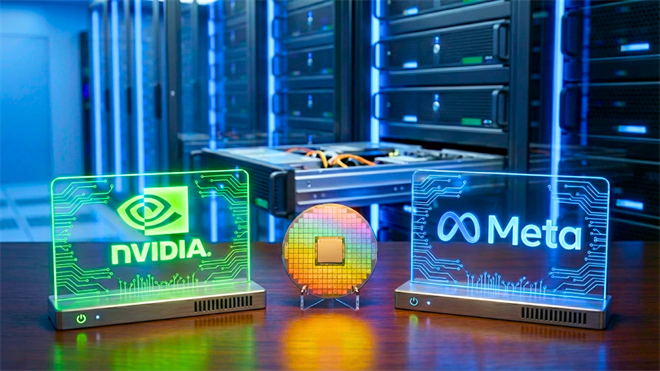
The artificial intelligence (AI) trade has evolved from a speculative gold rush into a heavily industrialized arms race. On Feb. 17, 2026, two of the market’s most dominant forces, NVIDIA (NASDAQ: NVDA) and Meta Platforms (NASDAQ: META), announced an expansion of their partnership.
This new multigenerational agreement moves beyond hardware purchasing, establishing a deep codesign collaboration intended to secure the computing infrastructure for the next decade. Investors immediately recognized the financial gravity of the deal. Following the announcement, NVIDIA shares climbed approximately 2.3% to near $189, while Meta shares gained 0.6% to around $641.
The market reaction suggests that Wall Street views this alliance as a necessary step for Meta to dominate the consumer AI space and a critical confirmation of NVIDIA’s long-term revenue durability.
The Vera-Rubin Roadmap: Ditching Legacy Tech
The most significant aspect of this deal is not what Meta is buying today, but what it has committed to buying tomorrow. Meta confirmed it will deploy millions of NVIDIA’s current Blackwell graphics processing units (GPUs) immediately to handle its current workload. However, the company is also looking much further down the road, signing a formal agreement to adopt the upcoming Rubin architecture and the Vera central processing unit (CPU).
This specific commitment to the Vera CPU represents a major strategic pivot in how data centers are built. Historically, AI servers have used a mix of hardware, pairing NVIDIA GPUs with central processors from competitors such as Intel or AMD. This new deal signals that Meta is moving toward a full-stack dependency on NVIDIA. By adopting NVIDIA’s proprietary Arm-based CPUs, both the current Grace models and the future Vera models, Meta is effectively streamlining its infrastructure.
For NVIDIA, this is a massive competitive victory. It broadens their moat by ensuring they control the entire server rack, not just the graphics card. For Meta, this integration promises higher speed and efficiency. The deal also includes adopting NVIDIA’s Spectrum-X Ethernet networking. This technology is designed to drastically reduce latency, or the lag time between data requests. In the world of AI training, milliseconds of delay can cost millions of dollars in efficiency, making this networking upgrade a critical component of the agreement.
Personal Superintelligence: The Revenue Vision
Understanding the hardware is only half the battle; investors also need to understand the why. CEO Mark Zuckerberg has been clear about his goal: Personal Superintelligence. The company aims to provide a highly personalized, intelligent AI agent to every one of its billions of users across Facebook, Instagram, and WhatsApp. This is not just a chatbot; it is envisioned as a proactive digital assistant that knows your schedule, your preferences, and your relationships.
However, this vision faces a massive hurdle: Privacy. This is especially true for WhatsApp, a platform defined by its end-to-end encryption. Users want advanced AI features, but they are unlikely to embrace a system that requires Meta to read their private messages to function. If users do not trust the AI, they will not use it, and Meta cannot monetize it.
To solve this, the expanded partnership introduces a technology called Confidential Computing. This innovation allows NVIDIA’s chips to process data while it remains encrypted. Essentially, it allows WhatsApp to run powerful AI tasks on your messages without the system ever actually seeing the content. By solving this privacy paradox, Meta hopes to roll out AI agents to 2 billion WhatsApp users faster than any competitor, creating a massive new revenue stream and user engagement without triggering regulatory or consumer backlash.
Sticker Shock: Inside the $135 Billion Bill
Building the future is incredibly expensive, and the price tag for this dominance is raising eyebrows on Wall Street. Meta has stunned some conservative market observers with its capital expenditure (CapEx) guidance for 2026. The company projects spending between $115 billion and $135 billion this year alone. To put that figure in perspective, the collective CapEx spending for the entire Big Tech cohort, including Microsoft (NASDAQ: MSFT), Alphabet (NASDAQ: GOOGL), and Amazon (NASDAQ: AMZN), is estimated to reach nearly $650 billion in 2026.
This level of spending creates a divide among investors. The bear case argues that spending more than $100 billion in a single year erodes profit margins and carries significant risk. If the AI boom slows down, Meta could be left with billions of dollars in depreciating hardware. However, the bull case argues that this is defensive spending. By building its own massive compute clusters now, Meta avoids paying rent to cloud competitors like Microsoft or Amazon later. If they do not spend this money, they risk becoming tenants in a digital world they once owned.
For NVIDIA shareholders, however, Meta’s expense is pure income. This deal serves as a major catalyst ahead of NVIDIA’s fiscal Q4 earnings report, scheduled for February 25, 2026. Analysts expect the chipmaker to report revenue of roughly $65.5 billion for the quarter. This partnership supports the theory that demand is accelerating rather than slowing, as the world's largest companies race to secure chip supply for future generations.
Metrics and Multiples: Buying the Future
Despite the massive numbers involved, financial analysts remain largely bullish on both stocks, though for different reasons. The consensus view is that the AI market has shifted from a training phase to a deployment phase, which requires even more hardware than previously thought.
NVIDIA is currently trading at a price-to-earnings ratio (P/E) of approximately 47.0. While this is high for a standard industrial company, NVIDIA is growing at a pace that makes this multiple look reasonable to many growth investors. With an average analyst price target near $264, there is an implied upside of over 40% from current levels. The market is effectively betting that deals like the one with Meta will continue to happen, sustaining NVIDIA’s growth rate for years.
Meta Platforms tells a different story. Trading at a P/E ratio of roughly 27.2, it is valued more like a traditional utility than a high-flying tech stock. This discount reflects the market’s anxiety over that $135 billion spending plan. However, with price targets averaging between $835 and $850, analysts see deep value in the stock if Zuckerberg’s bet on Personal Superintelligence pays off.
A Partnership for the Next Decade
The expanded alliance between NVIDIA and Meta signals that the AI arms race has no finish line in sight. By locking in supply for chips that won't exist until 2027, Meta is signaling that it views AI not as a feature, but as the core utility of the future internet.
For investors, the takeaway is clear. NVIDIA has successfully entrenched itself as the indispensable engine of the global economy, securing revenue streams that extend for years to come. Meanwhile, Meta is betting its entire financial weight on the belief that whoever owns the best infrastructure will own the consumer relationship. As the calendar moves toward 2027, the success of this partnership will likely determine the trajectory of the entire tech sector.

Your Bank Account Is No Longer Safe
Your Bank Account Is No Longer Safe
Rocket Lab Earnings Loom as Neutron Timeline Takes Center Stage
Aerospace and defense company Rocket Lab (NASDAQ: RKLB) is just a week away from its fourth quarter earnings report, scheduled for Feb. 26 after the market closes. The stakes are high.
Not only will investors be looking for updated timelines and forward guidance, but the stock has also pulled back sharply from its recent highs. Shares are down nearly 30% from their 52-week and all-time highs, pressured by a mix of softer risk appetite and company-specific concerns. With sentiment reset, this earnings report could prove pivotal for the stock’s near-term direction.
Here is what investors should focus on heading into the release.
Technical Positioning Remains Constructive
Despite the recent volatility, Rocket Lab’s longer-term trend remains intact. The stock is still up more than 1,300% over the past three years and sits roughly flat year to date. Over the past two months, shares have experienced sharp selling pressure.
The pullback was driven in part by broader market weakness and in part by concerns surrounding Neutron development. Even so, the higher-time-frame structure remains bullish.
On the weekly chart, Rocket Lab continues to trade above its 200-day simple moving average. The stock is also attempting to establish a higher low near $65.
Since its uptrend began in 2025, the pattern of higher highs and higher lows has not been broken.
As long as shares remain above the 200-day moving average and well above the November 2025 lows near $40, the broader uptrend remains intact.
Neutron Timeline Takes Center Stage
The most immediate source of investor anxiety has been the recent Neutron development update. In January, the company disclosed that a Stage 1 tank ruptured during qualification testing at its Long Beach, California, facility. Rocket Lab emphasized that such outcomes are not uncommon during development testing, particularly for a new medium lift launch vehicle. Still, uncertainty around whether the incident could delay Neutron’s maiden flight weighed heavily on sentiment.
The company said that it would assess the impact and provide an updated timeline during the fourth-quarter earnings call. That update will likely be the most closely watched element of the report.
If the maiden Neutron launch remains on track within the previously communicated window, and management provides constructive commentary on testing progress and customer engagement, sentiment could shift quickly.
What the Earnings Report Needs to Show
Operationally, Rocket Lab entered this quarter with momentum. In its third quarter 2025 results, the company posted record revenue and demonstrated continued demand across both Electron launch services and its Space Systems division.
Investors will be looking for that strength to continue. Management previously guided fourth-quarter revenue between $170 million and $180 million, with non-GAAP gross margin expected in the mid-40 % range. Meeting or exceeding that guidance would reinforce confidence in execution.
Electron remains the company’s financial backbone for now, and management continues to target non-GAAP margins of 45% to 50% as launch cadence increases. In addition, Rocket Lab ended last quarter with more than $1.1 billion in contracted backlog across launch and spacecraft production.
A meaningful portion of that backlog is expected to convert into revenue over the next year, which will be another key focus for investors.
The company also continues to secure government business. On Feb. 12, Rocket Lab announced an upcoming dedicated HASTE mission for the Department of War’s Defense Innovation Unit, marking its fourth hypersonic test launch in under six months. That cadence underscores growing demand for responsive launch capabilities.
This earnings report is about execution and reassurance. If Rocket Lab can deliver solid financial results, reaffirm its Neutron timeline, and demonstrate continued demand strength, the recent pullback may be more noise than signal.

The "Trump Effect" on IRAs over $50k
The "Trump Effect" on IRAs over $50k

MarketBeat Media, LLC dba TickerReport
345 N Reid Place, Suite 620, Sioux Falls, SD 57103.