Thanks for signing up for DividendStocks.com! It's the daily newsletter built for dividend and income investors. Before we can begin sending your daily updates, there’s one quick step left. Please confirm your subscription using the link below so our emails reach your inbox. Click Here to Confirm Your Subscription to DividendStocks.com Here’s a small glimpse of what you’ll get access to: Dividend Stock Ideas — Each newsletter features dividend stocks with high yields, sustainable payouts, and strong growth potential. Ex-Dividend Stocks — Want to capture upcoming dividend payouts? Find out which stocks are going ex-dividend this week. Market News and Events — Stay in the loop on the latest developments impacting popular dividend names like AT&T, Exxon Mobil, IBM, Procter & Gamble, and Verizon. Bonus: As a thank-you for confirming, you’ll also receive a free PDF copy of Automatic Income, our popular guide to building wealth through dividend investing. Let’s get your dividend journey started! Discover Top Income-Generating Stocks Here See you in your inbox soon,
The DividendStocks.com Team P.S. Don’t miss out click here to verify your subscription and secure your daily dividend insights and your free investing guide!
This Week's Bonus Article Wendy's Stock Is Cheap, But Can the Turnaround Actually Work?Submitted by Thomas Hughes. Article Published: 2/17/2026. 
What You Need to Know - Wendy's is well-positioned to rebound, but the timing is questionable amid competitors taking market share.
- Analysts are trimming targets but remain highly confident in the Hold rating.
- Institutions and short-sellers have the market set up to be squeezed when a catalyst emerges.
Wendy’s (NASDAQ: WEN) stock is well off its highs, presenting a deep-value opportunity. Trading at roughly 12x current-year earnings and under 8x on the 2030 forecast, the valuation implies potential for a significant upside versus industry leaders. The international growth story remains intact and supports results today, but self-inflicted problems in the core U.S. market will weigh on performance this year. The good news is management acknowledges several missteps and is taking corrective action. The bad news is public perception is difficult to reverse: the company has lost market share to competitors such as McDonald’s (NYSE: MCD) and is struggling to regain traffic. Several quarters of declining U.S. comps (same-store sales), margin pressure, and weak guidance have driven sentiment lower. Analysts Push Wendy’s Stock to Long-Term Low A little-known U.S. law is back in focus as analysts examine how existing presidential authorities could influence markets in 2026 and beyond.
In a new briefing, a former government advisor explains the historical context behind this statute, why it's being discussed again, and how certain policy actions could reshape capital flows during America's upcoming 250th anniversary period. The presentation focuses on preparedness, macro implications, and what investors may want to understand as events develop. See the full briefing here Wendy’s analyst trends have been broadly bearish, tilting target prices toward the low end of the range. Those trends point to a possible low, single-digit decline from mid-February levels, but there is a silver lining. Some indicators are negative—price target downgrades, for example—but others are more constructive. The number of analysts covering Wendy’s began rising in 2025 and is up about 30%, reaching 26 analysts in Q1 2026. Despite the headwinds, analysts rate the stock a Hold, with a 62% conviction rate and an even split between Sell and Buy ratings. Analysts have helped push the stock to long-term lows and suggest a price floor near $7, consistent with those lows. Consensus forecasts imply roughly 30% upside, but the key question is what could catalyze that move. Clear evidence of improving earnings—accompanied by stronger cash flow and a credible capital-return plan—would likely be the trigger. Wendy’s has already trimmed its dividend and scaled back buybacks. If operating results do not improve, the dividend could face further cuts or suspension. Free cash flow is declining but remains positive and currently covers payouts. The 2025 free cash flow payout ratio was about 62%—elevated, but still allowing room for debt service. The balance sheet shows lower cash and total assets alongside higher long-term debt and liabilities, producing an equity decline of more than 50%. Shareholders’ equity stands at only $117.3 million, and leverage is high: long-term debt is roughly 23 times equity and about 0.6 times total assets. Short Sellers Could Rein in a Near-Term Rebound Short interest is not at record levels but is near historical highs—about 20% of the float as of late January. That elevated short position makes a swift rally less likely until short-covering abates. When it does unwind, however, the rebound could be powerful. Institutional investors own more than 85% of the shares, providing a supportive base; institutions have accumulated during the selloff. Early 2026 buying activity has outpaced selling by about two-to-one, which could act as a tailwind once sentiment turns. From a technical perspective, critical support is near the long-term lows hit during the COVID-19 panic—around $6.82, slightly below the low-end analyst target of $7. Momentum indicators such as MACD and stochastic suggest the stock is significantly oversold, and trading volume patterns indicate buyers have been stepping in on price weakness. 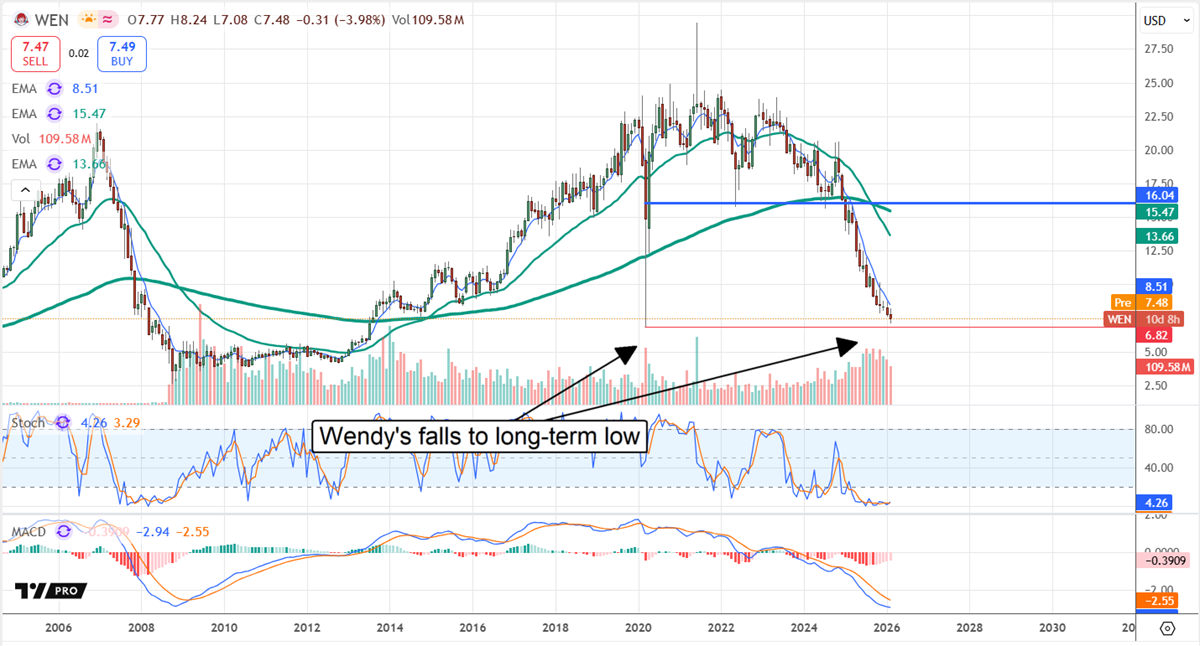
Volume has picked up as the price fell, which can signal bargain-hunting. Still, if upcoming results disappoint or show no improvement, any rebound may stall and the stock could test new lows, potentially triggering a deeper selloff. Management assumes weak comparable sales will persist, plans additional store closures to improve footprint efficiency, and has guided revenue and earnings well below consensus. Consumer Tailwinds Could Serve as a Catalyst Early indicators point to consumer tailwinds in 2026. Labor markets remain resilient, supporting broad employment, and tax refunds appear to be larger than last year. Initial data show refunds running about 10% higher than in 2025—positive for consumer spending and consumer discretionary stocks.
| 
