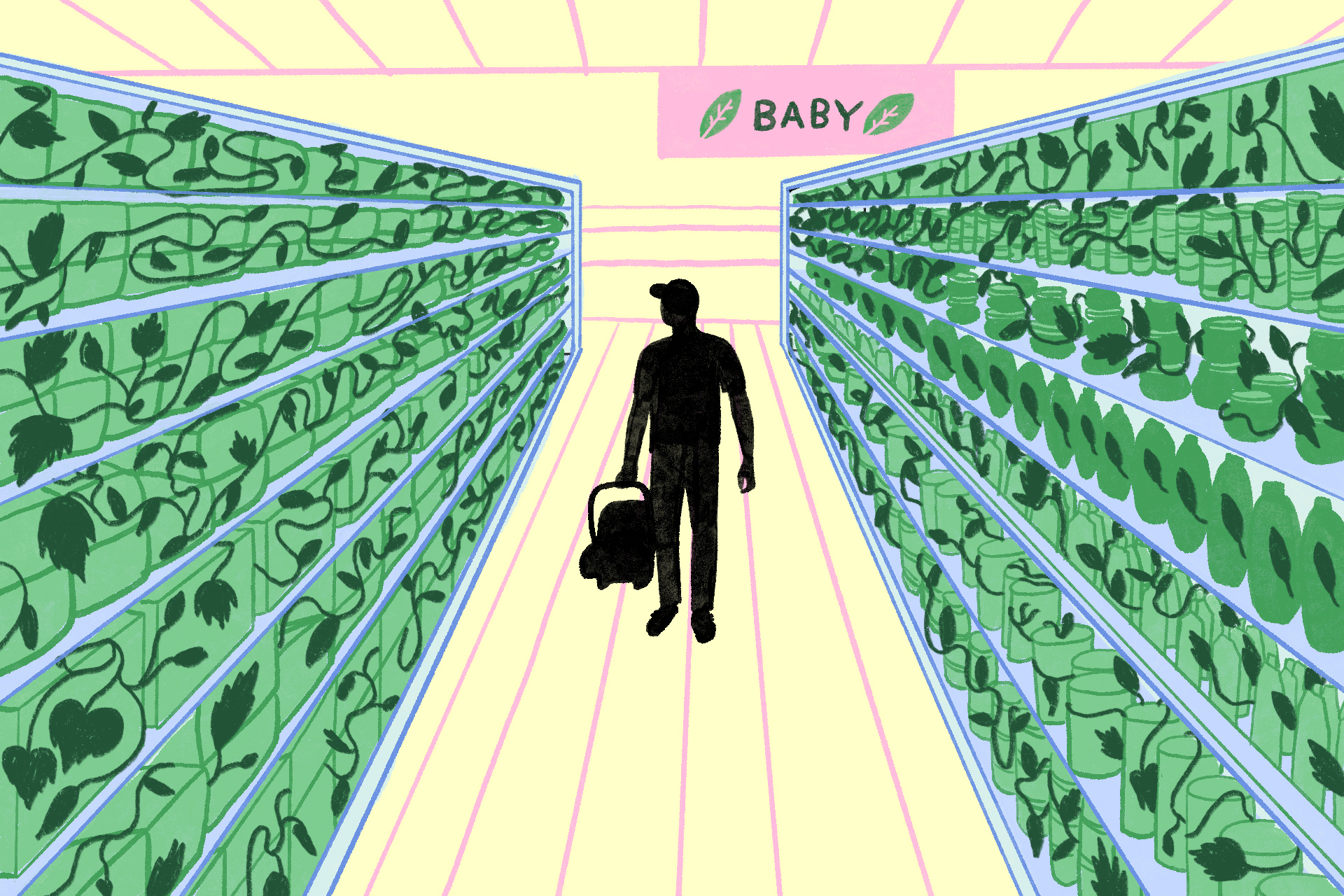
Nothing has made me appreciate the sheer scale and power of targeted advertising like having children. Months before the births of both my kids, it felt like every ad I encountered wanted to sell me baby products. And on seemingly every product were the same two words in bold letters: plant-based.
I'm not kidding. Diapers, baby wipes, teething rings, bath toys — it's all plant-based these days. Once I saw the phrase on baby products, I started to notice it everywhere. There are plant-based foods, of course (like Impossible burgers and Beyond sausage). There's plant-based protein, which is kind of like the plant-based meat only less meaty and now showing up in weird places like breakfast cereal. And once you leave the grocery store, you can find plant-based cosmetics, cleaning products, toothbrushes, sneakers, phone cases, and yoga mats. Don't forget the plant-based packaging to wrap it all up.
It wasn't immediately clear to me what plants did to deserve the spotlight here. I knew that plant-based foods tend to be better for people and for the environment. But was the same true for plant-based plastics, fabrics, and chemicals?
Still, as a dad trying to keep my kids from harm, I hoped for the best. I bought the plant-based diapers, wipes, and toys. On their labels, alongside the term "plant-based" were words like "eco" and "food-grade," which signaled two big things to me as a consumer: safe and sustainable. The vast majority of plastics, for instance, are made from fossil fuels, which are damaging to everyone, and microplastics, the tiny synthetic particles left over as plastic breaks down, are showing up in our water supply and our bodies.
On the other hand, I've seen how brands prey on consumers' anxieties and use greenwashing to make them seem healthier and more sustainable. Is the boom in plant-based products more of the same? I decided to find out.
Don't you dare call it vegan
You can trace the term plant-based back to the early 1980s, when a nutritional biochemist named Thomas Colin Campbell was presenting a paper to the National Institutes of Health research grant committee. It was about the role of nutrition in cancer and the benefits of consuming more vegetables, fruit, and grains, rather than meat, but Campbell thought calling the diet vegetarian would be polarizing to the committee. "My solution was to choose 'plant-based' for lack of a better word," Campbell later wrote. He later expanded the description of the diet to "whole food, plant-based."
The term slowly entered the mainstream in the decades that followed, but Campbell has said it really took off after the success of his 2005 book The China Study. The book is based on a study of the lifestyles of 6,500 Chinese people and linked plant-based diets to lower rates of cancer. It was only a couple years later that Michael Pollan coined his now famous mantra, "Eat food, not too much, mostly plants," in a New York Times Magazine story that he later adapted into the bestseller The Omnivore's Dilemma. This is also broadly when we saw the rise of flexitarianism, the diet that's mostly plants but allows for a little meat or fish.
Plant-based products invaded the grocery store in the 2010s. While labeling something as "vegetarian" or "vegan" might turn some consumers away, the plant-based moniker offered the perfect mix of natural and approachable. After all, who doesn't like plants? Following a significant rise in the number of new food and drink products labeled as plant-based between 2012 and 2018, the number of plant-based packaged goods increased by 302 percent from 2018 to 2022.
The jump from food to all kinds of consumer products happened for several converging reasons around this time.There was the federal government's push for more biobased products through the expanded Farm Bill of 2018, as well as the bioplastic industry's newfound ability to scale up its production. More brands bet on plant-based branding (LEGO released its first plant-based pieces, which were made of sugarcane-based polyethylene, that same year). In 2020, Pampers brought the trend to the mainstream baby market with its Pure diapers, which had plant-based liners.
All of these plant-based products are supposedly engineered to be better in some way. Plant-based cosmetics that are supposed to be better for your skin (although not as good as human-based cosmetics apparently). Plant-based cleaners are supposed to be better for the air quality in your home. Plant-based packaging is supposed to be better for the planet.
The problem is that "plant-based" doesn't have an agreed-upon definition (nor does "better"), and the label isn't regulated in any way. When you see something bearing the "certified organic" or "Fair Trade Certified" seal, you know that it's met a strict set of requirements established by the United States Department of Agriculture (USDA) and Fair Trade USA, respectively. But there's nothing stopping a company from slapping "plant-based" on its packaging, just like there are no regulations limiting the use of the terms "natural" or "green." In 2025, the Federal Drug Administration (FDA) released draft guidance on "plant-based" labeling, but those recommendations are nonbinding.
"I wonder if 'plant-based' is a new 'natural,' because saying something is natural has obviously been played out," Josée Johnston, a sociology professor at the University of Toronto, told Vox. "Nobody takes that seriously anymore."
Plant-based items aren't necessarily appealing to consumers just because we think they're good. They also represent the absence of bad. The label makes you believe that because an item isn't made of conventional plastic, it must be free of the microplastics that might invade your bloodstream and settle into your brain. Surely it won't take centuries to decompose in a landfill.
But just as products billed as "natural" aren't necessarily free of artificial ingredients, products marketed as plant-based are full of things that aren't plants — some of which are quite dangerous. They can include things like PFAS, which are known as forever chemicals because they break down slowly and accumulate in the body, which are linked to serious health problems, like cancer and weakened immune systems among children. Chemicals in plant-based products can also emit volatile organic compounds, or VOCs, which are a form of air pollution that can cause respiratory problems in the short term and, in the long term, also cancer.
Plastic that's plant-based rather than petroleum-based sounds like it would be biodegradable, too. But the most popular bioplastic, known as polylactic acid, or PLA, actually requires specific industrial composting conditions to break down efficiently. In other words, you can't just dump bioplastics into your backyard compost bin and expect them to fertilize your garden. If you put a PLA-based plastic bottle in your garden, it actually could take centuries to decompose.
Shifting to these plant-based materials can have positive effects. In general, using bioproducts over fossil fuel-based products can help lower emissions and reduce landfill waste, when managed properly. But they also come with climate consequences of their own. For example, growing plants requires less land than livestock, but it still takes up a lot of land. Meanwhile, if bioplastics aren't composted in a particular way, they act like petroleum-based plastic in landfills and the environment. They don't break down, but they do produce methane, a powerful greenhouse gas.
None of this necessarily means you should avoid plant-based products. It just takes some extra work to know what's in them — and what to do with them when you're done.
Read the rest of the story at Vox
—Adam Clark Estes, senior technology correspondent