
Nobody noticed yet… but they will.
We just reached the end of an economic age.
Something that usually takes decades, even centuries, to play out just happened in what seems like a blink of an eye.
Unless you understand the magnitude of what just happened, you could risk losing everything you’ve worked so hard to achieve because this collapse is only just getting started.
You see, for our entire life, the story arc has been clean: it was the relentless rise, in both wealth and status, of a broad social class of professionals but that rainbow is now at an end.
Because for the first time ever, capital can now compound without additional labor.
The centuries-old relationship where job creation and GDP rose together has snapped and the economy can now scale without bringing workers along for the ride.
And this “snap” is about to change everything.
This is one of those moments in which I believe vast fortunes will be made and lost. I’m talking about a generational transfer of wealth… the type that can either enrich you or potentially impoverish you, based on the decisions you make.
Because history shows us that while these shifts always lead to catastrophic losses for those who refuse to prepare… they also unleash unprecedented wealth building potential for those who understand, and harness, the forces at work.
And this isn’t a prediction. It’s happening right now.
It’s why, although we’re seeing massive headline economic growth, the average American is being left behind.
AI Engels’ Pause
They don’t teach you this in school, but they should.
During the Industrial Revolution, Friedrich Engels noticed that although the revolution was making Britain incredibly rich when measured via GDP… the vast majority of British people were living in hell.
Between 1790 and 1840 Britain’s GDP exploded. The steam engine created massive efficiency gains, corporate profits doubled, and the stock market soared.
But for the average worker, real wages remained flat or fell… the average life expectancy in some industrial cities collapsed to just 35 years…
It was as though someone had pressed a giant “Pause” button on quality of life for the working class.
Of course, the wealth did eventually trickle down but it was half a century later and during that half century, the societal devastation was dire. It took two full generations for the labor market to adjust.
And the weavers who lost their jobs to power looms, they didn't become "machine repairmen."
They starved. They rioted. They were shot by the military or shipped to penal colonies. And it was Engels’ Pause that gave birth to Marxism.
And we’re seeing this again with AI.
The only difference is, this time it won’t take decades to play out. It took the radio 38 years to reach 50 million users. Television took 13. The internet took 4. But ChatGPT hit 100 million users in two months.
We are effectively speed-running the 19th century. We’re compressing 50 years of displacement into less than a decade… and this time the disruption isn’t coming for the illiterate farmhand…
It’s coming for the accountant. It’s coming for the lawyer. It’s coming for you and me.
Right now, knowledge work makes up roughly 50% of America’s GDP and much of that is at risk of automation in the next handful of years.
We’re talking about 5 million white-collar jobs — the bedrock of the American tax base – facing extinction over the next few years. Just take a look at the most recent cuts:
- U.S. Government: 307,000 employees
- UPS: 78,000 employees
- Amazon: 30,000 employees
- Intel: 25,000 employees
- Nissan: 20,000 employees
- Nestle: 16,000 employees
- Microsoft: 15,000 employees
- Bosch: 13,000 employees
- Dell: 12,000 employees
- Verizon: 13,000 employees
- Accenture: 11,000 employees
- Ford: 11,000 employees
- Novo Nordisk: 9,000 employees
- Microsoft: 7,000 employees
- PwC: 5,600 employees
- Salesforce: 4,000 employees
- IBM: 2,700 employees
- American Airlines: 2,700 employees
- Paramount: 2,000 employees
- Target: 1,800 employees
- General Motors: 1,500 employees
- Applied Materials: 1,444 employees
- Kroger: 1,000 employees
- Meta: 1,000 employees
It’s why AI is not just a productivity or efficiency tool, like everyone thinks, it’s a Labor Replacement Engine. And it’s why there’s such a gaping disconnect between the “real” economy and the stock market.
It’s why all the President’s claims of a “booming” economy don’t feel real for the tens of millions of people who don’t own assets.
It’s why, even though markets are hitting all-time highs, households are falling further and further behind. And this wealth divide is only going to be amplified as AI is integrated into every aspect of the economy.
IMF Managing Director Kristalina Georgieva just warned that artificial intelligence will hit the labor market like a “tsunami.”
The changes this will bring to the economy, stock market, and financial system are unprecedented. Which is why it’s critical that you watch my interview with Luke Lango.
We explain how all of these forces are converging to trigger an economic “reset” the likes of which we haven’t seen in 250 years – one that could trigger the greatest transfer of wealth in American history.
Both for the good and the bad.
Young or old. Rich or poor. Left wing or right… there is no escaping what’s coming. And yet, despite this inevitability, I promise you, you’ve never heard a whisper about this story before now.
Almost nobody… not the legacy financial media, political commentators, even the top analysts on Wall Street have connected these dots. But now, we’re sharing the full story with you.
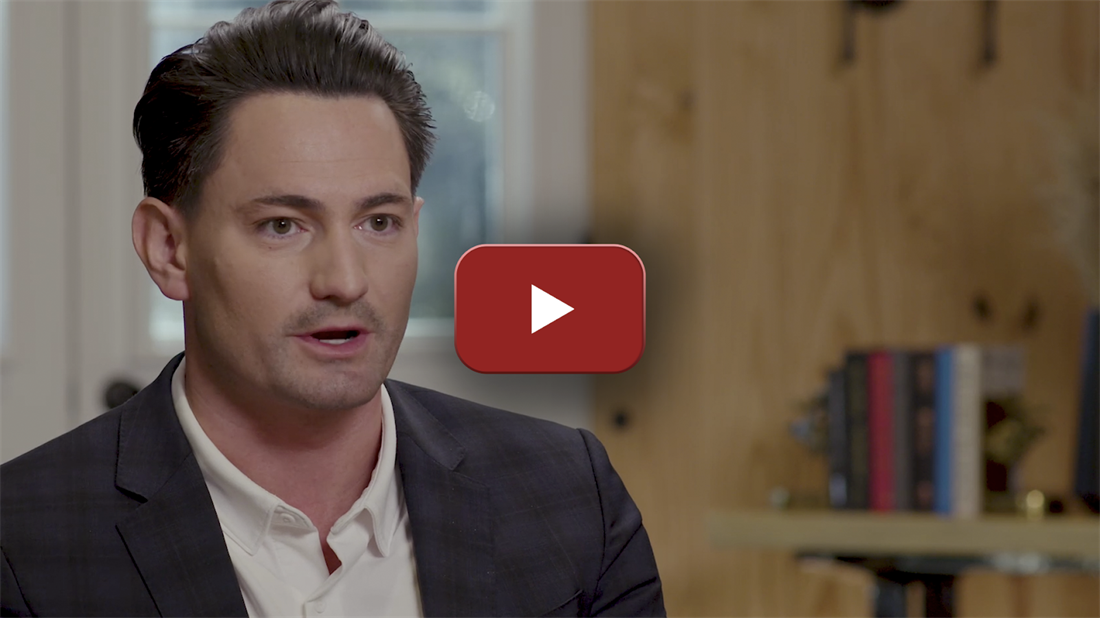
The stocks to buy… the stocks to sell… and the three money moves our research indicates you should make to ensure you and your loved ones end up on the winning side of this new economic reality.
Because as you’ll discover today…
If you understand the new rules of this system…
You won't just survive the chaos, you’ll own the assets that could potentially make you a fortune as the American economy is reshaped from the ground up.
Good investing,
Porter Stansberry
Magic Mushrooms, Hard Cash: Compass Pathways' Trial Win, Fast Raise
Reported by Jeffrey Neal Johnson. Date Posted: 2/20/2026.

Key Points
- Compass Pathways has successfully met its primary goals in its late-stage clinical trials, demonstrating that its lead therapy delivers significant patient benefits.
- The latest results confirm that this novel treatment approach provides rapid relief for patients and maintains significant durability of effect over time.
- Achieving these milestones validates the biological foundation of the entire sector and positions the company as a prime target for major pharmaceutical deals.
- Special Report: [Sponsorship-Ad-6-Format3]
Treatment-Resistant Depression (TRD) is one of the most persistent and costly challenges in modern healthcare. For millions of patients who have cycled through multiple antidepressants without relief, the treatment landscape has long been a graveyard of failed promises. This week, however, the sector witnessed a historic shift. Compass Pathways (NASDAQ: CMPS), a biotechnology company pioneering psilocybin-based therapy, delivered clear evidence that its synthetic formulation, COMP360, can significantly reduce depressive symptoms in patients for whom other drugs have failed.
But scientific breakthroughs in biotech often come with a heavy price tag. Just hours after announcing a clinical victory that sent its stock higher, Compass Pathways moved quickly to address the financial reality of drug development by launching a proposed public offering. For investors, the last 48 hours were a masterclass in the binary nature of biotech: the exhilaration of a successful trial followed immediately by the sobering mechanics of funding a commercial launch.
The Binary Event: A Classic Sell-the-News Setup
Have $500? Invest in Elon's AI Masterplan (Ad)
What if you could claim a stake in what's set to be the biggest IPO ever… starting with just $500?
Everyone is talking about Elon Musk's SpaceX IPO.
On Feb. 17, 2026, Compass Pathways released topline data from its pivotal Phase 3 trial, COMP006. The results were the green light the market had been waiting for. Compass Pathways' stock price rallied roughly 33% during the session, closing at $7.63, as volume spiked to more than 34 million shares—well above its average daily volume. That rally reflected the removal of the single biggest risk in biotech — clinical failure. By proving the drug works in a large, rigorous study, Compass validated its multi-year effort to turn a psychedelic compound into a regulated medicine.
The celebration was short-lived. After the data release, the company announced a proposed $150 million public offering priced at $4.275 per share, a discount of about 44% from the previous day's close. While necessary to extend the company's runway, offerings at such a discount are immediately dilutive, shrinking existing shareholders' stakes. The stock faced downward pressure in pre-market trading on Feb. 18, illustrating the tug-of-war between long-term value creation and short-term price shock. It subsequently recovered and continued upward.
Statistical Significance: Breaking Down the 3.8-Point Gap
To understand the market's initial enthusiasm, investors should consider the COMP006 trial design. Psychedelic trials have historically struggled with functional unblinding: a high-dose psilocybin experience is often obvious to participants, making it easy to guess assignment and potentially bias outcomes. Compass addressed this with an active-control design. Instead of an inert placebo, the control group received a 1 mg dose of COMP360—too low to be therapeutic but sufficient to provide a more rigorous baseline.
Key Clinical Findings:
- Primary endpoint hit: The 25 mg dose of COMP360 produced a -3.8 point mean difference in MADRS scores (a standard measure of depression severity) compared with the 1 mg control group (p < 0.001). This level of statistical significance supports the drug's efficacy.
- Response rate: 39% of patients in the 25 mg group achieved a clinically meaningful response at Week 6.
- Rapid onset: Unlike traditional antidepressants such as SSRIs, which can take four to six weeks to work, COMP360 showed statistically significant symptom reduction as early as the day after administration.
Importantly, the safety profile was favorable, with no major imbalances in suicidal ideation between groups. That safety signal is particularly important for FDA reviewers, especially after recent rejections of other psychedelic therapies due to safety-monitoring concerns.
The Six-Month Advantage
The value proposition of COMP360 extends beyond symptom reduction to durability. Most current TRD treatments require daily pills or frequent clinic visits—Spravato (esketamine), for example, involves repeated nasal-spray sessions that burden both patients and providers.
Data from the companion COMP005 trial show that participants who responded to a single 25 mg dose maintained improvement through Week 26. That suggests a potential shift toward episodic care: one supervised treatment session once or twice a year instead of chronic daily medication. For insurers and payers, this durability model could reduce the long-term costs of managing chronic depression.
Ripple Effects: The Tide Lifts All Boats
Compass does not operate in a vacuum. Its Phase 3 success de-risks the mechanism of action for the broader sector. If synthetic psilocybin works for Compass, it strengthens the biological thesis for competitors like Cybin (NASDAQ: HELP), which is developing a deuterated psilocybin analog (CYB003) aimed at faster onset and shorter duration.
Similarly, Definium Therapeutics (formerly MindMed) has seen renewed interest. Their lead candidate targets anxiety rather than depression, but the regulatory path blazed by Compass—particularly regarding FDA acceptance of psychedelic trial designs—makes it easier for others following behind. The Compass data suggest regulators are becoming more receptive, moving the sector from speculative science toward a commercial race.
Next Steps: NDA, DEA, and CPT
With positive data and a cash runway extended into 2027, Compass is shifting from a research organization toward a pre-commercial pharmaceutical company. The next step is submitting a rolling New Drug Application (NDA) to the FDA, which management expects to complete in Q4 2026.
Two unique hurdles remain:
- The DEA factor: FDA approval is not the final regulatory step. Because psilocybin is currently a Schedule I substance, the Drug Enforcement Administration (DEA) must reschedule the drug after FDA approval before it can be prescribed. The DEA typically has 90 days after FDA approval to issue an interim final rule, adding an additional administrative layer.
- Infrastructure: Compass is already preparing for commercialization by leveraging new CPT III codes (0820T, 0821T). These codes enable healthcare providers to bill insurance for the monitoring time required during the roughly 6-hour psychedelic treatment session, addressing a major logistical barrier to adoption.
The Long Game for Mental Health
Compass Pathways has cleared the highest hurdle in biotech: demonstrating Phase 3 efficacy with a novel drug class. The $150 million capital raise, while painful for short-term shareholders because of the deep discount, is a strategic step that extends the company's runway into 2027. That capital bridge is essential to carry Compass across the regulatory finish line.
For investors, the question has shifted from "Does the drug work?" to "Can the company execute?" With a validated asset, a clearer regulatory path, and additional capital, Compass is well positioned to lead the psychedelic renaissance—provided it can navigate the complex bureaucracy between a successful trial and a patient's prescription.
MCD and TXRH: 2 Low-Risk Restaurant Stocks With Upside
Reported by Dan Schmidt. Date Posted: 2/17/2026.
Key Points
- The restaurant industry has become a key indicator for the K-shaped economy.
- Winners and losers are beginning to emerge based on the perceived value they offer to both higher-end and lower-end customers.
- McDonald's and Texas Roadhouse continue to grow comps despite the tough environment thanks to their value-oriented focus that keeps diners coming back.
- Special Report: [Sponsorship-Ad-6-Format3]
The restaurant sector has often been at the center of the debate about the K-shaped economy. While consumer sentiment continues to diverge from actual spending behavior (especially in the retail sector), the food-service industry reveals these divergent trends quickly. The upper end of the "K" still indulges, while more cost-conscious consumers at the bottom are hunting for value to stretch their dollars.
In this environment, two restaurant chains are standing out for different reasons. The numbers speak for themselves: McDonald’s Corp. (NYSE: MCD) and Texas Roadhouse Inc. (NASDAQ: TXRH) continue to grow comparable sales and take share from competitors. Below, we explain why each has thrived amid a challenging dining landscape and why their stocks could outperform the restaurant industry this year.
McDonald's Continues to Dominate the Fast-Food Market
Have $500? Invest in Elon's AI Masterplan (Ad)
What if you could claim a stake in what's set to be the biggest IPO ever… starting with just $500?
Everyone is talking about Elon Musk's SpaceX IPO.
Recent earnings from McDonald's and Wendy’s Co. (NASDAQ: WEN) highlighted how fast-food operators are diverging.
McDonald’s reported Q4 2025 results last week, beating both earnings-per-share (EPS) and revenue estimates, with 9.7% year-over-year (YOY) sales growth.
Global same-store sales exceeded expectations with 5.7% YOY growth, including 6.8% growth in the U.S. By contrast, Wendy’s reported Q4 2025 revenue that declined 5.5% YOY and a U.S. same-store sales drop of 11.3%. How has McDonald’s been able to grow U.S. sales at nearly a 7% clip while other quick-service restaurants struggle?
The answer is value. McDonald’s projects operating margins above 40% in 2026, which gives it the flexibility to pursue a sustained Value Leadership strategy.
Unlike the short-term promotions used by Wendy’s and Burger King, McDonald’s Value Menu 2.0 is a permanent fixture. Extra Value Meals were reintroduced last September, and earlier this year the company launched the McValue platform, featuring $5 Meal Deals and Buy One, Get One for $1 offers. The Grinch Meal holiday promotion produced the biggest single-day sales figure in the company’s history.
McDonald’s app—boasting roughly 200 million active users—drives repeat business, while marketing efforts around chicken items like the McCrispy help mitigate the impact of beef-price inflation. The company also plans to open about 2,600 additional stores this year, even as competitors such as Wendy’s close underperforming locations.
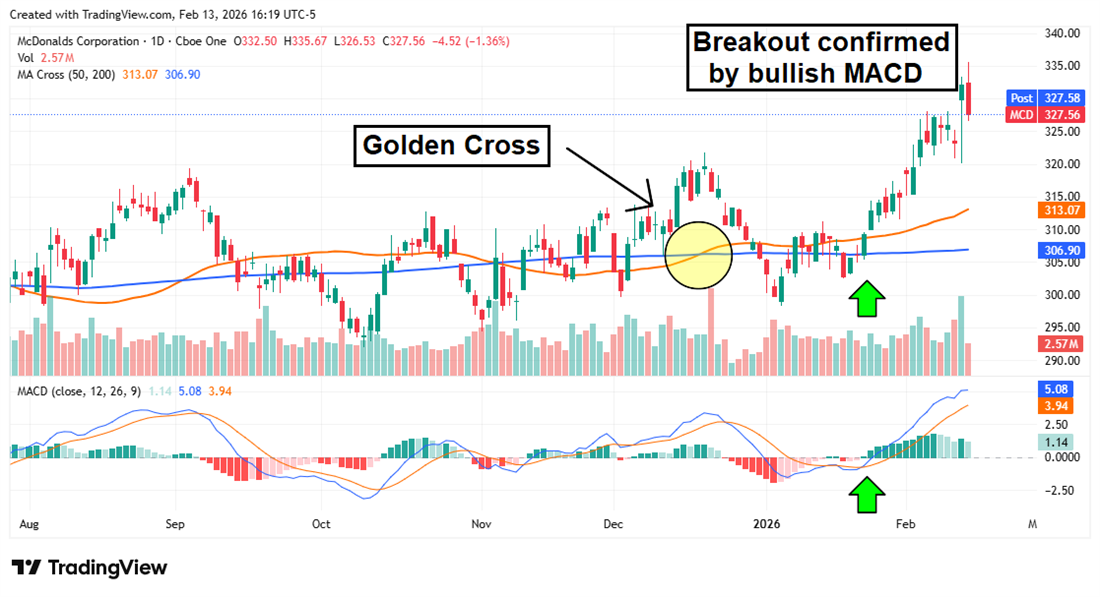
The breakout in MCD shares began well before last week’s earnings release. A bullish crossover in the Moving Average Convergence Divergence (MACD) indicator coincided with the stock moving above both the 50-day and 200-day simple moving averages (SMAs), signaling strong upward momentum. If lower-income consumers continue to trade down for value, McDonald’s is well positioned to keep growing sales, supported by both fundamental and technical catalysts in 2026.
Texas Roadhouse Grows Share Despite Commodity Headwinds
Soaring beef prices have hovered over Texas Roadhouse for much of the last year. Beef costs have risen faster than inflation since the COVID-19 pandemic, and the surge over the past two years has rattled restaurant owners and investors.
Part of the increase stems from cattle shortages, which have pushed live cow and steer prices to record levels—a trend that could persist into 2027.
Despite these headwinds, Texas Roadhouse continues to deliver same-store sales growth that outpaces many casual-dining peers.
The chain’s barbell business strategy combines value offerings for budget-conscious diners with premium steaks and upcharge options for guests willing to splurge.
In its Q3 2025 report last November, Texas Roadhouse posted comps of 6.1% and nearly 13% YOY revenue growth despite a 224-basis-point increase in food and beverage costs. The company raised menu prices by only 1.7%, a deliberate margin sacrifice to preserve perceived value for customers.
Customer experience is central to Texas Roadhouse’s edge. Traffic durability—consistent repeat visits—is key for fast-casual and casual-dining concepts. Large portions, attentive servers, streamlined digital kitchens, and many add-ons and upgrades make the chain feel like a special night out without an excessive price tag. Guests often say the restaurant is "worth it" for date nights and family dinners because the experience and value meet expectations.
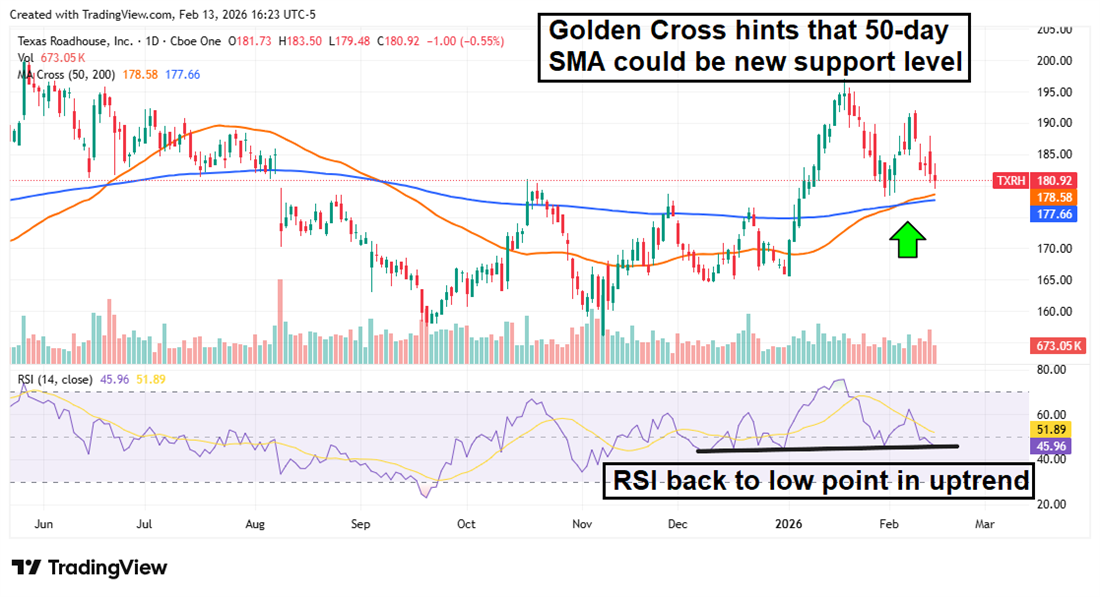
TXRH’s performance so far this year suggests 2025’s doldrums may be fading. The stock rose 11 days in a row to start 2026, breaking through the 200-day SMA that had blocked prior breakout attempts. That streak was followed by a consolidation in which the Relative Strength Index (RSI) moved back to more neutral levels while the 50-day and 200-day SMAs converged.
With a Golden Cross looking increasingly likely, the 50-day SMA could act as support for the next leg up. That zone has already been tested and held, and the share price is approaching the 50-day moving average—an attractive potential entry point for new investors, particularly with a catalyst this week when the company reports its Q4 2025 results after the market close on Feb. 19.
This message is a sponsored message provided by Porter & Company, a third-party advertiser of DividendStocks.com and MarketBeat.
If you have questions or concerns about your newsletter, please don't hesitate to email MarketBeat's South Dakota based support team at contact@marketbeat.com.
If you no longer wish to receive email from DividendStocks.com, you can unsubscribe.
© 2006-2026 MarketBeat Media, LLC.
345 North Reid Place, Sixth Floor, Sioux Falls, S.D. 57103. USA..