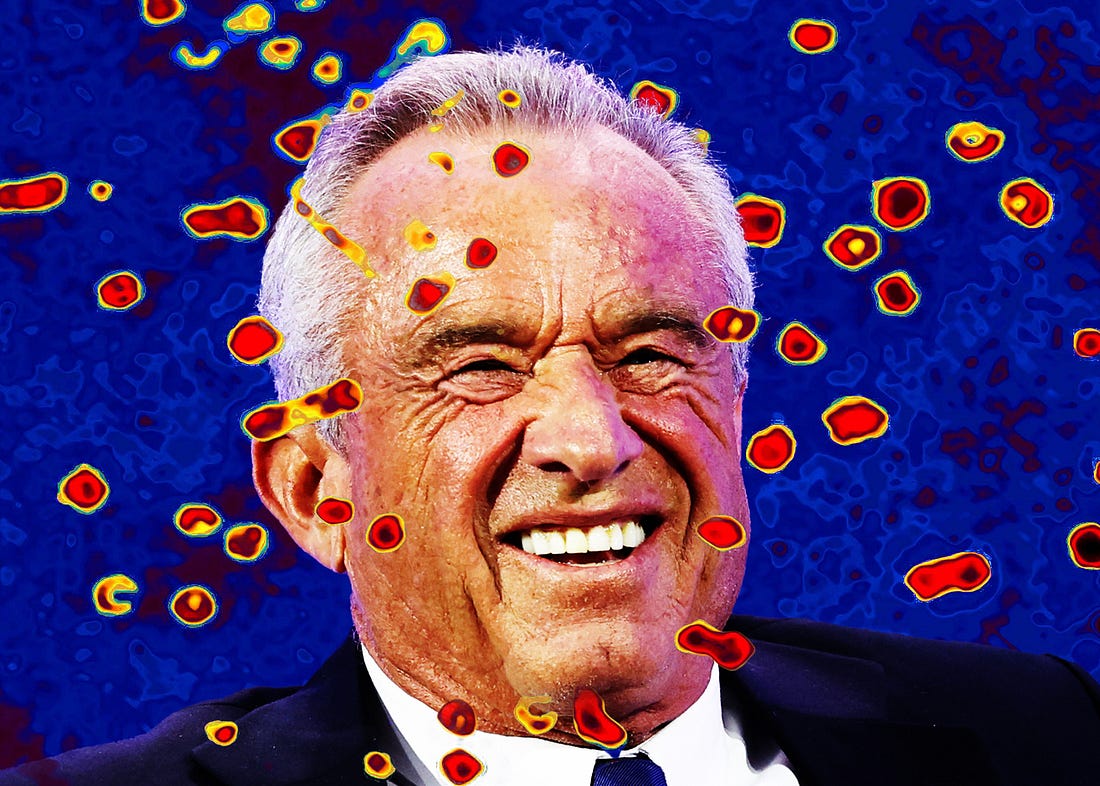
This Is What It Looks Like When RFK Jr. WinsHis handpicked ‘experts’ just voted to roll back hepatitis B vaccine guidelines—and reverse a historic public health victory.
AN ADVISORY COMMITTEE that Robert F. Kennedy Jr. packed with anti-vaxxers voted on Friday to roll back one of the modern era’s most successful immunization initiatives: the universal hepatitis B vaccination effort that has, by most accounts, practically wiped out the scourge’s incidence in children. Among the scientists expressing alarm is one who had a close-up view of the committee’s deliberations, because he was part of them. Cody Meissner, a pediatrician from Dartmouth Medical School, is one of eleven people whom Kennedy put on the CDC’s Advisory Committee on Immunization Practices after sacking all of the sitting members in June.¹ The mass dismissal was unprecedented, and Kennedy’s agenda was not difficult to perceive. The secretary of health and human services wanted to fill the committee with people who shared his hostility to vaccines. Meissner probably ended up on the list because, during the COVID-19 pandemic, he had been critical of mask and shot mandates. But Meissner has a long career of working on vaccines and has expressed strong support of them. He also has little patience for scientific nonsense or speculation from non-scientists, something he saw—and called out—frequently while taking part in this week’s proceedings. He described one presentation as “a terrible, terrible distortion of all the facts,” and described another resolution up for debate as “kind of making things up . . . like Never-Never Land.” At one point, one of the other committee members, Massachusetts Institute of Technology operations management professor Retsef Levi, suggested that one or two hepatitis B vaccine doses—rather than the three the CDC currently recommends—might be sufficient to provide some children with protection. “For a man with your accomplishments and full professorship at MIT, I’m surprised to hear you say that one dose may be as effective as three,” said Meissner, who unlike Levi has actual training in medicine. “There are absolutely no data to support that.” It was a conspicuously pointed remark for a committee where conversation has historically unfolded with the reserved, deferential tone of a friendly academic seminar. But it was consistent with the contentious atmosphere of the previous meeting, back in September—the first one with Kennedy’s new members, in which Meissner also expressed frequent dismay at the proceedings. The main difference between then and this past week was the result, because last time the committee didn’t end up endorsing major policy shifts. This time, it did. Current CDC policy is to recommend hepatitis B vaccination for all children, including a “birth dose” administered within the first twenty-four hours because newborns can pick up the disease from their mothers during delivery. The advisory committee on Friday proposed that the CDC alter those guidelines, recommending a birth dose only for mothers who themselves test positive for hepatitis B or whose status is unknown. For mothers who test negative, the advisory committee proposes, the CDC should recommend parents discuss with their doctors when to give their children the shots—or whether to give them any shots at all. News of the committee’s recommendation prompted an outcry from health experts who believe the change would mean, as Meissner put it in a rueful dissent, “more children and adolescents and adults infected with hepatitis B.” The committee’s decision is not binding. The proposal now goes to the CDC director—and immediately following the vote, Senate Health Committee Chairman Bill Cassidy, the Louisiana Republican who is also a doctor specializing in liver disease, urged the director to reject the committee’s advice. But the CDC director reports to Kennedy, who has already shown a willingness to defy, and even embarrass, Cassidy in pursuit of his anti-vaccination agenda. And Kennedy appears to have the full backing of his boss. On Friday evening, President Donald Trump praised the hepatitis B vote while calling for a full review of the U.S. vaccine schedule, which he described in a Truth Social post as “ridiculous” because it has so many shots. It means the new hepatitis B recommendations are likely to become policy, in what could be the first of many such changes to cost lives. A REFRESHER ON HEPATITIS B: It’s a viral disease that affects the liver. It infects through contact with bodily fluids, but because of its resiliency outside the body it spreads much more easily than diseases like HIV. (The hepatitis B virus can survive on surfaces at room temperature for many days.) Adults are frequently able to “clear” the disease on their own. Young children are not. Something like 90 percent who get infected as infants will go on to develop the chronic version, which can scar the liver for years without causing any easily detectable symptoms—sometimes leading to cirrhosis, cancer, and a painful, far-too-early death. The 1981 development of an effective vaccine was a true breakthrough; the Hepatitis B Foundation calls it the “first anti-cancer vaccine.” In the years that followed, government officials setting guidelines targeted only high-risk groups—which, in the case of babies, meant the children of mothers who were known to have the disease or were themselves at high risk for it. This included intravenous drug users, since that was such an easy and common method of transmission—and it’s why, even today, many people assume drug use and sexual activity are the only ways to get hepatitis B. But officials quickly realized they were still missing lots of cases. Sometimes mothers wouldn’t get screening—or any prenatal care—because they didn’t have a way to pay for their medical care, or an established relationship with providers.² Sometimes mothers would get tested but their records wouldn’t be available (or would contain errors) at delivery, because the United States lacks a reliable, unified tracking system. And that’s in addition to the babies who were born to mothers without the disease but acquired it during infancy from an adult contact like a relative or caregiver. It’s an especially big problem because half of the adults with hepatitis B are not symptomatic, and don’t realize they have it.³ Among those who noticed this were a doctor and a team of officials in Alaska, who pioneered a program of giving the shot to all newborns. That initiative’s ability to wipe out hepatitis B among children, and the success of a similar effort in Taiwan, helped convince U.S. officials to apply the program nationally. Lo and behold, pediatric infections fell by 99 percent. But this success hasn’t prevented the vaccine from attracting the ire of the anti-vaccination movement. In 2019, Kennedy’s anti-vax group, Children’s Health Defense, published a document called “The Flawed Logic of Hepatitis B Vaccine Mandates” questioning the shot’s benefits and alleging multiple harms. More recently, during an appearance on Tucker Carlson’s show this summer, Kennedy claimed—without evidence—that the CDC was covering up evidence that the vaccine led to autism. In reality, the vaccine has gone through extensive testing. The worst of the confirmed side effects are mild, fleeting soreness or fever, plus a one-in-a-million chance of anaphylaxis (an allergic reaction) that can happen with any medication. Reports of more serious consequences have been rare, and research has found they are not linked to the vaccine. “The hepatitis B vaccine in particular is extremely safe,” Jake Scott, an infectious-disease specialist at Stanford, told me. “We’ve got four decades of safety data, and there’s nothing there—there’s no there there.” That may help explain why, during this week’s meeting, Levi and other advocates for dialing back the vaccine guidelines didn’t point to evidence of specific harms. Instead, they suggested that the mere possibility of some unknown, yet-to-be-detected threat warranted limiting vaccines to higher-risk populations—as if an experiment in that very approach hadn’t already been run in the United States several decades ago, and been found to miss lots of cases. “They are imposing value judgments in direct contradiction of the data, and ignoring the history of [hepatitis B] vaccination in this country,” Tara Palmore, a prominent infectious disease expert who just stepped away from twenty years at the National Institutes of Health, told me. To defend their views, Levi and other critics of the current guidelines invoked an argument that’s also been part of the broader political debate over the shot: the fact that the United States is an outlier among “peer countries,” most of whom do not currently recommend a hepatitis B vaccine dose at birth. A whole session of Friday’s meeting was devoted to comparing the U.S. vaccine schedule with Denmark’s.⁴ But countries like Denmark aren’t really U.S. “peers” in this context because their medical systems are so vastly different. Denmark, like pretty much every other wealthy industrialized nation, has a well-tended universal health care system that consistently provides prenatal care. It also maintains unified electronic medical records. “I wish we had Denmark’s health care system here,” Michael Osterholm, the renowned University of Minnesota vaccine expert, told me. “In those countries, people don’t fall through the cracks. Their safety nets don’t have holes in the nets.” EXACTLY HOW (OR WHEN) THE NEW HEPATITIS B vaccine guidelines would change actual behavior is difficult to say. It’s not as if anybody forces parents to get their kids vaccinated today, the proof being that some parents decline the hepatitis B shot for their kids already. These decisions happen after parents speak with their medical providers, which is what—strictly speaking—the new guidelines would endorse. But there’s a reason both supporters and critics of vaccines fight about these guidelines: They really do affect decision-making. They signal to parents what top scientists believe is the smartest course of action. And they can influence physicians, who look to bodies like the CDC to undertake the kind of ongoing, exhaustive literature and research reviews they don’t personally have time to do on their own. “Moving from a clear recommendation based on data and decades of experience with the hepatitis B birth dose to a vaguer recommendation based on no new data at all makes things more difficult for both doctors and families,” Adam Ratner, a New York–based infectious disease specialist and the author of Booster Shots, told me. “The discussions today, along with the inflammatory statements about vaccines from RFK Jr. and the president, make it more likely that families will opt out of the birth dose, putting their children at unnecessary risk.” That’s not to say the scientists on government advisory committees are always right. They can misjudge or misread the evidence, or operate with incomplete information, or be subject to groupthink. That fallibility is a good reason to encourage a true diversity of viewpoints, which probably should include bringing in experts who come from adjacent but different fields—or have records of questioning the wisdom of their fellow scientists. But Kennedy has gone well beyond recruiting some contrarians with novel perspectives. He has populated the advisory committee almost exclusively with people with records of attacking vaccines in one way or another. While a handful like Meissner have maintained a belief in vaccines, the majority have repeatedly demonstrated a skeptical, sometimes hostile view that has no basis in evidence—and that exists only on the outer fringes of the scientific establishment. “It’s like putting the Flat Earth Society in charge of NASA,” said Osterholm. And it’s not just the complexion of the committee that has changed. It’s the people whose input they consider. In a sharp break with tradition, last week’s meeting did not include presentations by CDC subject-matter experts. But it did include a lengthy presentation by Aaron Siri, a lawyer and longtime Kennedy ally whose record includes petitioning the government to stop distributing the polio vaccine. Over the course of the two-day meeting, vaccine skeptics and critics—both on and off the committee—made at least sixty “false, misleading, or unsupported claims” according to a tally by the Evidence Collective, an independent group of medical and scientific researchers. “It is hard to imagine a decision-making process with less integrity,” Joshua Sharfstein, a vice dean for public health at Johns Hopkins University and former deputy FDA commissioner, told me.⁵ The best-case scenario is that the health system’s collective muscle memory on hepatitis B is strong enough to keep current practices going. At least in the immediate future, most medical providers and hospitals are likely to continue promoting the birth shot because they are accustomed to doing so—and because they understand its underlying logic. The advisory committee on Friday actually took a separate vote to affirm that public programs would continue to pay for the vaccines for anybody who wants them. Private insurers have said they will do the same. But in a highly politicized environment where the president and the nation’s top health care official are constantly talking down vaccines, some people are bound to take their word seriously. And over time the habits that doctors, hospitals, and insurers have developed are bound to wane. It doesn’t require imagination to know what all of this would mean for the babies who get hepatitis B, because it’s happened before. Now, thanks to Kennedy, it could happen again. 1 The eleven members consist of two separate batches Kennedy appointed. Meissner was part of the initial batch. 2 As many as 18 percent of pregnant women do not get hepatitis B screening, according to a recent literature review by the Vaccine Integrity Project. Many others will get testing only early in their pregnancies, which means there will be time to acquire the disease before delivery. 3 One of the people I interviewed for a previous Bulwark article on this subject, New Jersey physician Su Wang, is an example of what this dynamic can look like. She discovered she had hepatitis B after a routine blood test while in medical school. She later pieced together she had almost certainly acquired it during infancy, from one of her grandparents—both health professionals who would have been exposed to the disease themselves. 4 To be clear, a few other high-income countries (like Australia) do recommend birth doses. And several provinces in Canada are now considering moving to one because they’ve had the same spotty success at wiping out hepatitis B that the United States did back in the 1980s. 5 Sharfstein is also the coauthor—with Joanne Kenen and Lymari Morales—of a new, highly relevant book called Information Sick that’s about journalism, misinformation, and health care. You’re a free subscriber to The Bulwark—the largest pro-democracy news and analysis bundle on Substack. For unfettered access to all our newsletters and to access ad-free and member-only shows, become a paying subscriber.We’re going to send you a lot of content—newsletters and alerts for shows so you can read and watch on your schedule. Don’t care for so much email? You can update your personal email preferences as often as you like. To update the list of newsletter or alerts you received from The Bulwark, click here. Having trouble with something related to your account? Check out our constantly-updated FAQ, which likely has an answer for you.
|