| Written by Leo Miller 
After taking a big-time tumble in September, copper mining giant Freeport McMoRan (NYSE: FCX) has regained its footing, and then some. On Sept. 24, shares dropped nearly 17% as the company significantly reduced its guidance in light of a disaster at its Indonesian mine. The stock declined another 6% on Sept. 25, leaving FCX shares just over $35. However, Freeport has roared back with a vengeance since then. Shares closed at just over $47.50 on Dec. 16; an approximately 35% recovery from their September low. Now, Wall Street analysts see even more upside ahead. Below, we’ll detail why Freeport McMoRan has been able to stage such a robust rebound, and why analysts are growing increasingly optimistic. Ultimately, Freeport McMoRan continues to have solid upside potential going forward. All data is as of the Dec. 16 close unless otherwise indicated. FCX Fully Recovers After September Crash A mudslide occurred at Freeport’s Grasberg Block Cave underground mine in Indonesia in early September, tragically killing several workers. Subsequently, Freeport was forced to lower its guidance for 2025 and 2026 significantly. Freeport estimated that the mine could “potentially” return to pre-incident production levels in 2027. However, as MarketBeat pointed out at the time, this decline in production is temporary. There is a reasonable path by which Freeport’s copper production could return to pre-incident levels in the not-too-distant future. Thus, it appears likely that the market was overreacting to near-term disruptions, providing an opportunity for investors with a long-term mindset. The market appears to have coalesced around this view. FCX shares now trade above $45 per share; their level the day before the company lowered its guidance. Wall Street Moves Targets Above $55 in December The consensus price target on Freeport currently sits near $49, suggesting around 3% upside potential in the stock. However, among Wall Street analysts tracked by MarketBeat who updated their price targets in December, the average target comes in at over $56. This figure implies that shares could rise by 18%. This shows how analysts incorporating the most recent information in their forecasts are also among the most optimistic on FCX. On Dec. 4, Reuters conducted an interview with Freeport CEO Kathleen Quirk, which appears to have been a key impetus for analysts raising their price targets. Quirk said that copper production at Grasberg should return to 90% of pre-incident levels in 2026 and back to full production in 2027. These were more optimistic statements than the company’s initial assessment, leading to bullishness among analysts. Quirk also stated that Freeport has the opportunity to grow by 50% (roughly 8% – 9% annually) over the next five years through internal, organic means. She likened this potential growth to adding an entirely new mine to the company’s portfolio. However, this growth will not come with the major capital investment required to actually construct a mine. This internal expansion strategy contrasts with competitors such as BHP Group (NYSE: BHP), who have looked toward expensive merger and acquisition deals to bolster their production. Long-Term Tailwinds Supporting FCX’s Outlook Fiber optics is likely to keep replacing copper as the primary method for transmitting data. However, despite being able to transmit data more efficiently than copper, one thing that fiber optics cannot do is transmit electricity. This is why copper remains essential for electricity transmission and distribution—a growing need in both the artificial intelligence (AI) and electric vehicle (EV) sectors. Furthermore, although the shift toward EVs has slowed, experts expect them to continue rising in prevalence. Analysts believe that EVs make up around 9% of passenger cars sold in the United States today. BloombergNEF projects this number will increase to 27% by 2030. This is key for Freeport, as EVs require three to four times more copper than gas-powered vehicles. Additionally, rising demand for EV charging stations to support EV proliferation could create even more demand for copper. Data centers and a continued shift toward EVs are two key tailwinds supporting long-term copper demand, and thus Freeport McMoran’s outlook. While near-term gains may moderate, long-term investors focused on the copper supercycle still have reasons to be optimistic about FCX stock.  Read This Story Online Read This Story Online |  Elon Musk's Starlink project is generating major speculation ahead of a potential IPO that some analysts believe could reach a historic $100 billion valuation. According to James Altucher, there may be a smart "backdoor" way for everyday investors to position ahead of that event without needing traditional IPO access — and he says it can be done for under $100. He's also sharing a free ticker tied to this trend for anyone who wants to take a closer look. Click here to learn more |
| Written by Ryan Hasson 
One of the more intriguing headlines to surface recently is the growing expectation that SpaceX, Elon Musk’s space and satellite juggernaut, could pursue an IPO as early as 2026. Rumors suggest a potential valuation of $1.5 trillion, which would make it the largest public offering in history. While that prospect is understandably exciting for space-focused names like Rocket Lab (NASDAQ: RKLB) and Planet Lab PBC (NYSE: PL), which saw upward momentum on the news, it could prove just as crucial, if not more so, for an unexpected beneficiary: Alphabet (NASDAQ: GOOGL). The reason is simple. Alphabet is one of SpaceX’s earliest and most significant outside investors. If SpaceX ultimately goes public anywhere near the valuations currently being discussed, Alphabet stands to unlock one of the most extraordinary unrealized gains ever embedded inside a public company’s balance sheet. Alphabet’s Early Bet on SpaceX Alphabet’s involvement with SpaceX dates back to 2015, when Google invested roughly $900 million for a 7.4% stake in the company. At the time, SpaceX was valued at almost $12 billion. Starlink was still largely conceptual, revenue was minimal, and the investment was widely viewed as speculative. A decade later, that investment has quietly become one of the most successful venture capital bets of the modern era. In Q1 2025, Alphabet disclosed roughly $8 billion in unrealized gains tied primarily to its SpaceX stake, reflecting private-market valuations of roughly $350 billion at the time. That accounting gain alone represented nearly a quarter of Alphabet’s net income in one quarter, underscoring how material this holding has already become. If SpaceX were to IPO near the rumored $1.5 trillion valuation in 2026, Alphabet’s original $900 million investment could be worth more than $110 billion. That would represent an extraordinary return and would instantly elevate SpaceX from a footnote in Alphabet’s disclosures to one of the most valuable strategic investments ever held by a public company. Starlink As a Real Driver of Value What underpins this valuation trajectory is SpaceX’s transformation from a launch company into a global communications infrastructure provider. The reusability of the Falcon 9 booster, with some stages flying more than 20 missions, fundamentally altered launch economics and made Starlink viable at scale. As a result, Starlink has grown rapidly, surpassing an estimated 8 million subscribers by late 2025 and becoming SpaceX’s primary revenue engine. Annual revenue is now projected to exceed $11 billion in 2025, with margins that increasingly resemble those of a telecommunications utility rather than a traditional aerospace business. This shift has reshaped how investors view SpaceX. Recently, insider tender offers valued the company at $800 billion, nearly doubling its valuation in just a few months. SpaceX now accounts for the vast majority of global payload mass delivered to orbit and holds more than $22 billion in government contracts tied to defense and intelligence satellite networks. In practical terms, it has become a critical piece of global communications and security infrastructure. Why This Matters for Alphabet Shareholders For Alphabet investors, the importance of a SpaceX IPO goes beyond headline valuation. It highlights how deeply embedded Alphabet is in future-defining technologies outside of search, advertising, and cloud computing. A public listing would crystallize the value of an asset that currently sits vastly underappreciated within Alphabet’s broader story. It also reinforces a broader theme. Alphabet has quietly built one of the most powerful portfolios of long-duration innovation bets in the market. Alongside SpaceX, Waymo remains a significant option for autonomous transportation. On Dec. 16, it was reported that Waymo is exploring a capital raise at a valuation approaching $100 billion, signaling continued confidence in the commercial viability of robotaxi networks. Read This Story Online |  While President Trump's official salary is $400,000 per year... his tax returns reveal he's been collecting up to $250,000 PER MONTH from one hidden source. Until recently, most Americans couldn't touch the type of investment that makes up this investment. But thanks to Executive Order 14330, that just changed. If you love investing in disruptive new companies... Discover how to invest in the fund Trump uses to collect this income >> |
| Written by Dan Schmidt 
Traders might fondly remember the meme-stock era of 2021, but the companies involved have a more mixed response. Most (if not all) meme stocks have never come close to their 2021 highs and currently reside in the market's dustbin. One of those former high-flyers is Upwork Inc. (NASDAQ: UPWK), the online gig marketplace that went public in 2018. Upwork appeared to be in danger of penny stock status before COVID-19 struck, and shares soared from $6 to $58 over 18 months. Of course, UPWK was back under $10 a share shortly after the Fed started raising rates, and the whole run seemed like a fever dream. But now Upwork is once again soaring, and this time the 30% gain is boosted by more than just free money. Can the stock sustain this momentum as we enter 2026? We’ve got three reasons to believe, and two to remain skeptical. 3 Reasons to be Bullish on UPWK in 2026 If Upwork continues to ascend, 2025 may be remembered as the year the company became a mature tech sector enterprise. Revenue has been growing, and the company has embraced AI, signaling long-term adaptability. There are fundamental and technical tailwinds behind the surge this time, including these three factors. -
Revenue Growth Becoming Profitable It’s one thing to grow top-line sales, but eventually sales need to become profits, particularly after seven years as a publicly traded entity. Upwork has begun turning its sales into profits and is showing growth across several key areas. Not only has the company been beating top and bottom-line earnings expectations, but margins have reached record levels (29.6%), and the all-important Gross Services Volume (GSV) metric once again returned to growth in Q3 2025 at 2% year-over-year (YOY). During the Q3 conference call, Upwork raised full-year revenue and EBITDA guidance projections and touted its AI advances, which leads us to our next factor. -
Successfully Mitigating AI Headwinds Many analysts and investors expected generative AI to be a killshot for freelance job boards like Upwork, where many tasks are one-off gigs that companies theoretically could source from ChatGPT or Gemini. However, instead of siphoning off clients, Upwork opened its arms to AI for hybrid workflows. Companies can now hire human freelancers and specialized AI agents for complex projects, and AI-based GSV has grown more than 50% YOY. The company also introduced UMA, its “work companion,” to help freelancers and clients find each other more efficiently. -
Technical Trends Point to More Upside Strong fundamentals can take time to materialize in a stock price if technical tailwinds aren’t also in place. But this stock has the combination of record sales, margin growth, and promising technical trends. Upwork shares sent some mixed signals to investors when the price dropped despite a Golden Cross forming on the 50-day and 200-day simple moving averages (SMAs). 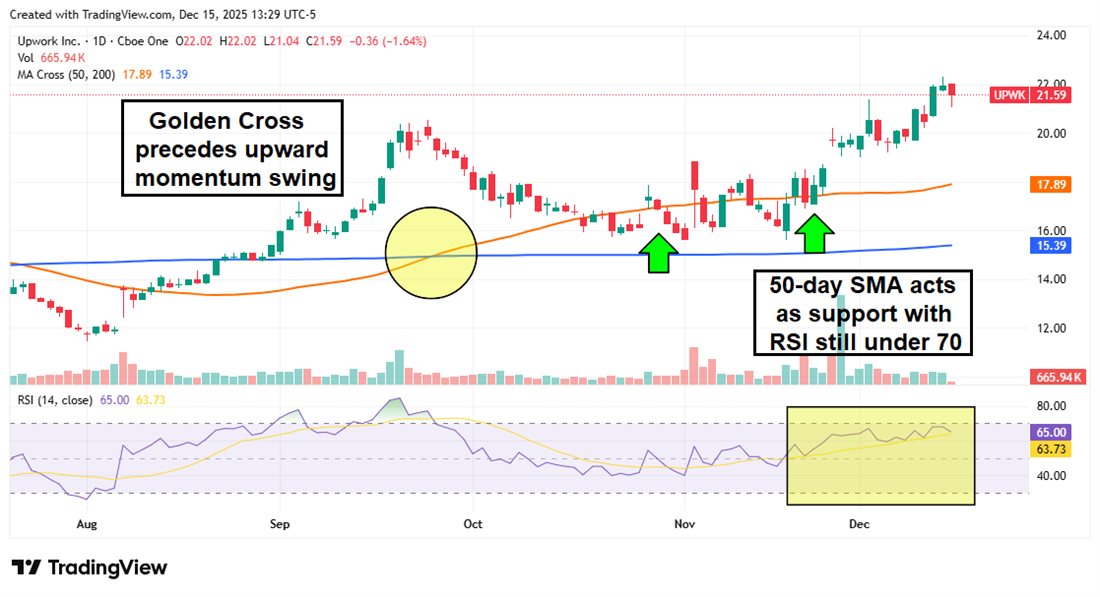
The Golden Cross wasn’t wrong though, just early. The 50-day SMA wobbled but held as support, and the stock quickly broke back above the 2025 high it notched in September. The Relative Strength Index (RSI) is elevated but still below the Overbought threshold of 70, suggesting more upside to come. 2 Reasons to be Bearish on UPWK in 2026 2025 performance aside, investors are most interested in what’s going to happen in 2026. For those interested in a position in UPWK, here are two factors to watch. -
Shrinking Gig Volume Is a Red Flag AI has been a boon to Upwork’s overall revenue growth, but it's also created a few cracks in the foundation. GSV is growing, but smaller jobs paying $300 or less are quickly evaporating as companies turn to generative AI rather than one-time freelancers to avoid onboarding. If Upwork cedes these smaller gigs to AI or competitors like Fiverr International Ltd. (NYSE: FVRR), the marketplace could resume shrinking in terms of GSV—even if higher-level jobs remain plentiful. -
Broader Labor Market Weakness Right now, the macro picture for Upwork is stable. The Federal Reserve lowered rates again this month, and low rates often benefit small-cap stocks with real cash flow and reasonable valuations. But the labor market is the canary in Upwork’s coal mine, and the company’s Enterprise segment (which serves large professional clients) has already shown weakness this year. Additionally, the company’s new Lifted platform for Enterprise clients is expected to entail substantial integration costs, which could knock 2% off the company’s margins in 2026. Margin stagnation combined with a job market slowdown, or even recession, would certainly reverse Upwork’s profit growth and likely take the stock down with it. Read This Story Online |  7 High Yield Dividend Stocks to Buy Now 💰
Love steady payouts? This free report reveals 7 high-yield dividend stocks you need to know about. From Company #3, a tobacco giant innovating with smokeless products, to Company #4, famously known as "The Monthly Dividend Company," these picks deliver steady income you can count on. Perfect for income-focused investors. |
|