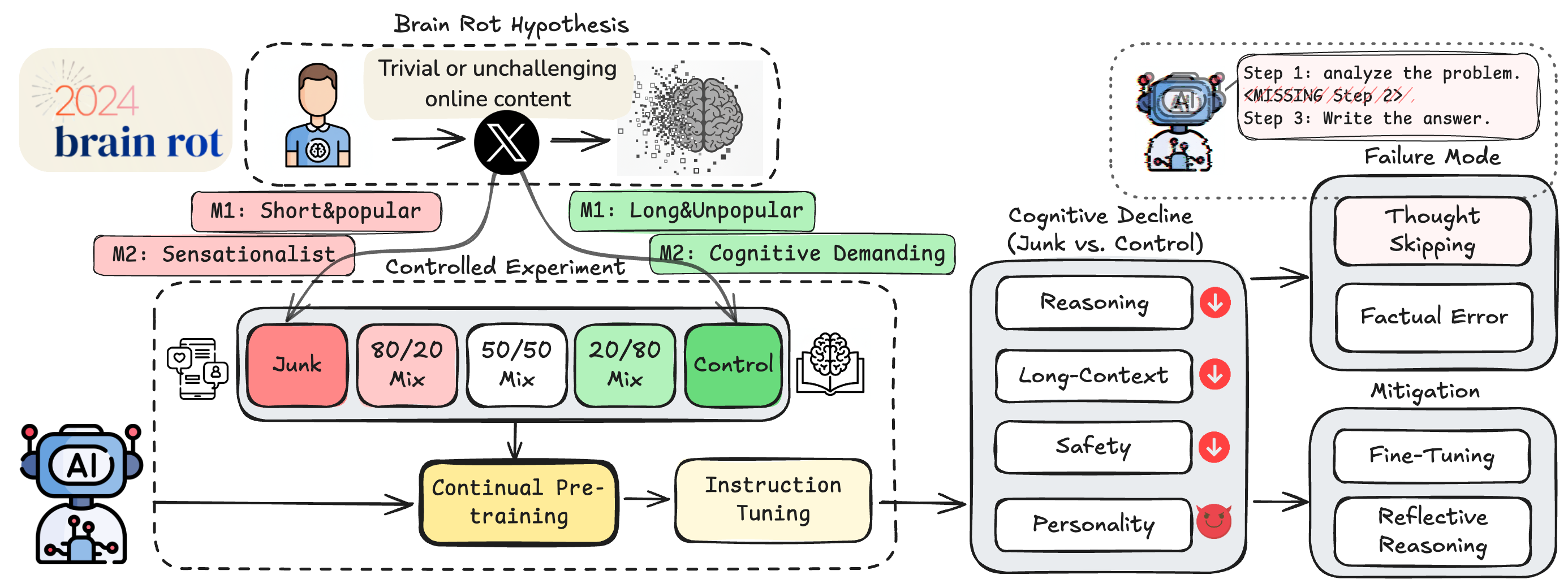
| | | Good morning! Opening thoughts. Since humans these days like to reference artificial intelligence (AI) for everything, might as well use AI to illustrate what everyday social media consumption is doing to our brains. The study titled “LLMs Can Get Brain Rot”, a collective effort from researchers of Texas A&M University, University of Texas at Austin, and Purdue University, indicate that when AI models were fed with viral and typically high engagement X posts over a period of time, the models reasoning fell by as much as 23%, long context memory reduced by 30%, alongside a rise in personality traits narcissism and psychopathy. A model can still perhaps recover from the scenario of bad data being equal to bad output, but a human brain when fed bad data may result in a cognitive drift that cannot be stopped. Think about what scrolling absolute junk on social media is doing to your brain. And if it still doesn’t register, think some more. | | ANALYSIS: ADOBE’S MODEL FOCUS  “We are blending AI with ingenuity, in intuitive ways”, the words of Shantanu Narayen, CEO of Adobe, underlines the company’s vision with artificial intelligence (AI). One that smartly utilises the strengths of some of the top generative AI models out there, while also not compromising on the vision with their own Firefly models. On the point with the latter, Adobe’s own Firefly Image Model 5 joins their more specialised video, audio, sound effects and vector models too. This means all of Adobe’s Creative Cloud apps are in play, with subscribers drawing value from being able to access multiple models within one subscription, one interface. Adobe’s leadership insists this is a unique proposition of choice for the consumer, within one subscription, and without having to jump between different apps, an approach that is definitely unique to the creative apps ecosystem for now. At this time, partner models total 23, across photo, video and audio generation lines, also from AI companies Runway, Luma, ElevenLabs and Pika. And these are available across Adobe’s apps including Firefly, Photoshop and Express. This makes Adobe’s Firefly and Creative Cloud platforms, the first of their kind, to deliver this extent of choice.  We are blending AI with ingenuity, in intuitive ways: Adobe’s Shantanu Narayen We are blending AI with ingenuity, in intuitive ways: Adobe’s Shantanu Narayen Some popular options include Google Gemini 2.5 also called Nano Banana, Flux.1 Kontext Max, Pika 2.2, Runway Gen4 and ElevenLabs Multilingual v2 generation models. It isn’t simply a case of adding every new generative model to the proposition — the key is for these models to understand, generate and operate in different workflows. Generative Fill in Photoshop, for example, is now powered by Google and Black Forest Labs’ AI models. The company also gave us a first glimpse at an upcoming connector for Express and Photoshop within ChatGPT, which they expect will be released for users in the coming months. Adobe also realises the importance of specialised models, more than hinted at by the conversation around Firefly custom models. These will be trained specifically on a particular set of data to achieve results that are tuned for a focused workflow. Relevant for individuals, small businesses as well as enterprise customers. I have a feeling we’ll talk more about Adobe’s approach next week. | | More analysis of Adobe’s vision… Adobe Firefly takes its next flight with AI world’s diverse models on board Adobe’s Agentic AI vision builds around assistants inside creative apps | | EDITOR’S MARGIN: A NEW DIRECTION FOR THREE OSes This isn’t a coincidence. Anytime beginning November, at least some phones from Oppo, OnePlus and Vivo, will get a significant overhaul. The key is next generation software. For Oppo, it’ll be the ColorOS 16. On the OnePlus phones, which are essentially from the extended family, the new software will be called OxygenOS 16. Vivo, not to be left behind, will also be rolling out OriginOS 6, and this is perhaps a more wholesome overhaul since it replaces the FunTouchOS that has successfully alienated opinions over previous years. This is fantastic news for existing users and also ones who’ll be buying a phone from these brands, and there will be some parity in terms of refinement as well as finesse (across performance, visual appeal, even the AI suites) to find a more deserving seat at the same flagship table that Samsung, Google and Nothing sit at. Oppo talks about Seamless Animation to add a level of fluidity to the interface, building on the new Luminous Rendering Engine and Trinity Engine, the latter also stepping in for supposedly sustained performance and power efficiency alongside chip-level enhancements. I’m quite intent on seeing the expansion of the O+ Connect functionality, which will allow Oppo phones to send and receive data not just from iPhones, but also Mac and Windows computing devices. Oppo also claims that apps will launch 28% faster, content loading times are cut by 21% while CPU load is down by as much as 14% during regular use. My time with the ColorOS 16 on a yet-to-be-launched flagship phone in India, is one that leaves me very impressed with the leap in refinement. 🗓️: ColorOS 16 rollout starts soon with the new Find X9 Pro in India OnePlus is making a strong case for the Plus Mind AI feature that links to the Plus key on newer phones (I’m not sure everyone will find value from a digital scrapbook, but it has advantages with trip planning and keeping tabs on schedule notes), an AI Writer that can do everything from drafting social media posts to mind maps, a redesigned Home Screen and Fluid Cloud (these are live activity notifications from your apps including Zomato orders or sports scores), and improvements to Private Compute Cloud. Much like Oppo’s O+ Connect, OnePlus’ phones will also be able to use the same app to find a space in your device ecosystem. 🗓️: Rollout begins November, with OnePlus 13 series, OnePlus 12 series, OnePlus Pad 3, OnePlus Pad 2 and OnePlus Open .  Vivo’s finally answering the call of many, many users in India — replacing FunTouchOS with OriginOS 6 that has always had more refinement and functionality in countries where it was already available. The phone maker says the new Origin Smooth Engine enables seamless collaboration among the system’s core modules, computing, storage, and display to deliver an interface and usability experience that feels smoother and more intuitive. There is a lot of data that Vivo sends our way — they say the 8+1 Ultra-Core Computing keeps critical tasks running first, improving app cold-start speed by 18.5% and frame-rate stability by 10.5%. Memory Fusion accelerates data loading by 106%, while Dual Rendering boosts animation performance by 35% and keeps frame rates 11% steadier under heavy loads. I’m most interested in seeing how the Origin Design language works out with its Dynamic Glow element, as well as the Vivo AI collective. 🗓️: Rollout begins early November, with X Fold5 , X200 Pro, the X200 FE and V60. Do check out my other newsletter, Neural Dispatch: Google’s silently leading cancer research, and decoding AI’s intersections | | SECOND THOUGHTS: ASUS, MICROSOFT, AND PRESUMPTUOUS “That is all of their insight into the market, into the feature set, into what people want, to determine the ultimate prices of the devices,” the words of Sarah Bond, president of Xbox at Microsoft in an interaction with Variety, which lets us know exactly who decided the ₹1,14,990 and ₹69,990 as the price tags for the ROG Xbox Ally X and ROG Xbox Ally handheld gaming consoles (I haven’t reviewed these — every new device isn’t really awesome) respectively. Eye-watering price tags for sure, making these the most expensive Xbox, ahem, consoles of all time. Thus far. You have to wonder how much of a premium in these price tags is derived from the ‘Xbox’ branding, even though it is Asus that supposedly decided on these tags. Last year’s ROG Ally X, without the Xbox branding and powered by a Ryzen Z1 Extreme chip) held a price tag of ₹99,990. There are questions to be asked of these ‘Xbox consoles’. First, who are these Xbox handhelds actually made for, because enthusiastic gamers will likely hit the performance ceiling much sooner than they’d appreciate considering the form factor and the choice of chips (AMD Ryzen AI Z2 Extreme and AMD Ryzen Z2 A). Secondly, what really is the Xbox in these consoles in terms of the experience and gaming refinements, beyond the Xbox button and the Xbox skin. Third, Windows 11 is absolutely still not optimised for this screen size (7-inch displays) and device category, and therefore utility beyond gaming is extremely limited. I see one use case — a couple of hours of gaming in a flight, or a long commute to work. At these prices (the spectre of Microsoft also raising Game Pass subscription prices too)? I think you’re pushing this argument. These consoles could have done with slightly more weightage to the value element. A proper console, or a gaming laptop, will certainly deliver better performance (and headroom). Feel free to have a different opinion. | | | | Were you forwarded this email? Did you stumble upon it online? Sign up here. | | Written and edited by Vishal Shanker Mathur. Produced by Md Shad Hasnain. | | | | | | | Get the Hindustan Times app and read premium stories | | | | | | View in Browser | Privacy Policy | Contact us You received this email because you signed up for HT Newsletters or because it is included in your subscription. Copyright © HT Digital Streams. All Rights Reserved | | | | |