

Ticker Reports for July 21st

3 Bullish Biotech Stocks With Explosive Growth Trends
Investing in biotechnology stocks is similar to the drug development process itself. That is, investors frequently experience long periods of nothing much happening, interrupted by periods of sharp movement.
This is particularly true of small-cap biotech stocks. In many cases, these are unprofitable companies with little to no revenue. However, these are also the companies that can provide the highest return for risk-tolerant investors.
The risk with these stocks is that the company can deliver poor clinical trial results. In some cases, promising medicine never gets through the rigorous Food & Drug Administration (FDA) process. Even if they do, there’s always the risk of competitors getting to market faster.
MarketBeat has made it easier for investors to manage the risk in biotech stocks with its new FDA Events tool that allows investors to stay on top of critical catalysts for these stocks. That information, combined with bullish analyst sentiment, can point you to stocks that may be ready for a breakout. Here are three small-cap biotech stocks to consider.
Precision Drug Delivery for Urologic Cancers
UroGen Pharma Ltd. (NASDAQ: URGN) is a small-cap biotech company focused on treating urologic cancers and diseases. The company’s flagship drugs, Jelymyto and Zusduri, feature UroGen’s proprietary RTGel technology. This allows the drugs to stay in the urinary tract longer, which can improve their efficacy.
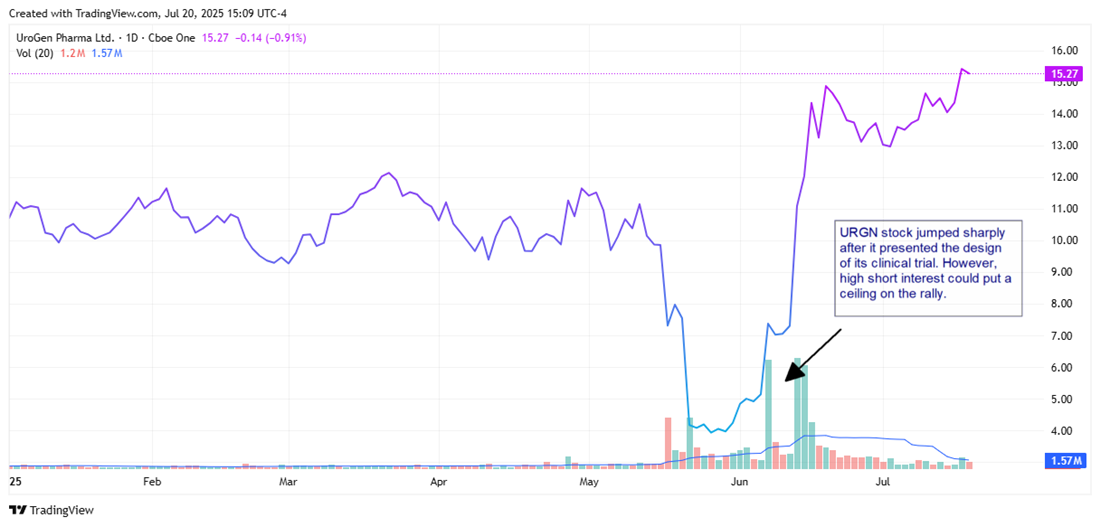
UroGen stock is up approximately 43% in 2025 as the company has applied to expand the Jelymyto label to include low-grade bladder cancer. This would significantly expand the drug’s addressable market to include the 6th most common cancer in the United States. Phase 3 trial results are due in the second half of 2025.
The UroGen analyst forecasts on MarketBeat give URGN stock a $32.86 price target, a gain of over 115% from its closing price on July 18. Investors should note that much of the stock’s aggressive price movement in the last three months is likely due to short covering. Over 42% of the URGN stock float is sold short, which could keep gains in check until a new catalyst exists.
A Comeback Play With Focused Pipeline and Partnerships
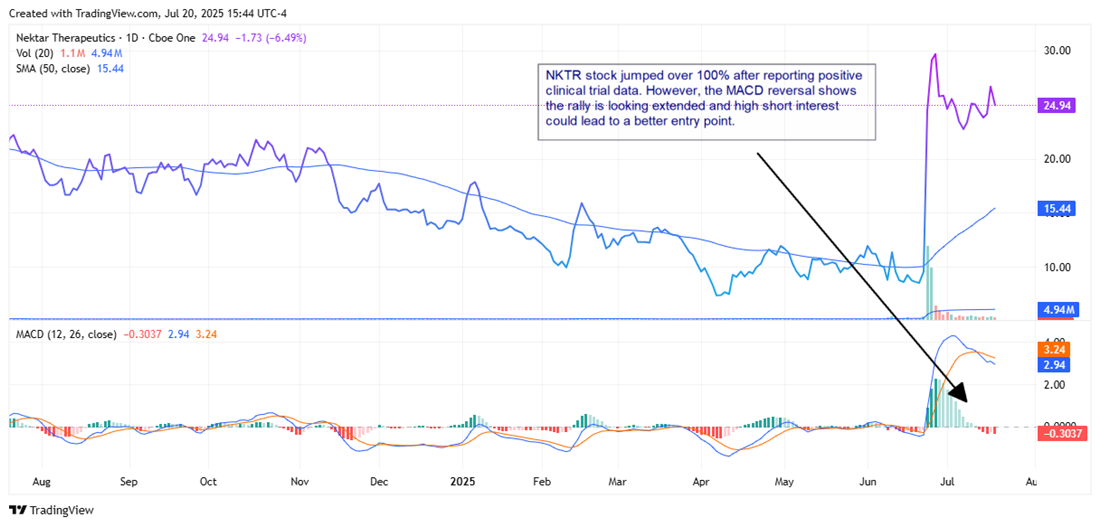
Nektar Therapeutics (NASDAQ: NKTR) is an example of why investing in biotech stocks carries significant risk. Even after a 78% gain in 2025, NKRT stock is still down over 93% in the last five years. The stock slide is largely due to several high-profile clinical trial failures.
However, investors are bullish about the company’s latest candidate for treating systemic lupus erythematosus and ulcerative colitis, among other conditions. The company delivered positive Phase 2b clinical trial results, which also resulted in a Fast Track designation from the FDA.
The Nektar Therapeutics analyst forecasts on MarketBeat have an $88.33 consensus price target on the stock, a 254% increase from its closing price on July 18. However, a pullback is likely with NKTR stock up over 100% in the last 30 days.
Short interest is around 10% and has jumped over 104%. On the other hand, after a series of asset sales and cost reductions, the company has extended its runway to get its drugs through the clinical trial process.
Using the Promise of Gene Editing to Prevent Heart Disease
Gene editing is one of the most tantalizing fields of study in the biotech sector. Verve Therapeutics (NASDAQ: VERV) is at the forefront of using gene editing to treat cardiovascular disease. Verve is still a clinical-stage company, so its product revenue is primarily from partnerships and equity offerings.
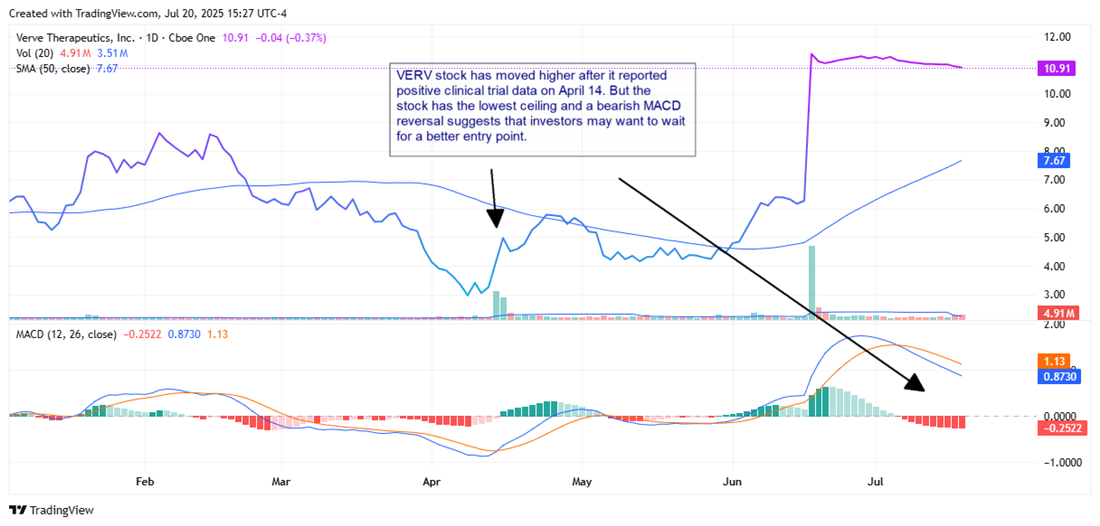
However, the company was approved for a Phase 1b U.S. clinical trial for its lead candidate, VERVE-102, in early 2025. This is a CRISPR-based editing therapy designed for one-time use. The drug targets the PCSK9 gene that drives high cholesterol and atherosclerosis.
Unlike the other two stocks on this list, VERV stock has the lowest ceiling. Analysts have a consensus price target of $14.57 on the stock. That's still a 33% upside, but that’s significantly lower than the potential in the other two stocks.
Analysts are likely considering the long-term nature of clinical trials. However, it’s worth noting that short interest has dropped over 30%, which is typically a sign that bearish sentiment is waning.

How to Collect Up To $5,917/mo From Trump's Made In USA Boom
How to Collect Up To $5,917/mo From Trump's Made In USA Boom

Is China Investable Again? 2 Stocks Soaring as Tensions Ease
British rock icons Oasis began their long-awaited reunion tour this month, and it's not hard to see parallels between the Gallagher brothers, Liam and Noel, and current China and U.S. trade relations.
After a long and bitter dispute, the two sides agreed to put the past aside and negotiate for the betterment of both parties. And while we likely won’t get a world tour with Presidents Trump and Xi Jinping anytime soon, it appears the two have learned the lesson the Gallaghers sang about in their concert staple Acquiesce: “Because we neeeeeed each other."
Thawing Ice: Fading Tariff Fears and Extending Olive Branches
The TACO trade is in full effect on Wall Street as investors brush off President Trump’s tariff threats in anticipation of friendlier terms when pen finally meets paper. While some tariff-affected sectors, such as homebuilders, continue to struggle, the rally has taken major indices to new highs, led once again by the AI darlings in the tech sector.
Surging stocks aren’t limited to U.S. borders either; indices in Europe like the German DAX and the U.K.’s FTSE 100 are also setting new records this summer.
The Shanghai Composite Index still has a long way to go before making a new high, but it is showing signs of life. It closed above 3,500 last week for the first time since 2021, and tensions between Trump and Xi Jinping appear to be softening.
China has agreed to restart importing rare earths into the U.S., while NVIDIA Inc. (NASDAQ: NVDA) is once again selling AI chips to Chinese firms. Investing in China has always been fraught, given the government's tight grip on the economy. However, tailwinds are picking up, and large-cap Chinese stocks are starting to look enticing from a valuation perspective.
Two Stocks Rising as China and the U.S. Resume Business
Public data on Chinese firms is sparse compared to other regions, making due diligence a must before investing. The government in China can drop the hammer (and sickle) at a moment’s notice, so not only must your investment targets have strong fundamentals, but they also need to be in good standing with the ruling faction.
Here are two companies that have their proverbial ducks in a row in the Chinese stock market.
JD.com: The Amazon of China
Sure, every publicly traded e-commerce company dreams of becoming the next Amazon Inc. (NASDAQ: AMZN), and none have come close to achieving this goal yet.
However, JD.com Inc. (NASDAQ: JD) has introduced some Amazon-like business segments this year that could open up new sources of revenue. In February, the company launched JD Food Delivery, which brings essential items like groceries and meals directly to customers’ doorsteps. JD can leverage its vast inventory to bring on-demand retail deliveries through this service as well, which can support margin growth by enhancing last-mile efficiency.
The JD Health brand continues to gain momentum through pharma partnerships with Pfizer and Innogen, and the newly launched AI Nutritionist chatbot has an impressive 91% user satisfaction rate.
JD reported Q1 earnings of RMB 301.1 billion (equivalent to $41.5 billion), representing a 15.8% year-over-year (YOY) increase from Q1 2024. Diluted EPS were RMB 3.59 ($0.50), up from RMB 2.25 in Q1 2024. Revenue from the New Businesses segment actually outpaced the growth of the JD Retail segment, at 18.1% compared to 16.3%, highlighting increased demand for these services (although they remain unprofitable at present).
Analysts have been mixed on the stock, which has a consensus Buy rating but also received three price target reductions in July. However, even with these reductions, the average price target remains $44.46, which is approximately 30% higher than the current market price.
Baidu: The Google of China
If JD wants to be the Amazon of China, Baidu Inc. (NASDAQ: BIDU) seeks to be the equivalent of Alphabet Inc. (NASDAQ: GOOGL). While the Search remains the company’s primary revenue driver, Baidu has expanded into the realm of AI with two ventures similar to Google's: AI Cloud and Apollo Go, an autonomous ride-hailing service.
The AI Cloud segment is becoming an important revenue source, as the company reported 42% YOY revenue growth in the division in Q1 2025, compared to 7% YOY in Baidu Core. Apollo Go is now offering rides in Dubai and Abu Dhabi, and has given more than 1.4 million rides in Q1 (up 75% YOY) and recently obtained a testing license for Hong Kong.
Despite a consensus Hold rating, the stock has risen by over 5% in the last month, and the average price target still indicates upside of more than 18%. Jefferies Financial Group lowered its price target earlier this month but still maintained a Buy rating on the stock, and the new target of $110 remains 17% above current levels.

Altucher: Turn $900 into $108,000 in just 12 months?
Altucher: Turn $900 into $108,000 in just 12 months?

3 Stocks Offering Diversification in Trump's Tariff & Trade Reset
President Donald Trump is in the early stages of executing what some are calling a “Great Reset” of the U.S. economy. Tariffs are one of the president’s tools of choice with a goal towards spurring a domestic manufacturing revival. According to the administration, achieving that goal has economic and national security considerations.
That said, the long-term payoff will take years. However, investors are already seeing some impact from the policy shift. Commodity demand is higher as companies pledge to build out infrastructure in the United States. Also, trade conflicts frequently create currency swings. To that end, the dollar just had its worst first half of the year since 1972.
Although tariffs are his primary tool, Trump is also focusing on lower taxes and less regulation to spur growth in the United States. That agenda is moving full steam ahead after the passage of Trump’s One Big, Beautiful Bill. Growth may kick into overdrive if the Federal Reserve cuts interest rates later this year.
That growth outlook has many investors flocking to technology stocks despite valuation concerns. A different strategy may involve looking at sectors that can build a diversified portfolio with a balance of strong growth and stable income.
Freeport-McMoRan: A Commodity Play for an Inflationary Environment
The surge in the spot price of gold hasn’t trickled down to mining stocks, which significantly lagged the market in 2024. The outlook is looking brighter as the Trump administration looks to cut mining regulations and embed them into law, making it harder for future administrations to reverse.
One way to play this growth is through an ETF like the VanEck Gold Miners ETF (NYSEARCA: GDX), which is up over 52% in 2025. However, some individual names also look intriguing. One of them is Freeport-McMoRan Inc. (NYSE: FCX).
Freeport-McMoRan is a gold miner, but the yellow metal takes a back seat to Freeport’s primary business. The company is one of the world’s largest copper producers. Copper is essential for everything from electrical wiring in data centers to renewable energy buildouts. As tariffs and incentives encourage more factories and infrastructure projects to move back to U.S. soil, demand for copper is expected to soar.
Freeport-McMoRan is also attractive to investors because it has a strong balance sheet with a debt-to-equity ratio of just 0.30%. FCX stock is up about 15% in 2025, but analysts are forecasting an additional 15% of upside. Several analysts have raised their price targets above the consensus price ahead of the company’s earnings on July 22.
Coca-Cola: Defensive Growth with a Global Footprint
With many investors in full risk-on mode, defensive stocks like The Coca-Cola Company (NYSE: KO) may get overlooked. It shouldn’t be. KO stock is up 10.9% in 2025. That’s no NVIDIA Corp. (NASDAQ: NVDA) performance, but it’s higher than many consumer staples stocks.
Strong demand for the company’s iconic beverage brands is a knee-jerk reaction explanation for that performance. Having said that, the company does have pricing power that has helped it balance earnings growth for shareholders with an eye on a pinched consumer.
However, this is also a trade and tariff story. A weaker dollar benefits Coca-Cola because the company generates significant revenue outside the United States. As foreign earnings are converted back into dollars, reported sales and profits can rise. The company also benefits from localized supply chains for production and delivery.
At 27x earnings, KO stock is expensive compared to its recent history. That said, Coca-Cola’s dividend yield and consistent cash flow make it attractive to investors who want exposure to income without sacrificing modest growth potential.
Verizon: Reliable Dividends in Uncertain Times
Investing in a company like Meta Platforms Inc. (NASDAQ: META) makes sense for investors with a long time horizon. But for investors in wealth preservation mode, there’s something to be said for boring but beautiful stocks. That’s the benefit of owning Verizon Communications Inc. (NYSE: VZ).
Verizon has averaged a total return of around 4.7% in the last 10 years. This is why it’s important to point out that VZ stock is up about 8% in the previous 12 months. Even when the stock price fell in recent years, investors have never had to worry about the company’s dividend.
That dividend currently yields 6.5%, which puts the stock in the top 10% of its sector.
The stock price surge is because the company’s capital expenditures on 5G are falling, as is its debt. That puts the focus back on the company’s reliable subscription model.

Everyone's watching Nvidia right now. Here's why I'm excited.
Everyone's watching Nvidia right now. Here's why I'm excited.

MarketBeat Media, LLC dba TickerReport
345 N Reid Place, Suite 620, Sioux Falls, SD 57103.