

Ticker Reports for July 18th

Why Abbott Laboratories Is a Q2 2025 Buy: Growth & Yield
If you wonder whether Abbott Laboratories (NYSE: ABT) is a good buy in Q2 2025, the answer is yes. The company’s management, portfolio, cash flow, capital return, and pipeline are why. The stock price came under pressure in July because the Q3 guidance update wasn’t better than what the market expected.
Sound crazy, but it's true: the robust outlook wasn’t enough to keep speculators interested, but it isn’t the speculators that matter in the long term. What matters in the long term is that the company’s growth trajectory is positive, supporting a robust capital outlook that includes dividends and share repurchases.
The combination of business growth, dividend distribution growth, and share repurchases serves as a lever for shareholder value that will propel the stock price to new highs.
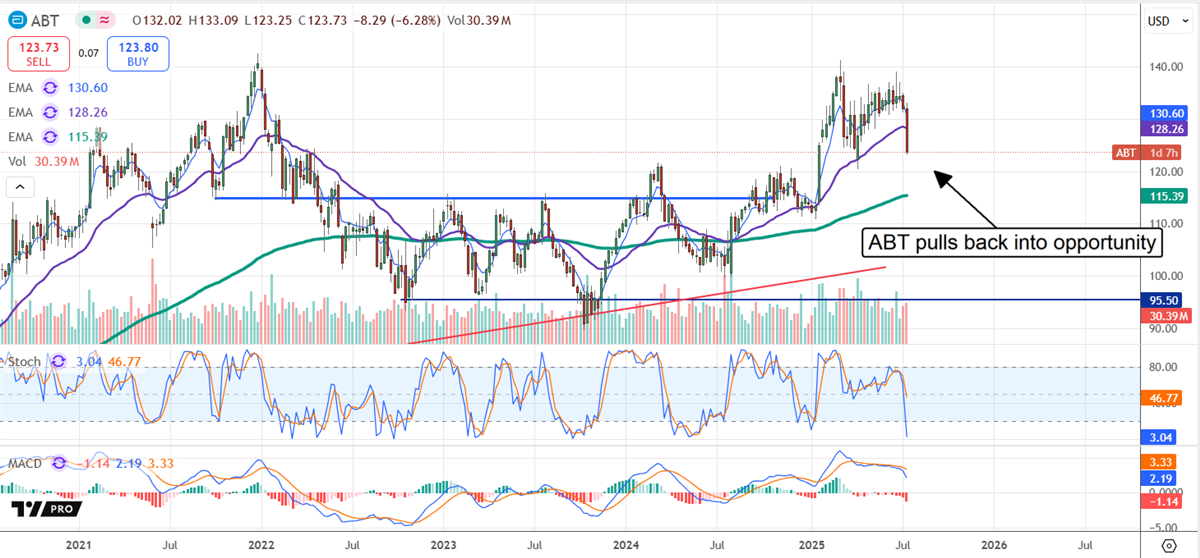
And the capital return is significant. The dividend is worth approximately 1.8% as of mid-July, is less than 50% of the earnings outlook, and has grown at a robust 10% CAGR over the past few years. Those are robust metrics for a Dividend Aristocrat, especially for a Dividend King like Abbott, which has increased its payout for over 50 years. That is a testament to management's foresight and execution, qualities that will continue to benefit investors in the long term.
Abbott’s share repurchases are also significant, as they reduce the share count quarterly. The company reduced its share count incrementally in the first half of the year and is expected to continue reducing it through the end of the year.
Abbott Punished for Good Results, Solid Guidance
Abbott Laboratories had a solid quarter, with revenue growth topping 7.4%, reported, about 70 basis points better than expected, driven by strength in all regions and reporting segments. Organically, growth was reported at 6.9% and 7.5% excluding COVID-19 testing supplies.
Regionally, the U.S. was strongest at 8.7%, but the International Market was also solid at 6.6%. Segmentally, Diagnostics was the only weak point but was impacted by COVID, declining on a reported basis but rising incrementally organically. Other segments grew by at least 3%, led by a strong, industry-leading 12% gain in Medical Devices.
The margin news is also good. Revenue leverage and operational quality offset macroeconomic pressures, resulting in a 100-basis-point improvement in adjusted gross and operating margins. The net result is $1.26 in adjusted earnings, only as expected, but up a leveraged 10.5% compared to the slower 7.4% top-line growth.
The critical takeaway is that the cash flow is sufficient to sustain the capital return outlook, balance sheet health, and pipeline advancement, which support the stock price action over time. Regarding the pipeline, the company reported advancement of several key studies and one major approval for the quarter.
Guidance is the sticking point for market action in July. The company narrowed its revenue growth range, indicating solid growth of 7.5% to 8%, with earnings in line with the consensus figure. However, a stronger catalyst was needed to lift the share prices. Investors should focus on growth, earnings, cash flow, and the pipeline, which promises to sustain them all.
Analysts' Trends Provide Support for Abbott Laboratories in 2025
The analysts' trends are supportive of Abbott’s stock price. The group issued a steady string of upgrades and price target revisions up to the day of the release, resulting in increasing coverage, firming sentiment, and a rising consensus price target.
The group has the stock pegged at Moderate Buy with a bullish bias, forecasting a 10% increase relative to the pre-release closing price. That is sufficient to put this market at a new all-time high when reached.

New crypto laws coming. Will you win or lose?
New crypto laws coming. Will you win or lose?

CSX Stock Rally: Strong Options Flow, Analyst Price Targets
When a wave of bullish activity from different corners of the market converges on a single, vital company, it can signal that a significant shift is underway. For CSX Corporation (NASDAQ: CSX), a critical artery of the American economy, those signals are now flashing brightly.
A powerful combination of unusual options market activity, positive analyst revisions, and strategic internal victories suggests the railroad giant is at a key inflection point, making a compelling case for investor attention.
CSX Options and Analyst Signals Point North
The most direct signals often come from the market itself, and recent activity surrounding CSX has been unambiguous. On July 11th, the options market saw a dramatic spike in interest, with traders purchasing over 24,000 call options on the stock.
This represented a 165% increase compared to the typical daily volume of around 9,200 contracts.
A call option gives a trader the right to buy a stock at a predetermined price, making it a direct bet that the share price will rise.
When call volume surges like this, especially for contracts expiring in the near future, such as the heavily traded August and September 2025 options, it indicates a growing conviction that a positive catalyst is on the horizon.
This sentiment is further confirmed by a low put-to-call ratio, a metric that shows a strong preference for bullish bets over bearish ones.
This market action is supported by a growing chorus of optimism from CSX’s analyst community. In the weeks leading up to the company’s second-quarter earnings report, several influential firms have upgraded their outlook on CSX stock:
- Raymond James (NYSE: RJF) maintained its Outperform rating and raised its price target to $37.00.
- Citigroup (NYSE: C) reiterated its Buy rating while boosting its target to a street-high of $38.00.
- Barclays (NYSE: BCS) and JPMorgan Chase & Co. (NYSE: JPM) also increased their price targets, signaling renewed confidence.
When a surge in options buying aligns with positive analyst revisions, it creates a powerful leading indicator. It suggests that short-term market sentiment and long-term fundamental analysis are pointing toward the same conclusion: confidence in CSX’s future is building.
How CSX De-Risked Its Operations
The market’s growing optimism is anchored in tangible, fundamental improvements within the company. CSX management has been proactively addressing its most significant operational risks, creating a more stable and efficient business engine that is ready to perform.
A landmark achievement was the June 2025 ratification of a new five-year collective bargaining agreement with the Brotherhood of Locomotive Engineers and Trainmen (BLET). With this and other recent deals, CSX has now secured long-term labor stability with nearly 75% of its unionized workforce.
In an industry where nationwide labor disputes can cause crippling service disruptions, supply chain chaos, and billions in economic damage, this predictability is a powerful competitive advantage. It allows CSX to provide reliable service guarantees to customers, which supports stronger pricing and helps win business from less stable competitors.
Simultaneously, the company has demonstrated a sharp focus on its cost structure. The recent decision to reduce its management layers is a strategic move aimed at creating a leaner, more agile organization.
By streamlining operations and controlling overhead expenses, CSX is directly improving its ability to convert every dollar of revenue into profit.
This financial discipline is crucial for shareholders, as it means that when revenue growth returns, more of that money can flow directly to the bottom line, boosting earnings per share (EPS) and supporting a higher stock valuation.
Why a Weak Quarter Created a Strong Buy
Investors examining CSX’s recent history will immediately notice the challenging first-quarter financial results, where both revenue and profit fell short of Wall Street estimates. However, understanding the context behind those numbers is the key to seeing the current investment opportunity.
The first-quarter weakness did not result from a core business flaw. Instead, performance was significantly impacted by temporary and costly operational disruptions.
These included major, large-scale infrastructure projects, such as service rerouting for the Howard Street Tunnel project in Baltimore and a massive $133 million rebuilding effort on its Blue Ridge subdivision following a hurricane.
These non-recurring events, combined with severe winter weather, created a perfect storm of short-term drags on efficiency and profitability.
Because these issues were situational, rather than structural, the market may have unfairly penalized the stock. This creates a potential valuation gap for investors who can look past the noise of a single difficult quarter.
With those major projects largely complete and network operations returning to normal, the stage is set for a strong sequential improvement. The stock's price may not yet fully reflect this return to operational normalcy, presenting an opportunity before the company's comeback is confirmed in its next earnings report scheduled for after the market closes on July 23, 2025.
CSX is Positioned for Prosperity
Having successfully navigated its most significant internal challenges, CSX now emerges as a leaner, more stable, and more efficient operator. By securing labor peace and streamlining its costs, the company has fortified its foundation and sharpened its competitive edge.
As a bellwether for the U.S. economy, the company’s performance is intrinsically linked to the activity of the industrial sector. Now, with its internal house in order, CSX can be viewed as a coiled spring, uniquely positioned to leverage any stabilization or modest improvement in manufacturing, consumer spending, or port volumes into significant earnings growth.
The company has transformed itself into a more effective vehicle for capturing economic upside.
The powerful combination of bullish market signals, validating Wall Street upgrades, and tangible internal improvements presents a compelling investment case.
The upcoming second-quarter earnings announcement now stands as the next major catalyst, offering the first clear data points that could confirm this turnaround story is officially on track, unlocking the stock's next move higher.

Special gold investment soars 2,300% ... 5,090% ... 9,850%
Special gold investment soars 2,300% ... 5,090% ... 9,850%

Discover Capital One's Strategy for Long-Term Stock Growth
In mid-May of 2025, Capital One Financial Corporation (NYSE: COF) finalized its massive $35.3 billion acquisition of Discover Financial Services (DFS). This landmark move has already helped propel its stock more than 25% higher. This impressive performance has brought Capital One’s share price near all-time highs, leading investors to a critical question: after such a powerful run, is the best of the growth story already priced in?
A detailed examination of the new company structure and strategy reveals that the transformation may be just beginning. The data presents a compelling case for continued long-term growth in the stock, built on a newly powerful and more profitable business model.
What Network Ownership Means for Capital One’s Profits
The most important change from this merger is a concept known as vertical integration. Think of it this way: before the deal, Capital One was renting space on the payment highways owned by Visa and Mastercard. Every time a customer used a Capital One card, the company paid a toll. Now, by owning the Discover network, Capital One owns one of these major highways itself.
This shift from network renter to network owner has a direct and significant financial impact. Management projects the deal will generate an estimated $2.7 billion in annual synergies by 2027. Synergies refer to the financial benefits that arise from the combination of two companies. In this case, they stem from cost savings (no longer paying tolls to Visa and Mastercard) and the new revenue opportunities that network ownership will bring them.
For investors, this is critical. Those billions of dollars are expected to flow directly to the company's bottom line, increasing profits and making the business more valuable on a per-share basis. This establishes a new, recurring, and high-margin source of revenue, which is a powerful foundation for supporting a higher long-term stock valuation.
How Capital One Plans to Grow Earnings
Beyond the immediate benefits of owning a network, the merger creates several clear pathways to future growth. These catalysts are expected to fuel higher earnings and, consequently, a higher stock price over time.
- A Built-In Growth Opportunity: As the largest credit card issuer in the U.S. by outstanding loans, Capital One has a massive, built-in customer base. The company can now strategically migrate its card portfolios to its own Discover network. Every card that moves over becomes more profitable because Capital One keeps the transaction fee. This provides a long-term, internal growth engine that can be methodically turned on for years to come.
- A Clear Path to Higher Earnings: This new model's financial goal is clear. Management projects the acquisition will boost earnings per share (EPS) by over 15% by 2027. A clear and credible path to double-digit EPS growth is one of the most reliable drivers of stock price appreciation.
- Driving High-Value Innovation: Owning its network gives Capital One the freedom to innovate new products and services. The company can now develop a premium travel card more effectively to compete with high-end products like the Chase Sapphire Reserve and American Express Platinum. Success in this market would attract higher-spending, higher-credit-quality customers, diversify its business, and create powerful new revenue streams that have not yet been factored into the current stock price.
Why Wall Street Sees More Upside
Even after its strong rally, a closer look at the company’s valuation and Capital One’s analyst data suggests the stock remains reasonably priced. A key metric for this is the forward price-to-earnings ratio (P/E), which compares a stock's current price to its expected earnings over the next 12 months. It’s a way of asking, "What am I paying today for tomorrow's profits?"
With a forward P/E of approximately 14x, Capital One presents an attractive valuation. This is particularly notable given the company's clear trajectory for substantial earnings growth. In comparison, the financial sector's average forward P/E is around 15.5x, further indicating that Capital One's valuation still has potential for appreciation.
Financial professionals and industry analysts echo this view. The consensus rating from 18 analysts is a Moderate Buy, with 14 recommending to Buy the stock. While four Hold ratings placed early in the year are still weighing down the overall rating, multiple firms have raised price targets or upgraded their ratings from Hold since the deal closed, suggesting that the remaining four holdouts may soon follow suit.
These upgraded price targets, which represent analysts' 12-month forecasts for the stock's value, suggest plenty of room for growth. Since the company completed the merger, five firms have rerated the stock, with the average rerating placing it around $247.00. This suggests a healthy upside as the market continues to adjust its valuation of the stock.
A Transformed Company Built for Growth
The acquisition of Discover was a strategic game-changer that created a fundamentally more profitable and powerful company. The clear path to higher earnings, driven by massive synergies and new growth catalysts, provides a strong rationale for continued stock strength.
For investors with a long-term perspective, Capital One now appears well-positioned to deliver significant shareholder value in the years ahead, making a compelling case that its new chapter of growth has only just begun.
Jeff Bezos' honeymoon humiliation
Jeff Bezos' honeymoon humiliation

MarketBeat Media, LLC dba TickerReport
345 N Reid Place, Suite 620, Sioux Falls, SD 57103.