
“In politics, nothing happens by accident. If it happens, you can bet it was planned that way.” -Franklin D Roosevelt.
Over the past year, the Trump administration has executed a series of moves that – taken in isolation – look reckless, if not downright crazy.
Threatening to invade Greenland. Planning to annex Canada. Striking Venezuela. Seizing Russian oil tankers in international waters. Signing a relentless torrent of executive orders. Bombing Tehran.
The financial press has covered each event as if it exists in a vacuum.
They are wrong.
Every single one of these strange moves is closely connected.
And flows from a single, coordinated strategy – a 29-page National Security Strategy document published by the White House, laying out what we’re calling the “Donroe Doctrine”.
Trump's corollary to the original Monroe Doctrine of 1823.
The Monroe Doctrine was simple: keep European powers out of the Western Hemisphere. It defined America's sphere of influence for nearly two centuries.
The Donroe Doctrine updates that mission for the 21st century. Its target is not European colonialism – it is China.
And it changes everything about how you invest your money from here on out.
The Grand Plan
While America spent the last two decades bogged down nation-building in Iraq and Afghanistan, fighting the war on drugs, the war on terror, and mired in identity politics…
China was executing a quiet, methodical strategy of its own.
It poured more than $100 billion into Venezuela alone – building energy infrastructure, locking up oil exports, and establishing a critical nexus of influence stretching from Caracas to Tehran to Moscow.
It quietly cornered 70% of the world's rare earth mining and 90% of global processing – the critical materials without which no AI chip gets made, no GPU runs, no data center operates.
It built alternative financial systems specifically designed to weaken the U.S. dollar – settling oil transactions in yuan and gold, eroding the petrodollar's grip one transaction at a time.
While we were distracted, China was building an empire.
The Donroe Doctrine is America's response.
Not a diplomatic response or a policy response – a wartime response.
This Is What Mobilization Looks Like
I've spent 30 years studying how capital migrates from one side of the market to the other.
But this is unlike anything I’ve seen in my career.
In fact, the only time America has mobilized public and private money like this is during the throes of World War II – when freedom and democracy itself was at stake.
Think about what FDR did in 1941.
He drafted General Motors to build Sherman tanks. He conscripted Boeing to produce bombers. He mobilized General Electric, Caterpillar, Ford – the entire industrial complex of America – in service of a single national objective.
Private capital and public power moved in lockstep. Trillions of dollars (in today's terms) were channelled into a concentrated set of companies critical to the war effort.
And the investors who understood where that capital was flowing made fortunes that lasted generations.
Trump is running the same play.
Except this time, the battlefield isn't Europe. The weapons aren't tanks and bombers. And the critical resources aren't steel and rubber.
They are the physical foundations of artificial intelligence.
The energy to power it, the minerals to build it, the chips to run it and the infrastructure to scale it.
And the mobilization is already underway – at a scale that dwarfs anything FDR attempted.
Meta, Google, Amazon, and Microsoft committed more than $400 billion in 2025 toward data center construction, with that figure expected to hit $650 billion in 2026.
Apple is spending $500 billion – more than the entire GDP of Norway – to fast-track AI development on American soil.
The UAE has committed $1.4 trillion. Nvidia another $500 billion.
Threatened with 100% tariffs, Taiwan Semiconductor Manufacturing is relocating 40% of its chip supply chain to Arizona.
And for the first time in our history, the U.S. government is buying direct stakes in mission critical companies at the frontier of this war for control of the AI supply chain.
Trump has signed executive orders opening 625 million acres for offshore drilling, fast-tracking mining permits from years to days, and reopening retired coal and nuclear plants to meet the colossal energy demands of AI infrastructure.
I don’t necessarily like the way the President is going about his business. In my view, this level of command and control has the whiff of socialism about it.
But I learned long ago that the most dangerous (and costly) position to hold in the market is a moral one.
As investors, we have been given a map… a map telling us where trillions of dollars in urgent and mission-critical capital is headed.
All we have to do is follow it.
Where The Capital Is Flowing
History is unambiguous on what happens when a nation mobilizes like this.
During the First World War, U.S. Steel, General Motors, and Bethlehem Steel made fortunes for their shareholders.
During the Second World War, it was Lockheed, Ford, and Caterpillar.
During the Cold War, Northrop, Raytheon, General Dynamics, and Boeing.
In every case, the pattern was identical. Wartime capital flows fast. It concentrates into a narrow set of companies critical to the national objective.
And the investors who understood where it was going (before the rest of the market caught on) were the ones who built generational wealth.
That same pattern is playing out right now.
As money has flooded into the AI supply chain, the companies sitting at the chokepoints of America's colossal mobilization are already surging.
Stocks like Vertiv (+500% since 2024), GE Vernova (+700% since 2024), Arista Networks (+750% since 2021), and Taseko Mines (+370%since 2024) to name just a few.
And a critical event this December could accelerate everything. When world leaders gather in Miami for the G20 summit (at Trump's own resort) I believe the full scale of what he’s been building will become impossible to ignore.
Not just the AI mobilization.
Because the Donroe Doctrine isn't just a geopolitical strategy or an industrial initiative.
It is a historic monetary event.
Trump’s New Dollar
My new research tells me Trump's initiative will impact every aspect of your financial life – from your stock portfolio to your retirement account to your savings.
That extends, I can tell you now, to the dollar in your pocket.
Because buried within Trump's grand plan is something that will send shockwaves through American life:
A complete replacement of the U.S. dollar as we know it.
A new monetary order – already signed and sealed in the backrooms of the State Department – that will divide America into two groups:
Those who understand what’s happening to their money. And those who don't.
I've spent months making sure you end up on the right side.
By identifying one key investment you can make today to give you immediate exposure to what’s unfolding…
And uncovering five companies critical to Trump’s unstoppable drive to dominate the AI supply chain – and reset the dollar in the process.
Good investing,
Porter Stansberry
Short Squeeze Alert—Moderna Stock Surges on New Strategy
Submitted by Chris Markoch. Publication Date: 7/1/2026.

Key Points
- Moderna shares rose nearly 20% after Science Day, but the gain is partly attributed to a short squeeze, not fundamentals alone.
- Moderna's pipeline spans three horizons targeting cancer and rare diseases, though Horizons 2 and 3 will not generate revenue until after 2028.
- With MRNA trading near double its consensus price target of $37, analysts suggest waiting for a better entry point before adding exposure.
- Special Report: Forget SpaceX. Buy the company Musk can't replace.
Shares of Moderna (NASDAQ: MRNA) are behaving like it’s 2020. The stock is up nearly 20% since the company’s Science Day event.
At that event, Moderna outlined its strategy for using mRNA to combat cancer and rare diseases. It’s a move beyond vaccines, and investors seem to like it.
This is what I’m recommending my readers do now that SpaceX is public… (Ad)
The SpaceX IPO wasn't the big trade - according to Larry Benedict, founder of The Opportunistic Trader, it was the trigger. Benedict, who delivered a 279% return on cash in 2025 across a 20-year winning streak, says the listing launched what he calls the 'Final Phase of Elon's Master Plan.'
He's identified one specific ticker - not SpaceX, Tesla, or any Elon-affiliated company - that he believes could see billions in inflows as this phase unfolds. He calls it his trade of the year.
Watch the video now to get the ticker name and full trade detailsLooks, however, can be deceiving. Prior to the event, MRNA had short interest of over 16.5%, which required more than 10 days for short sellers to cover their positions.
The result? A classic short squeeze that has sent the stock to nearly double its consensus price target of around $37 as of June 30.
However, the price move by itself isn’t disqualifying. The expansion of mRNA as a treatment for diseases is where the promise has always been. That leaves investors with a decision ahead of Moderna’s Q2 2026 earnings report, scheduled for July 30.
Why mRNA Still Matters
The promise of mRNA is that it changes how medicine is made. Traditional drugs are manufactured in factories and injected into the body. mRNA medicines work differently. They deliver genetic instructions, and the body’s own cells produce the protein needed to treat the disease.
That matters for two reasons. The same platform can be reprogrammed for different diseases by changing only the instructions. And that flexibility could make drug development faster and more efficient over time.
COVID-19 vaccines proved the platform works in infectious disease. The question Moderna is now trying to answer is whether the same approach can deliver meaningful results for cancer, autoimmune diseases, and rare diseases.
If the answer is yes, the platform becomes far more valuable than its vaccine franchise alone. That’s the long-term story driving the recent move.
3 Horizons, 1 Long Runway
At Science Day, Moderna organized its business into three “Horizons” that map how the platform scales over time.
Horizon 1 is Moderna’s commercial engine. It includes four approved vaccines (Spikevax, mRESVIA, mNEXSPIKE, and mCOMBRIAX), the investigational intismeran autogene cancer therapy, and a rare disease franchise led by a propionic acidemia treatment. This accounts for the bulk of the company’s current revenue.
Horizon 2 is the next wave. It includes T-cell engagers targeting multiple myeloma and ovarian cancer, cancer antigen therapies for solid tumors and Lynch syndrome, and a multiple sclerosis therapeutic linked to the Epstein-Barr virus. Most are in Phase 1 or Phase 2 trials. The earliest meaningful readout is mRNA-1195 for multiple sclerosis, which is expected in the second half of 2026.
Horizon 3 is the long-term bet. The headline asset is mRNA-6007, an in vivo CAR-T therapy aimed at lupus. Moderna expects this to enter human trials by the end of 2027.
That’s a lot of potential. However, none of Horizon 2 or Horizon 3 will generate revenue until after 2028. Phase 1 and Phase 2 readouts are clinical milestones, not commercial ones. The path from trial to approval to launch takes years.
Why Caution Is Warranted
On June 26, the day after Moderna’s Science Day event, Piper Sandler reiterated its Overweight rating on MRNA and raised its price target to $77 from $69. Even at the former price target, Piper Sandler was already one of the most bullish analysts.
It’s important to note, however, that the new price target doesn’t leave much upside for MRNA after its recent gains. Analysts may be holding off on issuing opinions until the company’s earnings report, especially since there won’t be any revenue or earnings from these new initiatives for several years.
That puts the entire burden on Horizon 1. The four approved vaccines, the intismeran Phase 3 program, and disciplined cash management have to fund the pipeline long enough for the platform story to pay off.
That’s why long-term investors who aren’t in the stock should wait for a better entry point. It’s also a reason for current shareholders to take some risk off the table.
Where the Squeeze Logically Gives Back
The most likely first pullback level is $60. It’s a round-number psychological level and represents a healthy give-back of about half the move off the mid-June breakout. Pullbacks of that size are normal after a sharp rally; they reflect profit-taking and leave the bullish structure intact. Anyone trimming into the squeeze would look to add back near this level.
The deeper, higher-conviction support is $55. That was the top of the April-to-June trading range and the launch point of the Science Day breakout candle. Prior resistance becomes new support, and this is where the squeeze froth fully resets without breaking the thesis.
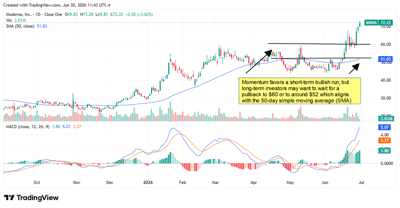
The line in the sand is $52, where the 50-day SMA sits at $51.83. A close below that level would mean the breakout has failed, and the stock has fallen back into the range it traded in before Science Day. At that point, the platform re-rate needs a fresh catalyst, such as the July 30 earnings report, to reassert itself.
Xcel Energy Stock Offers Stability as Electricity Demand Builds
Submitted by Peter Frank. Publication Date: 6/26/2026.

Key Points
- Xcel Energy combines dependable dividends with consistent earnings growth, supported by regulated utility operations.
- A $60 billion capital investment program is expected to drive long-term growth through grid expansion and rising electricity demand.
- Analysts broadly rate the stock a Buy, though its valuation limits near-term upside potential.
- Special Report: Forget SpaceX. Buy the company Musk can't replace.
Xcel Energy (NASDAQ: XEL) is dependable, predictable, and steady. In other words, it’s generally boring—yet analysts rate it a solid Buy.
Xcel is the kind of stock income-oriented investors often overlook because it does not make headlines, and growth investors skip because it sounds like a bond substitute. Both groups may be missing something. The Minneapolis-based company is delivering solid earnings growth, predictable guidance, and a steady long-term outlook.
This is what I’m recommending my readers do now that SpaceX is public… (Ad)
The SpaceX IPO wasn't the big trade - according to Larry Benedict, founder of The Opportunistic Trader, it was the trigger. Benedict, who delivered a 279% return on cash in 2025 across a 20-year winning streak, says the listing launched what he calls the 'Final Phase of Elon's Master Plan.'
He's identified one specific ticker - not SpaceX, Tesla, or any Elon-affiliated company - that he believes could see billions in inflows as this phase unfolds. He calls it his trade of the year.
Watch the video now to get the ticker name and full trade detailsBut with a fairly valued price-to-earnings ratio, the stock is not for everyone. Investors should balance its dependable dividend and stability against its current valuation, execution risks, and limited near-term upside.
Xcel Thrives After Decades of Investments
Xcel’s regional dominance has been built over decades. The current company was formed in 2000 through the merger of New Century Energies and Northern States Power, bringing together utility operations in the upper Midwest and Rocky Mountain West. Before the merger, Xcel operated as a classic regulated utility. It offered steady dividends, predictable low-single-digit growth, and a stock that moved mostly with interest rate changes.
That picture began to change as the industry shifted and electricity demand surged. Xcel was an early mover in renewable energy, turning to wind and solar alternatives ahead of many peers. Those investments positioned the company well in states such as Colorado and Minnesota, where regulators began mandating the decarbonization of electricity supply.
At the same time, the development of large-scale data centers in the company's service areas pushed load growth to levels not seen in decades.
Today, the company serves 3.7 million electric customers and 2.1 million natural gas customers across eight states, including Minnesota, Michigan, Colorado, Texas, New Mexico, and the Dakotas. Importantly, that geographic breadth also helps reduce the risk that a single state rate case could materially affect the overall business.
Capital Spending Planned for Long-Term Growth
The push for additional energy generation in the region continues to spur the company’s growth.
Xcel has announced plans to pursue a $60 billion capital investment program through 2030, driven by electrification demand, data center growth, and the ongoing transition away from fossil fuels. The company says it is targeting, among other things, electric grid expansion, renewable development, new generation capacity, and transmission infrastructure.
If approved by regulators, the build-out could significantly expand Xcel’s rate base and provide a strong path for earnings growth well beyond the current year. The company has set an earnings-per-share growth objective of 6% to 8% or higher annually, an aggressive level for a regulated utility. The company’s compound annual growth rate already stands at 6.2% for ongoing earnings per share since 2005.
The company also expects its dividend, currently paying approximately 59 cents per share each quarter, to continue yielding about 3% going forward. Given its projected earnings growth, the company said it expects annual dividend increases of 4% to 6%, extending a 22-year trend of dividend hikes.
Strong Financial Results Support Outlook
The financial results have been tracking that plan.
First-quarter 2026 ongoing earnings were $567 million, or 91 cents per share, up 17% from $483 million, or 84 cents per share, in the same quarter a year earlier. GAAP earnings came in at $556 million, or 89 cents per share. The quarterly increase was driven by higher electric revenue and continued recovery of electric infrastructure investment through rates, the company said.
The company also updated its full-year 2026 earnings guidance to a range of $4.04 to $4.16, compared with $3.80 in 2025.
Overall, with electric generation providing three-quarters of its revenue, Xcel reported $4 billion in operating revenue in the first quarter this year, compared with $3.9 billion a year earlier.
Analysts See Limited But Steady Upside
That combination of income stability and visible earnings growth has impressed most analysts. The company currently carries a solid Buy rating. Of the 17 analysts tracking the stock, 16 rate Xcel as a Buy, while one labels it a Sell.
The 12-month average price target is around $91 per share, within a range of targets from $96 to $84. With a current price of about $80, the company’s predictability is clearly reflected in the valuation.
In fact, the stock’s steady climb is also evident in its history. Shares are currently trading approximately 5% higher than three months ago, 10% higher than the start of the year, and more than 20% higher than one year ago.
Investors Should Weigh the Risks
Despite Xcel’s current predictability and steadiness, utility companies are never without risk. In the market, the utility sector competes with bonds for many investors, and interest rate hikes can hurt valuations as well as borrowing costs for major projects.
In addition, Xcel's capital program is ambitious by any measure, and large capital programs are never guaranteed. Cost overruns, supply chain delays, or adverse regulatory decisions can lead to less recovery than management expects.
Wildfire liability is also a risk, especially with exposure in Colorado and other western states. Xcel has recognized this risk and formed a partnership with the National Forest Foundation in May this year specifically to support wildfire mitigation and forest restoration.
Stability Remains Xcel’s Biggest Strength
Xcel has a lot to recommend it. It’s a well-positioned regulated utility with a reliable dividend yielding 3%, projected annual earnings growth of 6% to 8%, and roughly 12% upside from current levels.
For conservative investors, it also offers a business aligned with long-term trends in electricity demand and the clean energy buildout. But it is well-priced, and appreciation could be slow.
In many ways, the company might be boring. But with steady accumulation and a multi-year horizon, Xcel’s income, growth, and delivery of an increasingly essential product might be exciting enough.
This email communication is a sponsored email provided by Porter & Company, a third-party advertiser of MarketBeat. Why was I sent this email message?.
If you need assistance with your newsletter, please email MarketBeat's U.S. based support team at contact@marketbeat.com.
If you would no longer like to receive promotional emails from MarketBeat advertisers, you can unsubscribe or manage your mailing preferences here.
© 2006-2026 MarketBeat Media, LLC. All rights protected.
345 N Reid Pl. #620, Sioux Falls, S.D. 57103-7078. U.S.A..