
|
Dear Reader,
There’s a strategy behind the Iran war.
I know because I heard it directly. In a closed-door meeting with a source whose connections run deep into global power networks. He walked me through the real purpose. The real objective. And the massive deal tied to it. I verified every piece. And what I found confirms it: This isn’t random. It’s planned. The sooner you understand this… The better positioned you’ll be.
To your future,

Addison Wiggin
Founder, Grey Swan Investment Fraternity
Today’s editorial pick for you Biotech Is Booming Again: Here’s Why Investors Are Paying AttentionPosted On Jul 07, 2026 by Ian Cooper 
The biotech sector is booming thanks to a strong resurgence of mergers and acquisitions. Table of ContentsBiotech stocks are back in the spotlight as pharmaceutical mergers, breakthrough drug discoveries, and advances in artificial intelligence fuel renewed optimism across the biotechnology sector. In fact, investors are once again looking at biotech companies as potential growth opportunities, driven by billions of dollars in acquisition activity, promising clinical trial results, and a wave of innovation in gene editing, cancer therapies, and precision medicine. For investors seeking exposure to this fast-growing industry, biotech ETFs have also emerged as a popular way to diversify. Surging M&A ActivityAt the moment, larger pharmaceutical companies are buying smaller biotech firms to strengthen their pipelines. Vertex, for example, is acquiring Crinetics Pharmaceuticals in a massive $10 billion deal. The buyout provides Vertex with Palsonify, an FDA-approved drug for the rare endocrine disorder acromegaly, along with other promising pipeline assets. AbbVie announced plans to acquire Apogee Therapeutics for nearly $11 billion. Merck acquired Bio-Techne Corp for $11.3 billion in cash. Novartis agreed to pay $1.1 billion upfront (up to $1.5 billion total) to buy clinical-stage antibody-drug conjugate (ADC) developer Myricx Bio. That’s happening because many of the world’s largest drug companies are facing a problem: several of their best-selling medicines will soon lose patent protection. Once that happens, cheaper generic versions can enter the market, reducing profits. To replace that lost revenue, many pharmaceutical companies are buying biotech firms with promising new drugs instead of spending years developing treatments on their own. Innovation Is Moving FastBiotech has always been driven by innovation, and that hasn’t changed. Researchers are making progress in areas such as cancer treatments, gene editing, rare diseases, and precision medicine. Artificial intelligence is also helping scientists discover new drug candidates more quickly and efficiently. These advances are giving investors more confidence that the next generation of breakthrough medicines is already being developed. Several biotech companies have also reported encouraging clinical trial results and received important regulatory approvals this year, helping improve sentiment across the sector. For people who want exposure to the industry without betting on a single company, biotech exchange-traded funds (ETFs) offer a simple way to invest across dozens of businesses. That includes: Broad Exposure to Industry LeadersiShares Biotechnology ETF (NASDAQ: IBB) With an expense ratio of 0.44%, the iShares Biotechnology ETF (IBB) offers investors a cost-effective way to gain broad exposure to the biotechnology sector. The fund tracks a diversified portfolio of biotechnology and pharmaceutical companies, including both established industry leaders and emerging innovators developing cutting-edge therapies. By investing in a single ETF, investors can reduce the company-specific risk associated with individual biotech stocks while participating in the long-term growth potential driven by advances in drug development, precision medicine, and genetic research. 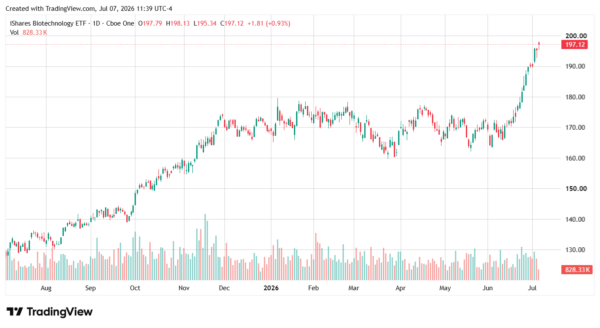
Greater Upside From Emerging Biotech CompaniesState Street SPDR S&P Biotech ETF (NYSEARCA: XBI) With an expense ratio of 0.35%, the SPDR S&P Biotech ETF (XBI) provides investors with an affordable way to gain exposure to the biotechnology industry. Unlike market-cap-weighted biotechnology funds, XBI uses an equal-weighted approach, giving smaller and mid-sized biotechnology companies a greater representation alongside larger firms. This structure offers investors broader exposure to emerging biotech companies that may have significant growth potential driven by innovative drug development, clinical trial successes, and advancements in biotechnology research. 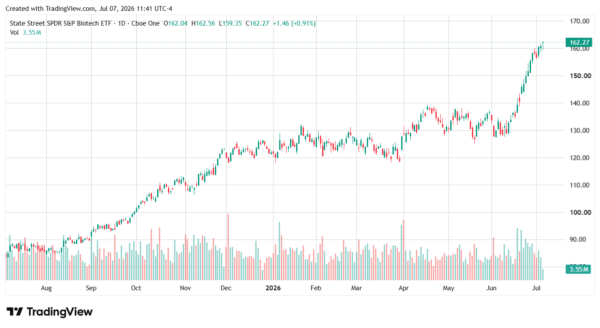
A Higher-Risk Strategy for Short-Term TradersProShares Ultra Nasdaq Biotechnology ETF (NASDAQ: BIB) With an expense ratio of 0.95%, the ProShares Ultra Nasdaq Biotechnology ETF (BIB) is designed for investors seeking leveraged exposure to the biotechnology sector. The fund aims to deliver twice (2x) the daily performance of the Nasdaq Biotechnology Index, making it a tactical investment vehicle rather than a traditional long-term holding. 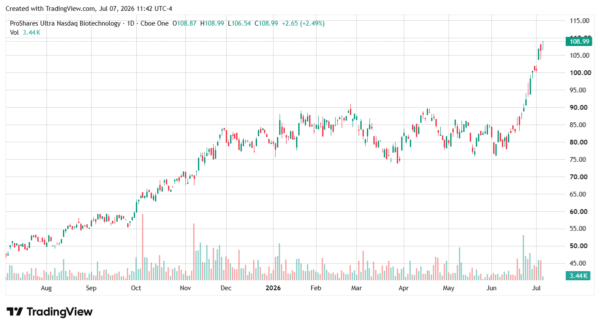
Why Biotech Could Be One of the Market’s Biggest Growth OpportunitiesThe biotechnology sector appears to be entering a new growth phase, fueled by increased merger and acquisition activity, breakthrough medical innovations, and the growing use of artificial intelligence in drug discovery. As large pharmaceutical companies race to replenish their product pipelines, many smaller biotech firms are becoming attractive acquisition targets, creating new opportunities for investors. This is a PAID ADVERTISEMENT provided to the subscribers of StockEarnings Free Newsletter. Although we have sent you this email, StockEarnings does not specifically endorse this product nor is it responsible for the content of this advertisement. Furthermore, we make no guarantee or warranty about what is advertised above. Your privacy is very important to us, if you wish to be excluded from future notices, do not reply to this message. Instead, please click Unsubscribe. StockEarnings, Inc |
