
Dear reader,
Most investors run from volatility. The method I have used for the last decade turns it into a weekly paychecks.
Instead of betting on which way the market moves, this strategy harvests income from the swings themselves.
One setup. Once a week. Designed to pay, week after week — without guessing direction or day trading.
[See how volatility becomes cash flow →]

Is the Airline Stock Dip After the Iran Attacks Justified?
Authored by Nathan Reiff. Posted: 3/10/2026.

Key Points
- Many airline stocks have plummeted by 20% or more in the last month amid the start of war in Iran and related oil price volatility.
- Airline companies face numerous negative pressures related to the war, including canceled flights, the potential for suppressed demand, and more.
- Jet fuel prices and cracks have spiked, meaning that even airlines not doing business within the area of conflict will feel the repercussions.
- Special Report: Have $500? Invest in Elon's AI Masterplan
As the war in Iran appears likely to continue, it may be no surprise to investors that airline stocks have been among the first to feel a significant impact. These shares are closely tied to fuel costs, geopolitical stability and consumer demand—all three of which have grown increasingly erratic as the conflict escalates and spreads geographically. Both major carriers and smaller domestic and regional names have seen sharp declines: Delta Air Lines (NYSE: DAL) and American Airlines Group Inc. (NASDAQ: AAL) have each fallen roughly 22% and 27%, respectively, over the past month.
For some investors, that price decline may present an opportunity to add to positions in the sector. But it will be important to weigh whether the initial shock of the conflict—and the attendant oil-price worries—fully explains the selloff, given the airlines' relatively strong recent domestic performance. If the conflict proves prolonged and further pressures fuel and demand, delaying purchases or building positions gradually may be prudent.
Major Air Carriers Face Multiple Negative Drivers
Only 48-Hours Left? (Ad)
I've worked for the CIA, personally met four US presidents, and spent 45 years studying the markets—calling Black Monday six weeks before it happened, predicting the fall of the Berlin Wall, and pinpointing the exact bottom in 2009. But what I'm about to share with you is the boldest prediction of my career.
After meeting Elon Musk face-to-face at a private gathering of Wall Street elites and months of my own research, I'm now staking my reputation on one date: March 26, 2026. That's when I believe Elon will announce the SpaceX IPO—what Bloomberg is calling the biggest listing of all time. I have found an access code that lets you grab a pre-IPO stake before it happens, but in 72 hours, your window could close.
Click here to see how to claim your SpaceX access codeDelta, American and other major carriers have been hit by a combination of negative factors.
First, thousands of commercial flights to and from locations across the Middle East have been canceled, creating operational and logistical costs while eroding revenue potential.
Second, jet-fuel costs have risen sharply. The Argus US Jet Fuel Index climbed to $3.88 on March 6 from $2.50 just a week earlier. While crude oil itself has been volatile, refined products such as jet fuel have experienced even greater stress. Jet-fuel prices and so-called "cracks"—the differential between crude oil and the refined jet fuel—have surged.
Third, consumer demand remains uncertain. In its most recent earnings report, Delta said demand remained healthy despite government-shutdown-related headwinds, citing loyalty and cargo growth and improvements in non-ticket revenue.
Fellow Big Four carrier United Airlines (NASDAQ: UAL), in its Q4 2025 report, pointed to its highest-ever seat completion factor and a 12% year-over-year gain in premium revenue.
If consumers expect higher gasoline and broader price increases due to oil-market volatility, leisure travel could weaken as households redirect spending toward essentials. That drag on demand might not be immediate but could persist even after fuel markets stabilize.
Can Regional Airlines Fare Any Better?
Even airlines that don't operate in the Middle East—or those that are primarily domestic—are likely to be affected because fuel is a major cost for all carriers.
One modest bright spot is Air Canada (TSE: AC), which has fallen only about 13% in the last month. Still, a decline of that size is hardly a win for the industry as a whole.
Some Wall Street analysts have already adjusted expectations. Since the start of the month, for example, Weiss downgraded DAL to Hold from Buy, and other firms have trimmed price targets. That could lead some investors to wait for further price declines before entering positions.
Watching short-interest trends can also help gauge market sentiment. Companies like American were already facing rising short interest before the conflict began, which the current environment could amplify.
Ultimately, how quickly and how far airline stocks recover will depend on the duration and geographic spread of the war. The start of 2026 may feel eerily similar to early 2020, when COVID-19 effectively grounded the industry worldwide—though to reach those lows, share prices would need to fall substantially farther than they have so far. For now, bearish investors may wait to see how low airline stocks can fly.
Energy Vault Electrifies Market With Accelerated Growth
Authored by Thomas Hughes. Posted: 3/19/2026.

Key Points
- Energy Vault’s latest quarterly update showed sharply higher revenue and improving profitability metrics alongside a larger contracted backlog.
- Management’s 2026 outlook calls for continued top-line growth, but margins and cash generation remain key execution tests.
- Analyst sentiment has been cautious, while institutional ownership remains significant and short interest is notable.
- Special Report: Have $500? Invest in Elon's AI Masterplan
Energy Vault (NYSE: NRGV) faces risks and hurdles, but it appears on track to sustain strong growth, improve profitability, and create value for investors. The Q4 release and guidance update not only confirm the company's trajectory but show its flywheel is generating cash flow faster than anticipated. Among the highlights: an improving bottom line driven by an impressive revenue surge and operational execution that produced a surprise adjusted profit, positive cash flow, and stronger capitalization — trends the company expects to continue into 2026.
What is Energy Vault? It is a utility-grade energy storage company focused on colocated storage for renewable projects. One of its differentiators is a gravity-based system for long-duration storage: towers and cranes lift heavy blocks to store potential energy — much like the weights in a cuckoo clock — enabling long-term energy storage without the degradation typical of chemical batteries. The company also offers lithium-ion, hydrogen, and hybrid solutions for municipalities, industries, and major utilities.
Energy Vault Outperforms and Issues Strong Guidance for 2026
Only 48-Hours Left? (Ad)
I've worked for the CIA, personally met four US presidents, and spent 45 years studying the markets—calling Black Monday six weeks before it happened, predicting the fall of the Berlin Wall, and pinpointing the exact bottom in 2009. But what I'm about to share with you is the boldest prediction of my career.
After meeting Elon Musk face-to-face at a private gathering of Wall Street elites and months of my own research, I'm now staking my reputation on one date: March 26, 2026. That's when I believe Elon will announce the SpaceX IPO—what Bloomberg is calling the biggest listing of all time. I have found an access code that lets you grab a pre-IPO stake before it happens, but in 72 hours, your window could close.
Click here to see how to claim your SpaceX access codeEnergy Vault delivered a robust quarter driven by a substantial capacity ramp. Operating and contracted capacity increased 8.3x on a trailing-twelve-month (TTM) basis, contributing to a 358% jump in Q4 revenue to $153.3 million — roughly 50 basis points ahead of consensus. That revenue strength, along with solid execution, is accelerating the company's path to profitability.
Q4 2025 results also showed a marked improvement in GAAP gross profit, with gross margin expanding by more than 1,000 basis points, alongside positive adjusted EBITDA and adjusted net income. In short, Energy Vault returned to positive adjusted earnings in the quarter, giving management the confidence to issue upbeat guidance and point to an improving profitability profile.
Looking ahead, 2026 could be stronger still. The company is forecasting about 30% revenue growth at the midpoint, well above the MarketBeat consensus. That outlook is supported by the TTM capacity ramp and a backlog that grew 42% sequentially and 300% year-over-year to more than $1.3 billion.
Cash flow outlook is another positive. The company increased its cash balance in Q4 through operations and capital-raising activities, and it expects to build on that position in 2026. In other words, Energy Vault appears better capitalized for the year ahead, and the risks of dilution and rising debt seem to be receding as the company moves toward sustained profitability.
Analysts at Odds With Results; Institutions Are Accumulating
MarketBeat did not record immediate analyst updates following the release, though revisions are likely. The Q4 results and guidance run counter to recent trends of price-target cuts and downgrades driven by concerns about profitability, growth visibility, and capitalization.
While these results may not immediately prompt analysts to change their ratings, they could prevent further deterioration in sentiment. Currently the stock carries a consensus Reduce rating from five analysts, reflecting a 60% sell-side bias and a view that the stock is overvalued near $3.80. Institutional investors tell a different story: they own roughly 40% of outstanding shares and were net buyers in early 2026, purchasing at a rate of more than $2 for every $1 sold.
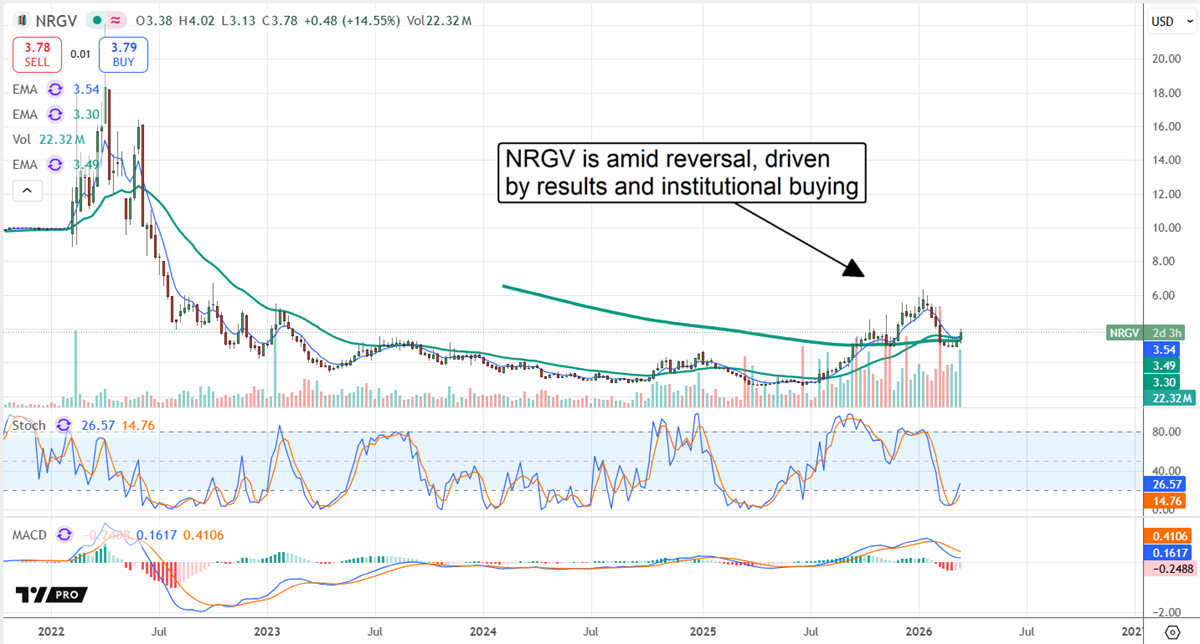
Institutional activity has coincided with a price reversal. NRGV hit a low in 2025 and then rallied above key moving averages, suggesting potential for further upside. In 2026, a pullback found support at a critical pivot, indicating improving market sentiment.
In this environment, the prevailing bearish view appears to be shifting toward a more bullish one and could gain momentum as the year progresses. How quickly that happens will depend on upcoming news, continued institutional buying, and whether analysts revise their stances. If sentiment turns more positive, the stock could retest the $6 level and potentially move higher. The primary risk is elevated short interest — short sellers increased positions before the report and could limit near-term upside.
This email content is a sponsored email provided by Traders Edge Network, a third-party advertiser of InsiderTrades.com and MarketBeat.
If you need assistance with your newsletter, feel free to contact MarketBeat's South Dakota based support team at contact@marketbeat.com.
If you no longer wish to receive email from InsiderTrades.com, you can unsubscribe.
© 2006-2026 MarketBeat Media, LLC. All rights reserved.
345 N Reid Place #620, Sioux Falls, S.D. 57103-7078. United States..