| Written by Chris Markoch 
Even amidst market uncertainty, risk-tolerant investors may want to look at opportunities in stocks trading under $20. With broad market volatility persisting through the first quarter of 2026, it can feel tough to find growth outside of energy stocks. But history consistently shows that buying quality stocks at depressed prices is almost always a winning formula. Right now, fear-driven selloffs in several sectors have created entry points that patient investors may look back on fondly. Each of the stocks below carries a consensus analyst rating of Moderate Buy or better, plus a consensus price target reflecting at least 30% upside over the next 12 months. And all three sit outside the energy sector, proving that opportunities exist for investors willing to do their homework. A Building Materials Play With Major Upside QXO Inc. (NYSE: QXO) is the largest publicly traded distributor of roofing, waterproofing, and complementary building products in North America, with ambitions to become the tech-enabled leader in the approximately $800 billion building products distribution industry. That's a big vision, and analysts appear to believe in it. QXO stock is down about 20% in the last month and about 1% in 2026. The pullback is tied to a challenging earnings report that showed weak profitability margins and declining revenue, rattling investor confidence. Still, analysts remain bullish, with a consensus price target of $32.27, 70% above the stock's closing price on March 30. The caveat? Short interest sits around 17%, meaning retail investors could face some pressure in the near term. QXO may reward patient investors willing to ride that out. Riding the AI Identity Security Wave SailPoint (NASDAQ: SAIL) is a leader in unified identity security for enterprises, offering an AI-powered platform designed to address the critical security challenges of modern IT environments. In a world where AI agents and machine identities are multiplying rapidly, that's a growing market with no signs of slowing down. SAIL stock is down about 7% over the last month and has fallen by about 30% year-to-date, putting it well under $20 at about $13. The drop came after management issued conservative forward guidance that spooked investors, even though the company's annual recurring revenue crossed the $1 billion level, rising 28% year over year. But analysts see a rebound: the consensus price target of $21.49 represents over 60% upside. What makes SailPoint particularly compelling is the institutional conviction behind it. Buyers are putting $1.45 billion to work versus just $239 million in sales—a lopsided ratio that speaks volumes. With short interest at only 3.4%, there's virtually no headwind from bearish traders, making this one of the cleaner setups on this list. A High-Risk, High-Reward Drone Defense Play Ondas Holdings Inc. (NASDAQ: ONDS) is a leading provider of autonomous systems and private wireless solutions, targeting customers in rail, energy, public safety, critical infrastructure, and government markets with mission-critical networks, autonomous drones, counter-drone solutions, and artificial intelligence capabilities. Defense spending tailwinds are squarely in its favor. Trading around $8 per share, ONDS stock has taken a beating. It's down about 15% in the last month and 13% year-to-date. A fourth-quarter loss of $101 million weighed heavily on investor sentiment, overshadowing some genuine operational progress. But the analyst community is sticking with it, with a Moderate Buy consensus and a price target of $17.25, implying more than 100% upside. Institutional ownership tells an interesting story here. Buyers have committed $705.87 million versus just $104.53 million in sales. But total institutional ownership is only around 37%, meaning there's plenty of room for more institutional money to flow in as the company matures. The risk is real, though. Short interest at 34% is significant, and that alone is reason to approach Ondas with eyes wide open. This one is strictly for investors with a high-risk tolerance and a long enough runway to let the story play out. How to Balance Risk Across Speculative Stocks None of these stocks is without risk, which is precisely why they're trading where they are. For investors willing to take on different levels of risk, spreading exposure across all three could help balance the overall profile. SAIL's near-zero short interest offsets some of the pressure from ONDS's crowded short trade, with QXO sitting somewhere in between. It's also worth noting that analyst consensus price targets are 12-month projections, not guarantees. They represent informed expectations, not certainties. But for risk-tolerant investors with a 12-month horizon, QXO, SAIL, and ONDS each offer a combination of analyst conviction and meaningful upside that's hard to ignore.  Read This Story Online Read This Story Online |  |
| Written by Chris Markoch 
Cruise line operator Carnival Corp. (NYSE: CCL) is down nearly 6% after it reported Q1 2026 earnings on March 27. Investors seem to be concerned about the company’s earnings guidance for the coming year, despite Carnival’s double beat and bullish outlook for 2026 bookings. Shares of cruise line stocks had been soaring in 2026 as the industry is experiencing smooth sailing with bookings at or near record levels. Carnival's financial results bore this out, but the market punished the stock for reasons out of its control. Still, the company's improving balance sheet, discounted valuation, and long-term strategy support a bullish outlook, even as technical indicators signal short-term caution. Q1 Earnings and Guidance Were Strong Carnival noted in its Q1 report that approximately 85% of its 2026 bookings are already on the books, and cumulative future-year bookings hit a first-quarter record. That went along with a beat on the top and bottom lines. Adjusted earnings per share (EPS) of 20 cents beat estimates by 2 cents and were up about 53% from the prior year. Revenue of $6.17 billion edged out analyst expectations of $6.13 billion and was about 6% higher year-over-year. The wild card in the report was fuel costs, which have risen considerably following the recent spike in oil prices. Carnival doesn’t hedge fuel prices, so a 10% increase would result in a $160 million hit to the company's bottom line. Put another way, that works out to approximately 11 cents per share in diminished earnings. Since the report, several analysts have lowered their price targets on CCL stock. However, their response seems prudent, not panicked, while also maintaining a consensus Moderate Buy rating. PROPEL: Carnival's Roadmap for the Next Chapter Beyond the quarterly numbers, the bigger story in Carnival's report may be the formal launch of PROPEL (Powering Growth and Returns Responsibly), the company's strategic framework through 2029. Management has set ambitious targets for the plan, including: - Return on invested capital (ROIC) above 16%
- EPS growth of more than 50% versus 2025
- The return of more than 40% of operating cash flow to shareholders, totaling an estimated $14 billion
That shareholder return commitment is backed by a freshly authorized $2.5 billion buyback program and a reinstated dividend. Underpinning all of this is disciplined capacity growth. Only three new ships are planned throughout the PROPEL period. That comes alongside continued investment in private destination assets and fleet modernization. Notably, PROPEL also carries a leverage target of net debt to earnings before interest, taxes, depreciation, and amortization of 2.75x, signaling that returning capital and paying down debt are not mutually exclusive goals for management. Fuel Costs Could Lead to a Snapback Carnival can’t do much about rising oil prices, and that will be a stressor on the company's earnings for as long as prices remain elevated as a consequence of the Iran war. However, it would be far more concerning if the company were projecting margin pressure based on lower demand, which is not the case. Nevertheless, analysts have to make forecasts based on the available facts. That means the bet is for oil prices to remain elevated, which justifies lowering their price targets on CCL stock. Two things are worth noting. First, the lower price targets still allow for some upside. Most of the “lower” price targets still leave about 20% upside from CCL's current stock price. Second, fuel costs can reverse, and if they do, Carnival will reap those benefits. That may prompt analysts to rethink their targets for CCL and is likely to occur before the company delivers its next earnings report, which is scheduled for June. However, the cost of fuel isn’t a good reason to buy or hold Carnival during this period. A better reason is the company’s improving debt picture. Like most cruise line operators, Carnival took on significant debt in 2020. But according to its most recent report, interest expenses were down to $291 million from $377 million. That’s further indication of a stronger balance sheet. Another reason is the company’s valuation. At 11x current earnings and around 13x forward earnings, investors can get CCL stock at a discount to the broader market, consumer discretionary stocks in general, and the hotels, resorts, and cruise line industry. Technical Outlook: Watch for a Potential Death Cross Still, the technical chart tells a cautionary tale heading into April. CCL is currently trading around $24, well below both its 50-day and 200-day simple moving averages (SMA). More importantly, in the short term, the 50-day is rapidly converging on the 200-day SMA from above, suggesting a death cross pattern is imminent. Historically, that's a signal that draws selling pressure from technically-oriented investors. That said, a death cross is a lagging indicator, and by the time it forms, much of the damage may already be priced in. CCL has already shed roughly 25% from its recent highs near $34. 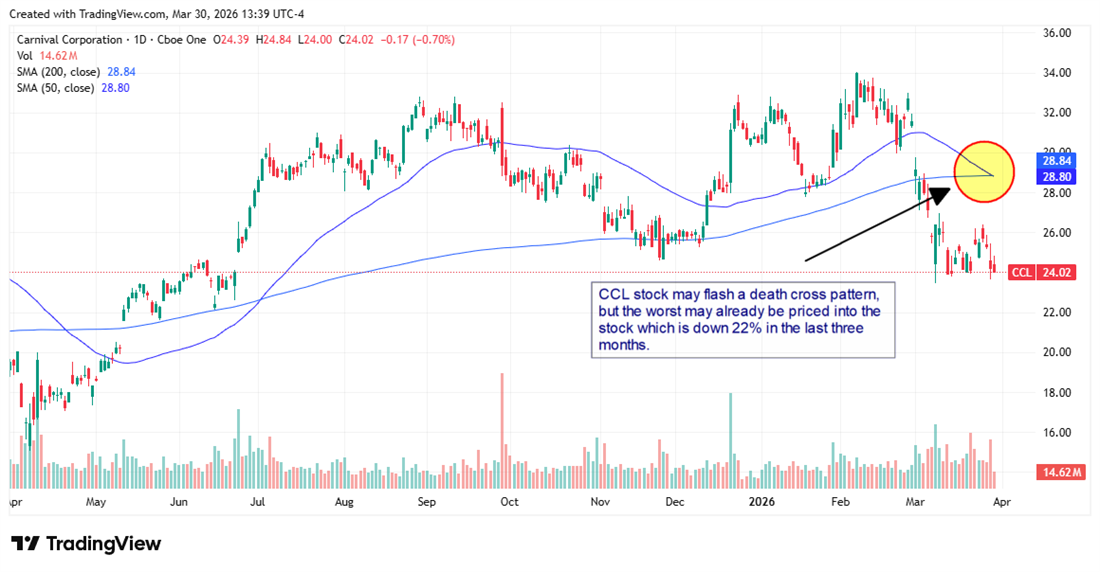
A true breakdown would likely require a new fundamental catalyst, such as sustained elevated fuel costs, weakening bookings, or a meaningful uptick in cancellations. Absent those, the stock may find support near current levels, especially given its undemanding valuation. If oil prices moderate, a snapback rally could develop well ahead of the June earnings report. Read This Story Online |  |
| Written by Jennifer Ryan Woods 
Over the last several years, the higher interest rate environment has been a persistent headwind for commercial real estate, and Starwood Property Trust (NYSE: STWD) has been no exception. The real estate investment trust (REIT)—which specializes in originating, acquiring, and managing commercial mortgage loans and other real estate-related investments—has seen its stock trend meaningfully lower over the last five years. The past year has been challenging for the company, driven by a combination of disappointing revenue, declines in book value per share (BVPS), and several quarters in which earnings failed to cover its dividend payout. However, the tide may be turning, as a mix of recent developments could signal near-term upside. Pandemic Pressure Followed by Rising Rates Pressured Shares Starwood’s struggles began during the COVID-19 pandemic, as shares plunged in early 2020, falling from around $26 to below $10 as mortgage REITs were hit by liquidity concerns and uncertainty across commercial real estate markets. While shares rebounded to pre-pandemic levels by mid-2021 as investor confidence returned, new headwinds quickly emerged. But as rates began rising in March 2022, property values declined and lending margins tightened, once again putting pressure on commercial mortgage REITs. The impact on STWD stock has been significant, with shares falling more than 30% over the past five years. But Starwood was not alone. Competitors such as Ares Commercial Real Estate (NYSE: ACRE), Blackstone Mortgage Trust (NYSE: BXMT), and Apollo Commercial Real Estate Finance (NYSE: ARI) also felt the pinch, falling roughly 65%, 40%, and 27%, respectively, over the same period. However, over the last year, Starwood has faced its own pressures, which have caused it to underperform the group. The stock has declined roughly 12% over the last year, and at a recent trading price around $17.37, it has been flirting with the 52-week low it hit in April 2025. The stock has also lagged the broader REIT industry, which is down less than 12%, and has been notably weaker than many of its closest peers. Over the past 12 months, Ares shares have risen around 4.75%, Blackstone Mortgage Trust is down roughly 3.65%, and Apollo Commercial Real Estate Finance is up more than 10%. Inconsistent Earnings and Dividend Coverage Weigh on Sentiment One issue that has weighed on Starwood is its inconsistent earnings. While earnings per share (EPS) have beaten expectations in four of the last six quarters, revenue has missed in five of those six quarters. The company has also reported negative net interest income in certain quarters, which has weighed on sentiment. Starwood’s dividend has also created some uncertainty. For more than a decade, the REIT has maintained its quarterly dividend of 48 cents per share, which currently yields about 11.26%. However, over the past four quarters, earnings have not fully covered the dividend, resulting in an unsustainable payout ratio of roughly 165%. Against the still-challenging higher-rate backdrop, the combination of mixed earnings and uneven dividend coverage has made some investors cautious. However, several recent developments could help reignite optimism. Better-than-expected revenue for the first time in a while, positive commentary from the company regarding its dividend coverage, and a newly authorized share buyback may be just what investors need to regain confidence. Stronger Results and a Potential Buyback Could Shift Sentiment In Starwood’s Q4 2025 earnings report, released on Feb. 25, the REIT reported EPS of 42 cents, beating analyst estimates by a penny. Revenue of $492.95 million came in roughly $23 million above estimates. The better-than-expected revenue followed multiple consecutive quarters of revenue misses. Starwood also pointed to a stronger balance sheet, having executed $4.4 billion in capital raises and ending the year with $1.4 billion in liquidity. While EPS did not cover the 48-cent quarterly dividend, the company said on the earnings call that it expects dividend coverage to improve steadily throughout the year. Despite these positives, a continued decline in BVPS remained a concern. Following the earnings release, the company also announced that its board of directors authorized the repurchase of up to $400 million of its outstanding common stock and convertible notes over the next 12 months using existing cash. It remains to be seen how this will play out, but a buyback of up to 6% of shares outstanding could have a meaningful impact on earnings and support the stock. Wall Street Is Waiting for Clearer Signs of Improvement The reaction to the fourth-quarter earnings report and buyback announcement was mixed. Shares rose roughly 2% on higher-than-normal volume, though two analysts lowered their price targets despite both maintaining Outperform ratings on the stock. Currently, four analysts rate the stock a Hold while three rate it a Buy. However, the average 12-month price target implies potential upside of nearly 16% over the next 12 months. While Wall Street may continue its wait-and-see approach for the time being, the outlook could turn more bullish in the near term if Starwood delivers another quarter of strong earnings and revenue, improves its dividend coverage, and begins actively repurchasing shares. Read This Story Online |  Gold just hit a record high. NASDAQ valuations are stretched. Geopolitical tensions keep escalating. When these signals align, experienced investors don't panic — they prepare. A new guide breaks down which stocks and sectors have historically held strong when the broader market pulls back, and outlines practical steps you can take to position your portfolio before conditions shift further. Download your free crash protection guide today |
|