Welcome to The Early Bird! Every weekday morning at 7:00 AM Eastern, we send one quick email that answers a simple question before the market opens: What actually matters today? You’ll see the biggest stories, earnings, economic events, and market-moving headlines, boiled down so you can scan it in a minute and start the day informed instead of scrambling. Before we can send your first issue, there’s one quick step left. Just confirm your subscription below so it lands in your inbox, not your spam folder. Confirm Your Subscription Confirming now means you’ll get tomorrow morning’s Early Bird right on time. Glad to have you with us,
The Early Bird Team 🐤
*Confirm Your Subscription to The Early Bird P.S. Changed your mind? You can unsubscribe using this link.
Further Reading from MarketBeat.com Wendy's Stock Is Cheap, But Can the Turnaround Actually Work?By Thomas Hughes. Date Posted: 2/17/2026. 
Key Points - Wendy's is well-positioned to rebound, but the timing is questionable amid competitors taking market share.
- Analysts are trimming targets but remain highly confident in the Hold rating.
- Institutions and short-sellers have the market set up to be squeezed when a catalyst emerges.
Wendy’s (NASDAQ: WEN) stock has fallen sharply from its highs, creating what looks like a deep-value opportunity for investors. Trading at roughly 12 times current-year earnings and under eight times a 2030 forecast, the valuation implies substantial upside versus industry leaders — but the key question is whether management can execute a turnaround. The international growth story remains intact and supports results today. The bigger issue is self-inflicted weakness in the core U.S. market, which is likely to weigh on results this year. Management acknowledges several missteps and is taking corrective action. The harder challenge is changing public perception: the company has lost market share to competitors such as McDonald’s (NYSE: MCD) and is struggling to regain traffic. Several quarters of declining U.S. comps, margin pressure and tepid guidance have weighed on the stock. Analysts Lead Wendy’s Stock to Long-Term Low Analyst sentiment on Wendy’s has trended bearish, with price-target revisions contributing to recent weakness. These trends point toward another small, single-digit decline from mid-February levels, but there is a silver lining. Some indicators are more constructive. The number of analysts covering Wendy’s began rising in 2025 and is up roughly 30% to 26 analysts in Q1 2026. Despite persistent headwinds, the consensus rating is Hold, with a conviction rate of about 62% and an even split between Sell and Buy recommendations. Analysts have pushed the stock to long-term lows and imply a price floor around $7, which aligns with those lows. At the same time, consensus forecasts suggest roughly 30% upside, raising the question of what might trigger a rebound. Improving earnings that translate into stronger cash flow and a clearer capital-return outlook would be a plausible catalyst. Wendy’s has already trimmed its dividend and scaled back buybacks. If performance does not improve, the dividend could face further reduction or suspension. Free cash flow is declining but remains positive, currently sufficient to cover payouts. The 2025 free-cash-flow payout ratio is about 62% — somewhat high but still allowing room to service debt. The balance sheet shows lower cash, current and total assets, combined with higher long-term debt and liabilities, driving a decline in shareholders' equity of more than 50%. Shareholder equity stands at $117.3 million and leverage is elevated: long-term debt is roughly 23x equity and about 0.6x total assets. Short-Sellers Set Wendy’s Market Up For Rebound Short interest is a headwind for Wendy’s investors. While not at record levels, short interest has been trending near historical highs — about 20% of the float as of late January — and that makes a sustained rebound less likely until the short position eases. When it does unwind, the bounce could be vigorous. Institutional investors own more than 85% of the shares outstanding, which provides a degree of support; institutional buying in early 2026 outpaced selling by roughly two-to-one, suggesting a potential tailwind once positive momentum returns. From a technical perspective, critical support sits near the long-term lows reached during the COVID-19 panic, around $6.82 — just below the low-end analyst target of $7. Momentum indicators such as the MACD and stochastic show the stock is deeply oversold, and the rising trading volume on the way down suggests buyers have been accumulating bargains. 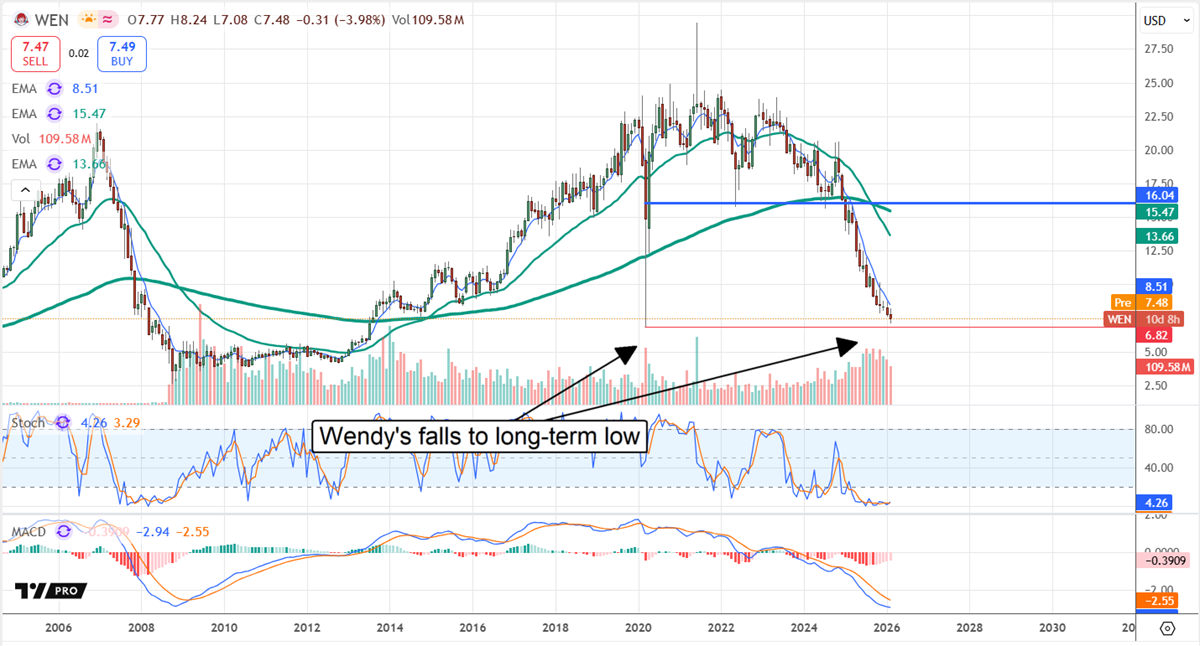
The growing volume as prices fell is a constructive sign, but the upcoming results are a key test. If results fail to show improvement or disappoint relative to expectations, the recovery could stall and there is a risk of new lows, possibly triggering a deeper selloff. Wendy’s currently expects weak comparable-sales trends to persist, plans additional store closures to improve footprint efficiency, and has guided revenue and earnings well below consensus. Consumer Tailwinds Can Be a Catalyst for Wendy’s Early 2026 data point to consumer tailwinds. Labor markets remain resilient, supporting broad employment, and tax refunds appear stronger than last year. Preliminary figures suggest refunds are averaging more than 10% higher than in 2025, which would be supportive for consumers and consumer discretionary stocks.
| 

