Welcome! Thank you for subscribing to the Earnings360 newsletter, your daily source for quarterly earnings news and updates.
Each morning edition contains a wrap-up of today's pre-market earnings announcements and yesterday's earnings announcements after the closing bell.
Please take a moment to confirm your subscription below so we can ensure these updates reach your inbox.
Confirm Your Subscription Here
The Earnings360 Team
Additional Reading from MarketBeat Media Whirlpool's Worst May Be Over—Upside Opportunity AheadWritten by Thomas Hughes. Published 11/17/2025. 
Key Points - Whirlpool's 2026 outlook has its stock price tracking for a reversal that could add 25% to 100% to its stock price within a few quarters.
- The high-yielding dividend is reliable following management's right-sizing.
- Institutional and analyst trends suggest a robust upside for income investors.
Whirlpool’s (NYSE: WHR) downtrend may not be fully over, but technical, fundamental and market indicators are starting to align — suggesting downside looks limited while upside potential appears considerable. Daily, weekly and monthly charts show a market that has been trending lower but is extremely oversold and overextended — poised for a rebound supported by improving operational performance and renewed sell-side interest. Whirlpool’s Market Is Deeply Oversold: Market Recovery Ahead Trump Ally Says Congress Approved the Setup for a Digital Dollar 2.0
But according to Rep. Marjorie Taylor Green, it's a bill that contains "the entire setup, groundwork and infrastructure to move from cash to digital currency." >>> Click Here before it becomes law. The chart action is notable: recent daily candlesticks reflect a catalyst revealed in 13F filings showing that David Tepper’s Appaloosa Management significantly increased its stake. Appaloosa, known for pursuing high-conviction positions, added roughly 5.5 million shares and is now a nearly 10% owner. While not a controlling shareholder, the stake gives Appaloosa meaningful influence and signals confidence that results should start to improve in fiscal 2026. That filing coincided with a roughly 6% pop in the stock, indicating buyers stepped in at a critical level. Those price levels are broadly in line with the 2020 lows from the COVID-19 selloff. In short, this could be an early sign the tide is turning for Whirlpool. Headwinds remain, but the company expects tariff pressures to ease in 2026, and analysts are forecasting meaningful margin improvement. 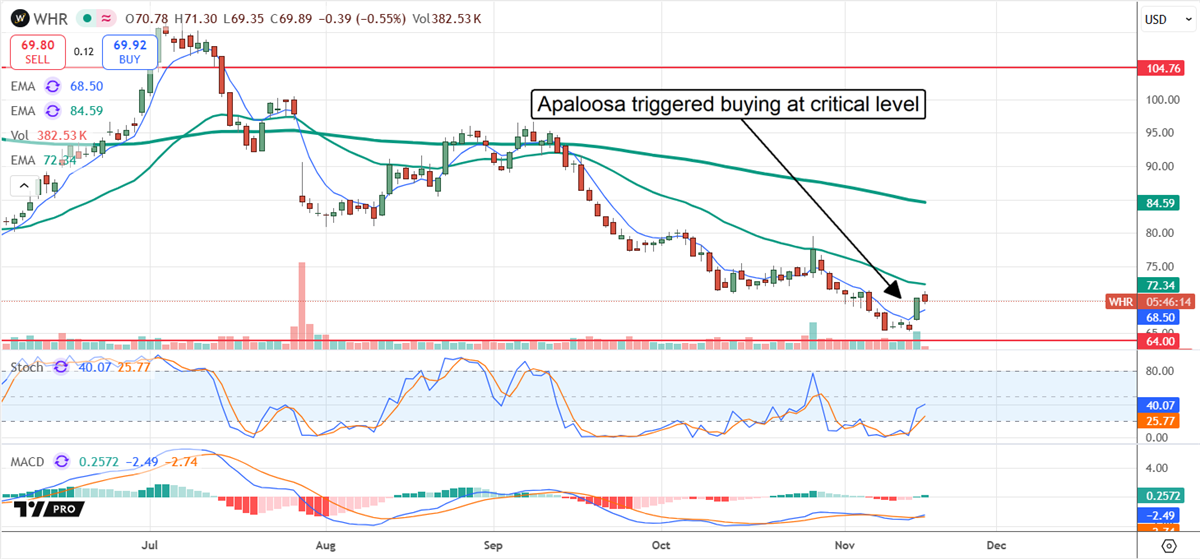
Analysts project Whirlpool’s fiscal 2026 revenue to be roughly flat year-over-year, with earnings rising about 8%. Longer-term estimates improve, with revenue growth expected to resume by fiscal 2027 — and current estimates may be conservative. While the outlook for rate cuts has softened, the FOMC is still expected to ease policy by another 50 to 100 basis points by mid-next year and potentially further by the end of 2026. That backdrop suggests housing activity could pick up and help underpin Whirlpool’s performance, particularly given its largely domestic supply chain. Whirlpool’s Insider, Institutional, and Analysts Trends Hang in the Balance Sell-side activity points to value alongside risk. Insiders recorded no buys or sells in 2025 — which can be read two ways — but collectively still own more than 2% of the company, a meaningful stake given the roughly $4 billion market cap as of mid-November, and they haven’t been selling. Institutional ownership remains high. After some selling in early Q4, institutions have been net buyers in 2025 and now own more than 90% of the stock, providing durable market support. Analysts’ trends are mixed. MarketBeat’s consensus sentiment is Reduce based on nine tracked analysts: four Hold, two Buy and the remainder Reduce. Recent price-target revisions were varied, but there remains a consensus expectation that implies roughly 25% upside and the potential for catalysts in upcoming releases. If operational quality improves over the coming quarters and the outlook brightens, analyst sentiment is likely to follow, which would help lift the stock. In that scenario WHR could plausibly gain about 25% initially and then participate in a larger recovery thereafter. Whirlpool’s Biggest Risk Is Priced in and in the Rearview Mirror The largest near-term risk — a dividend cut — has already occurred. The current payout still yields north of 5% as of November and appears manageable. Elevated debt is a concern, but improved cash management and expected margin improvement should help mitigate that risk.
|