

Ticker Reports for October 31st

MongoDB: It's No Trick, This AI Play Is a Treat
MongoDB (NASDAQ: MDB) was on track to end October as the Most Upgraded stock, as tracked by MarketBeat. The only reason it didn’t is that Alphabet reported its earnings on Oct. 30, outperforming the consensus, providing solid guidance, and sparking a round of bullish analyst revisions. The takeaway is that MongoDB, once in the doghouse because it wasn’t living up to AI-inflated expectations, is back in favor.
The data reveals a significant shift in the outlook, reflected in the stock’s price, and a catalyst ahead to drive another improvement in market sentiment.
The catalyst is the Q3 earnings release scheduled for early December. The analysts are optimistic following the Q2 release, which revealed momentum and better-than-expected guidance. As it stands in early November, the consensus forecast is for tepid sequential growth and year-over-year (YOY) growth to slow to the low double digits.
However, the revision trend suggests outperformance is likely; the question is by how much. Based on the trends and last quarter's report, the $1 million sequential gain is expected to be outperformed by several hundred basis points with quarterly strength compounded by favorable guidance.
MongoDB Analysts Signals Shift in Sentiment
MarketBeat’s analyst data reveals strong and growing support for MongoDB. The 39 tracked analysts rate the stock as a consensus Moderate Buy. Coverage is on the rise, the bias is to the upside, and sentiment is firming.
More than 75% of the targets are pegged at Buy or equivalent; recent revisions included several upgrades and numerous price target revisions, with the consensus providing support in early December and the high-end pointing to another 25% increase.
Among the most recent reports is the initiation of coverage at Wells Fargo. The firm initiated coverage of the stock at Overweight and set a Street-high target of $430, citing factors such as agentic coding, software development, and the proliferation of agents running on the platform.
In their view, not only is the development of agents accelerating, but those in effect are on the verge of scaling. This provides a significant growth lever for the business that the market underappreciates.
MongoDB’s Chart Reflects Rapidly Improving Sentiment
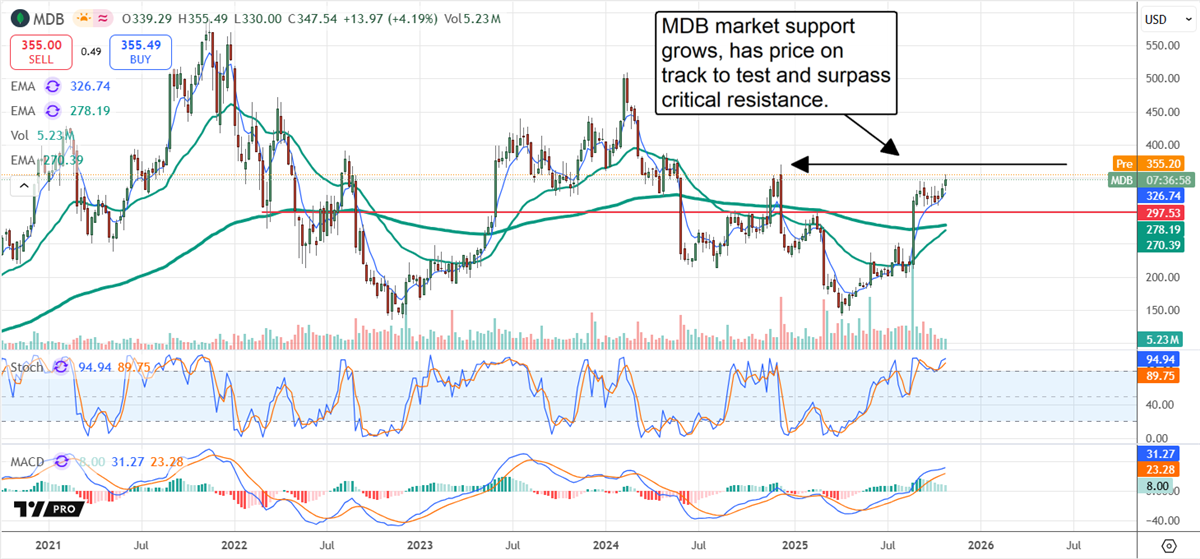
MongoDB’s stock price has been and remains range-bound. However, the Q3 action reflects the rapidly improving sentiment, suggesting that this market is on track for higher prices. Not only does the action reveal a bottom at the range’s low end, but the subsequent updraft is robust, driven by a record-high volume spike and compounded by bullish indications in the MACD and stochastic.
The price action in late October formed what appears to be a Bullish Flag and continuation pattern, but there is a risk.
The risk is the resistance targets. While MDB’s stock price broke out from its flag pattern bullishly and set a new closing high, it remains below a critical resistance target that could cap gains until a potent catalyst emerges. In this scenario, MDB’s stock price can advance to $370 but may struggle to move above that level until the earnings release.
Valuation Concerns? MongoDB Is a Value Relative to Low-Ball Estimates
There is some concern about valuation, given that the stock is trading at 93x its current-year earnings outlook, but it is pricing in robust growth. MongoDB’s consensus forecasts low-teens revenue growth, wider margins, and accelerated earnings growth over the next decade.
The earnings per share compound annual growth rate is expected to be in the low $20s, placing the stock at approximately 12x its 2035 forecast, which is likely conservative. In this scenario, MDB’s stock price could advance 100% to 200% from its early November levels to align with the broader market and other established tech companies that deliver profits and profitable growth.
Valuation concerns or not, the institutions are heavily exposed to this stock and have been buying on balance since Q2. The Q1 activity included significant sales, which align with the stock’s price drop.
The activity since then has been robust, accumulating shares at approximately $2 for each $1 sold, and aligns with the stock’s rebound. Assuming this trend continues, the institutional activity alone is enough to keep this stock’s price moving higher.

Nvidia CEO Makes First Ever Tesla Announcement
Nvidia CEO Makes First Ever Tesla Announcement
$14B Japanese Facility Signals TSMC's Bold AI Strategy
The artificial intelligence (AI) boom has unleashed a historic, seemingly insatiable demand for advanced computing power. At the epicenter of this technological revolution stands one company: Taiwan Semiconductor Manufacturing (NYSE: TSM) (TSMC), the critical manufacturing partner for nearly every major AI chip designer.
Amid this surge in demand, the company’s second factory in Japan marks a strategic next step in its $14 billion investment. This is more than a simple expansion; it is a direct response to the most critical questions facing investors and a clear signal of the company's long-term strategy to dominate the next era of technology.
A Counterintuitive Play for AI Supremacy
The primary driver behind TSMC’s aggressive capital spending is the unprecedented demand from the AI sector.
The numbers speak for themselves. In TSMC’s third-quarter 2025 earnings report, the company revealed that High-Performance Computing (HPC) (the segment that includes powerful AI accelerators) now constitutes a commanding 57% of its total revenue. This intense demand is highly profitable, contributing to the company's gross margin of 59.5% and prompting management to revise its full-year 2025 revenue growth forecast upward into the mid-30s percentage range.
At first glance, building a new semiconductor fabrication plant (or "fab") in Japan for more established technologies might seem like a diversion. However, the strategy is more sophisticated.
The new Kumamoto facility will focus on high-volume specialty process nodes (such as 12nm to 28nm) for key customers in the automotive and industrial sectors—a brilliant strategic maneuver.
By dedicating a new, highly efficient facility to these essential chips, TSMC frees up its most valuable and constrained asset: the advanced fabrication capacity in its Taiwan gigafabs. The shift allows the company to dedicate more cleanroom space and top-tier engineering talent to accelerating the ramp-up of the high-margin 3nm, 2nm, and future A16 nodes that the AI revolution is built upon. This move effectively optimizes TSMC's entire global production network for maximum profitability.
De-Risking the World's Most Important Supply Chain
For years, a key concern for investors has been TSMC's heavy reliance on manufacturing in Taiwan. The new Japan expansion is an integral part of its risk mitigation strategy. This approximately $14 billion project represents a significant and calculated component of a massive 2025 capital expenditure plan totaling $40 billion to $42 billion, underscoring a well-funded and deliberate global strategy.
By building a major facility in Kumamoto, Japan, the company is diversifying its manufacturing footprint into a geopolitically stable, trusted allied nation with a world-class engineering talent pool and a deeply integrated semiconductor supply chain.
The project's viability is further de-risked by strong support from the Japanese government and strategic partners such as Sony (NYSE: SONY), which ensures a stable operational environment. The move is part of a broader, multi-pronged global diversification plan that includes:
- Leading-edge fabs in Arizona, United States: Focused on serving the immense demand from U.S. AI and HPC customers.
- A specialty automotive fab in Germany: Designed to support the European automotive industry's transition to advanced vehicles.
This global strategy demonstrates TSMC's unmatched ability to execute complex, large-scale international projects. For customers who demand a resilient supply chain, this proven reliability fortifies its role as the industry's indispensable partner.
Why the Bull Case for TSMC Just Got Stronger
By simultaneously solving for capacity and de-risking its supply chain, TSMC is making its core investment thesis more compelling than ever.
The market has rewarded this strategy, with the stock delivering an impressive year-to-date return of over 54%.
Despite this run-up, Wall Street sees further stock appreciation, with a consensus Buy rating and an average price target of over $371, providing investors with a healthy upside.
This strategy directly strengthens the AI toll road argument: TSMC profits from every significant advance in AI, regardless of which company designs the winning chip. The Japan investment is a tangible move that widens and strengthens this toll road, making it ultimately more profitable.
While the stock trades at a premium price-to-earnings ratio (P/E) of around 31, the valuation reflects its dominant market position and clear growth catalysts. For investors, the nearly $14 billion expenditure should not be viewed as just a line item on a balance sheet. It is a strategic investment in durability, reliability, and dominance. This proactive fortification of its business model provides a clear, bullish signal that supports the stock's long-term growth trajectory.

Buffett, Gates and Bezos Quietly Dumping Stocks—Here's Why
Buffett, Gates and Bezos Quietly Dumping Stocks—Here's Why
How Royalty Pharma Prints Cash Without Biotech's Biggest Risks
Investing in biotechnology often feels like navigating a minefield. A single failed clinical trial can decimate a stock, while a blockbuster approval can generate spectacular returns. For many investors, this extreme volatility is a deterrent. However, an alternative model exists that allows participation in the industry’s upside while mitigating its most significant risks.
Royalty Pharma plc (NASDAQ: RPRX) has mastered this approach. Operating as a strategic financier rather than a traditional drug developer, the company has rewarded investors with a year-to-date stock appreciation of over 42%.
This performance is backed by a flurry of recent activity, including deploying nearly $1.3 billion across two major deals and raising an additional $2 billion in capital to fuel its next phase of growth, cementing its status as a compelling, lower-risk way to invest in the future of medicine.
How Royalty Pharma Prints Money From Medicine
Royalty Pharma's business model is elegantly simple. A biopharmaceutical royalty is a contractual right to a percentage of a drug's top-line sales. The company provides large, upfront cash payments to drug developers, academic institutions, and other innovators in exchange for the rights to these future royalties.
This structure creates clear benefits for all parties:
- For Partners: It provides immediate, non-dilutive funding for critical activities such as late-stage trials or commercial launches.
- For Royalty Pharma: It secures long-term, cash-generating assets tied to the performance of de-risked medicines.
For investors, the key lies in diversification. Royalty Pharma's portfolio comprises over 35 revenue-generating therapies spanning major therapeutic areas such as oncology, rare diseases, and immunology. This breadth spreads risk widely, ensuring that the underperformance of any single product does not derail the entire financial engine. It transforms the unpredictable nature of biotech into a more stable and forecastable business.
Deploying Capital, Delivering Growth
Royalty Pharma's recent moves demonstrate a well-oiled machine: raising capital efficiently, deploying it into high-quality assets, and returning the profits to shareholders.
A Fresh $2 Billion for New Opportunities
In September, the company priced a $2 billion offering of senior unsecured notes with maturities stretching out to 2055. This successful capital raise highlights its strong access to debt markets and provides the dry powder needed to execute large-scale acquisitions from a position of financial strength, keeping its growth pipeline full.
Betting on a Blockbuster Cancer Drug
In August, Royalty Pharma acquired a royalty interest in Amgen's (NASDAQ: AMGN) new cancer therapy, IMDELLTRA, for up to $950 million. IMDELLTRA is a first-in-class treatment for small-cell lung cancer, an aggressive disease with a poor prognosis. This deal is a textbook example of the company's de-risking strategy. The drug is already FDA-approved and on the market, generating $215 million in sales in the first half of 2025. This transaction secures a long-duration revenue stream, expected to extend through at least 2038, on a commercial-stage asset with analyst-projected blockbuster potential.
Funding Innovation With Built-in Protection
Also in September, the company partnered with Zenas BioPharma (NASDAQ: ZBIO), committing up to $300 million for a 5.5% royalty on its autoimmune drug candidate, Obexelimab. Here, Royalty Pharma is investing in a late-stage asset, but the deal is structured to mitigate risk by tying payments to the achievement of positive clinical and regulatory milestones. This approach paid early dividends when Zenas announced positive Phase 2 data in multiple sclerosis on Oct. 27, 2025, validating the drug’s potential as a franchise molecule and showcasing management’s adeptness at identifying promising assets.
Sharing the Success With Investors
The robust cash flow from this successful model enables Royalty Pharma to fund growth and deliver direct shareholder returns simultaneously. The company has a $3 billion share repurchase program and bought back $1 billion in stock in the first half of 2025 alone. Further, it maintains a consistent and growing dividend, which increased by 4.8% in January 2025 and was recently reaffirmed at 22 cents per share for the fourth quarter.
A Bullish Case With a Dose of Realism
The outlook for Royalty Pharma remains strong. Wall Street analysts hold a consensus Buy rating on the stock, with an average price target of $46 and a high-end target of $54, suggesting healthy upside potential from its current share price. A key near-term catalyst will be the company's Q3 2025 financial results, scheduled for release on Nov. 5.
While the business model is designed to be low-risk, it is not risk-free. Investors should monitor the ongoing royalty dispute with Vertex Pharmaceuticals (NASDAQ: VRTX) over the drug Alyftrek. However, this is best viewed as a manageable, single-product issue. The company’s strength lies in its portfolio of over 35 commercial products, which provides a level of diversification that insulates it from over-reliance on any one royalty stream.
For investors seeking a disciplined and financially robust way to gain exposure to the biopharmaceutical sector, Royalty Pharma’s recent strategic execution demonstrates a company operating at the top of its game.

Forget Tesla — This Tiny AI Stock Is Musk's Real Play
Forget Tesla — This Tiny AI Stock Is Musk's Real Play

MarketBeat Media, LLC dba TickerReport
345 N Reid Place, Suite 620, Sioux Falls, SD 57103.