For a better reading experience, make sure to listen to the songs before you read the entries. You can see this and previous entries at rorschachmusic.substack.com, Week 31: List Songs“A Hard Rain’s A-Gonna Fall” by Bob Dylan / "People Who Died" by The Jim Carroll Band
“A Hard Rain’s A-Gonna Fall” by Bob Dylan  One thing I’ve noticed about list songs (of which I’ve listened to hundreds this week) is that they tend towards either the ecstatic/apocalyptic or the comic/absurd. In the former camp are songs like “Everybody Knows,” “It’s The End Of The World As We Know It (And I Feel Fine),” and “We Didn’t Start The Fire.” In the latter camp are tunes like “Carol Brown,” “Fifty Ways To Leave Your Lover,” and “Reasons To Be Cheerful Part 3.” This tune is definitely of the former. I wrote a book about mystical language, about how writers use words to usher in epiphanic experiences. Historically, this is most often done through apophatic language: you talk about an ineffable thing by saying what it isn’t: “God has no form, but He is not formless,” that sort of thing. But there are also writers who use the opposite technique, which is called cataphatic language, the language of excess: You say “God has form, and God is formless, and a God is a circle, and God is a mist,” and so on, until you run out of manuscript to illuminate. The more serious theologians don’t like cataphatic language because it’s not as pristine and elegant as apophatic writing. They’re not wrong. Apophatic language is as precise as a mathematical equation; its goal is to clear your head of thoughts, to leave you an empty vessel for God’s appearance. Cataphasis, by contrast, is a mess. So much stuff is thrown at you that there’s no chance of symmetry, and no chance to complete the equation. It tries to usher you into a higher state of knowing by overwhelming you. It’s therefore the mystical equivalent of a sugar rush; there’s a chance you might reach a higher state of being, but more likely you’ll end up passed out on the floor with a stomach ache. “A Hard Rain’s A-Gonna Fall” is Bob Dylan’s first masterpiece, and it is a deeply cataphatic song.¹ It was released on The Freewheelin’ Bob Dylan, Dylan’s first album of original music, and it stands out from the other songs on the album, most of which are either love songs or more straightforward protest songs,² as something much more strange and ambitious. “Hard Rain” is best understood as a nightmare vision of the end times. In his autobiography, Dylan said that he wrote it after days scanning microfiche in the New York Public Library: "After a while you become aware of nothing but a culture of feeling, of black days, of schism, evil for evil, the common destiny of the human being getting thrown off course. It’s all one long funeral song." Living in the post-Trump information age, I relate very much to this: the relentless barrage of awfulness. And the song is unrelenting itself in its structure.³ In the sleeve notes, Dylan wrote “Every line in it is actually the start of a whole new song. But when I wrote it, I thought I wouldn't have enough time alive to write all those songs so I put all I could into this one." He’s being typically facetious, but the essential principle is correct; it’s why the song works. Every line hints at a world beyond it, but, before you’ve had time to enter it, the next image hits. It’s truly cataphatic (and almost nauseating). While some of that imagery seem to have connections to real-world problems – the “black branch with blood that kept dripping” and the “white man who walked a black dog” seem to refer to lynchings and slavery, for example – but mostly the images conjure dread in a more abstract and discomfiting way: a newborn surrounded by wolves; a young child lying next to a dead pony; a room full of men wielding bleeding hammers; a woman on fire. It ends, though, with a note of optimism:
We often talk about art as a “reflection of the world” but miss the bigger implication of this metaphor, which is that we can’t see ourselves without a mirror. Dylan knows that can’t really do this successfully just by listing headlines and real-world events (I’m looking at you, Billy Joel), because our experience of the world is emotional and messy and ugly and strange and defies rational understanding. To reflect the world back at us, the song has to be the same. Dylan, therefore, is doing something valuable here: he’s helping us truly see the horror of the world, so that we can’t block it out, reduce it, or turn away from it. The song isn’t perfect, though. The entire “what do you hear” verse is weak, especially the lines about the poet dying in the gutter and the clown crying in the alley (and annoyingly they appear back to back). And Dylan hasn’t quite found his singing voice yet; he’s still doing his Woody Guthrie impression, and it’s a little cringey how hard he hits his “R’s.” Still it’s an amazing bit of writing, and it holds up to multiple interpretations. The live version from the 1975 might be even better: 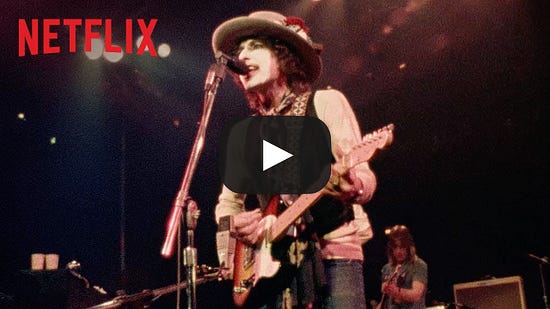 “People Who Died” by The Jim Carroll Band  There are some list songs, like “Hard Rain,” that are about overwhelming you with variety, and there are others that break through your defenses with relentless repetition. These, too, can be transformative, in a different way. For the most part, we are wired to treat the miraculous as mundane; as Eliot’s little bird says, “Human kind cannot bear very much reality.” I often think about the fact that there are no two human faces that are identical – every new face is a brand new thing – and I wonder why each encounter isn’t as awe-inspiring as a flying saucer descending from the sky – because it should be. But this isn’t our experience, of course, because we reduce singularity to sameness with that dangerous word “like.” We haven’t seen that face before but we’ve seen faces like it before — so we don’t have to attend to it. We do this with almost everything we encounter, and the end result is that we’re able to live much of life on autopilot, without seeing or feeling very much at all. This s necessary a lot of the time. We can’t spend our lives being stunned by everything we see; it would be exhausting. And there are certain things that are too painful to think about too. It’s death, of course, that human beings are worst at looking at directly. Can you remember when you first found out that people die? That we don’t go on forever? You’d think it would be a defining moment, a complete reorientation of our existence. But no one remembers that moment. I think it’s probably because we only learned it in a technical sense; we never really comprehend the reality of death. Jim Carroll tries to remedy this in his song “People Who Died.” Carroll is best known as a poet and author. His book, The Basketball Diaries, was made into the Gen-X classic film, and forms part of Leonard DiCaprio’s perfect angsty-poet trifecta, along with Romeo and Juliet and Total Eclipse. Lyrically, “People Who Died” does what it says on the tin: it’s a list of thirteen people Carroll knew who died. And they all died horribly: drugs, suicide, war, cancer, murder. The song offers no commentary, no reflection, no moralizing, no takeaway. He says their names, how they died, and then sings, in the chorus “THESE ARE PEOPLE WHO DIED! DIED!” It just goes on and on and on. And, once he gets to the end of his list, he starts over again at the beginning, just in case you missed it the first time. The song wouldn’t work at all if it was a sad, minor key dirge, or even furious emo song. The former would be cringeworthy, teenage poetry stuff. The latter would be naive, pointless. It only works as a weirdly giddy punk song, because Carroll’s tone isn’t one of lament, or anger, or disgust, but of sheer incredulity. He’s trying to hammer the reality of death home to the listener, but also to himself: “Can you believe it?! How is this possible?! But it’s real!” I find the song weirdly cathartic. It’s horrific and empowering all at the same time. Another strange and magical thing. Honorable Mentions “Reasons to be Cheerful, Part 3” by Ian Dury and the Blockheads  Of course, death isn’t the only thing we’re weirdly numb to. We can also be maddeningly blind to the wonderful things in life. This is a song of pure, unpretentious joy, and is certainly my favorite cockney rap song of all time. “No Pussy Blues” by Grinderman  Nick Cave’s main band, The Bad Seeds, had become a more serious, stately band over the years, and the angry, screaming Nick Cave of earlier days had been replaced by his more grown-up baritone balladeer persona. So, in 2006, Cave started Grinderman as an outlet for his angrier side. Cave, though, knew this made Grinderman his mid-life crisis band, so there’s an element of sad sack humor that runs through the whole thing. “No Pussy Blues” is Cave, standing on stage and “gazing out at all the young and beautiful,” realizing that he’s old and dried up, and venting his sexual frustration. It’s hilarious. And I love how the guitar solos are basically just musical screaming. You should also check out Cave’s other brilliant list song “Baby, I’m On Fire,” the video of which has to be seen to be believed: 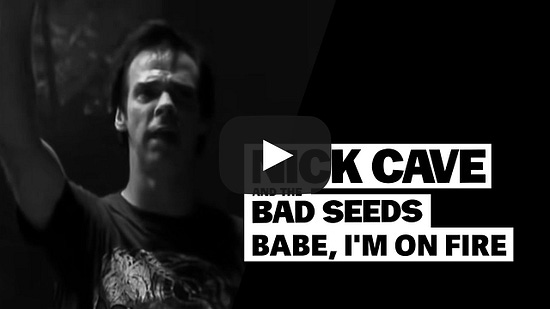 1 Dylan wrote more apophatic prophetic and apocalyptic work later on; the entire album John Wesley Harding, for example, is composed of obscure minimalist parables, and his masterpiece “Every Grain of Sand” is quite literally about experiencing a mystical confrontation with God after reaching rock bottom. 2 People have tried to read “Hard Rain” as a protest song with nuclear fallout being the rain in question, but this is too worldly an interpretation; I don’t think it can really be read as anything other than a biblical flood. 3 The song is saved from spinning off its axis into meaninglessness by the clever structure, which he borrows from the traditional ballad “Lord Randall,” which starts:
You can read older entries on the Rorschach Music website. You can hear Jim's own music on his other site, Jim Clements Music. If you liked this post, please share it!
© 2022 Jim Clements
|