Over the past six years, whenever I have sat down to write this weekly letter, my departure point has usually been something that nags at me—a question, a contradiction, a mild obsession, or some persistent intellectual discomfort. What I have never done before is begin with an actual physical irritation. I am making an exception today only because I have gradually come to realize that it might offer an unexpectedly useful metaphor for artistic inquiry. In March 2020, I was among the first people in New York City to contract COVID-19. It was the most severe illness I have ever experienced, and I count myself fortunate to have recovered. Like many others, however, I was left with a lingering consequence. I developed granulomatous dermatitis, an autoimmune skin condition that is not dangerous but produces a nearly constant itch. It can be managed, though never entirely silenced, and it is likely to remain with me for the rest of my life. So my daily life has become organized around an unlikely collection of objects: prescription-strength corticosteroid creams, ointments, and back scratchers. Living with granulomatous dermatitis has turned scratching into a form of body dialectics, governed by a simple but unforgiving paradox. As anyone who has been bitten by a mosquito knows, scratching offers immediate relief while simultaneously making the itch worse. By provoking further inflammation, it sets off the vicious itch-scratch cycle dermatologists warn against. One is left with the small but constant dilemma of whether to seek the fleeting satisfaction of scratching, knowing it will likely intensify the discomfort later. The Stoic philosopher Seneca recognized this paradox nearly two thousand years ago when he remarked that “the foul itch enjoys anything that scratches it.” For Seneca, the itch became a moral metaphor: vice resembles an itch because it welcomes precisely the action that sustains it. What promises relief is often the very thing that perpetuates the condition. Speaking of ancient philosophers, Plato also pauses to consider itching and scratching in The Republic, of all places. He presents it as an example of what he calls a “mixed pleasure”: the sensation of scratching feels pleasurable not because it is a positive good in itself, but because it temporarily relieves a preceding discomfort. From this observation, Plato develops a broader argument about human desire. Many of the pleasures we pursue, he suggests, are not genuine fulfillment but merely the temporary easing of a persistent lack. The tyrant’s endless hunger for power belongs to this category. Like the itch that returns after scratching, certain desires become more demanding the more they are satisfied. Yet I find myself arriving at a rather different conclusion. Applied to artistic inquiry, the itch is not something to be eliminated but something to be cultivated. Every meaningful investigation begins with an irritation—an observation, contradiction, or question that refuses to leave us alone. In that sense, it is hard to make progress without the propulsion inspired by the itch.
I think back to the first time I encountered Adrian Piper’s 1988 Cornered at the Museum of Contemporary Art Chicago. Consisting of a monitor in front of an overturned table set against the corner of a gallery, playing a video where the artist directly confronts the viewer. Piper addresses the viewer with remarkable calm, methodically dismantling common assumptions about race and identity while reminding us that, statistically speaking, many people who identify as white almost certainly have Black ancestry. The work never raises its voice— it simply refuses to allow the viewer the comfort of remaining outside its argument. The discomfort it produces does not arise from confrontation alone, but from the unsettling realization that one’s own assumptions have quietly become the subject of examination. What has always fascinated me was not simply Piper’s argument, but her extraordinary composure. Rather than responding to injustice with indignation, she dissects it with almost forensic precision. Sometimes the most effective response to absurdity or oppression is neither outrage nor silence, but the careful unfolding of an argument that leaves no comfortable place to stand.
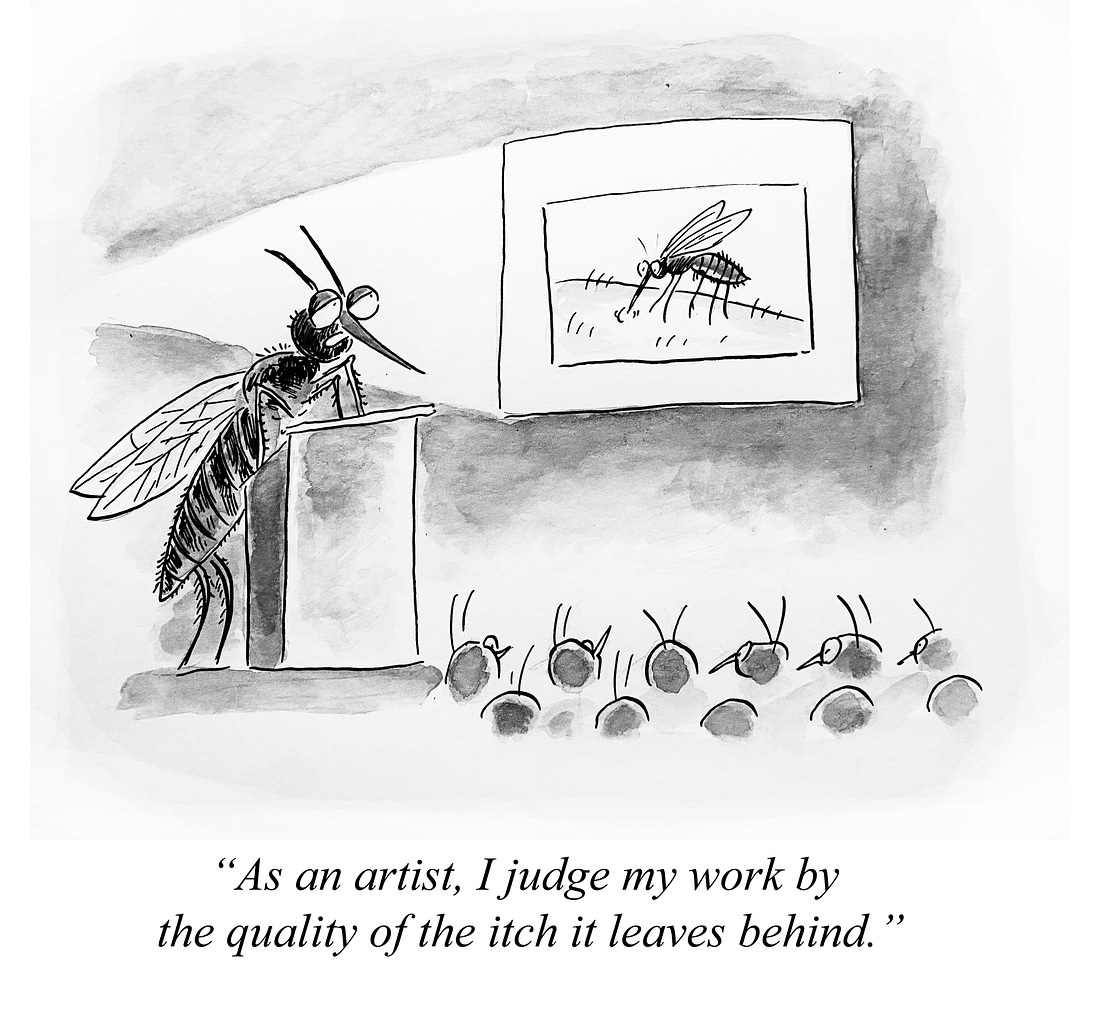
Another persistently itchy work, for me, is David Hammons’ famous basketball hoop adorned with crystal chandeliers. At first glance it seems almost absurd: an impossible object that combines the aesthetics of the playground with those of the ballroom. The sculpture immediately recruits the viewer into imagining an action: one instinctively pictures throwing a basketball toward the hoop, only to realize that the very act would shatter the crystal chandeliers. The work generates an irresistible impulse while making its fulfillment impossible. Like an itch, it asks to be completed while ensuring that completion would destroy precisely what made it compelling. The mental imagery it provokes immediately suggests collisions between high culture and popular culture, wealth and scarcity, ornament and utility, Black urban experience and the institutions that have historically excluded it. Yet none of these readings ever feels sufficient. Hammons has an extraordinary ability to construct visual paradoxes that resist being solved. The work does not conceal a hidden meaning waiting to be decoded; rather, it continually generates new meanings while frustrating any definitive interpretation. Long after seeing it, I find myself mentally returning to it—not because I failed to understand it, but because it continues to produce new intellectual itches. The temptation, of course, is to reach for an easy explanation or a ready-made opinion. Those easy answers often resemble scratching the skin: they offer the comfort of resolution while leaving the deeper condition untouched. For the artist, the challenge may be to resist that relief—to remain with the itch long enough to discover what it is really asking. And here the analogy becomes especially revealing. No one takes pleasure in watching another person scratch an itch. The relief belongs entirely to the person whose itch is being scratched. Self-indulgent art often works in much the same way: it mistakes the artist’s private relief for a public experience. A work that merely documents the artist’s catharsis asks us to celebrate the scratching rather than share in the condition that produced it. Compelling art works by contrast, do not invite us to witness someone else’s scratching: instead, they give us the itch. Sometimes it reveals a discomfort we did not know we carried; at other times it implants one where none existed before. Either way, it leaves us unable to return to our previous state of ease. The artist’s task, then, is not to exhibit the process of scratching but to translate a private irritation into a public one. The itch must migrate from the maker to the viewer. A successful artwork does not answer the question that troubled the artist; it recruits the viewer into asking it. If the work merely records the artist’s relief, it remains a diary. If it succeeds in making its audience itch—about an idea, an injustice, a contradiction, or a possibility—it becomes inquiry. Perhaps this is why the best works of art continue to unsettle us long after we encounter them. They refuse the false relief of easy answers. Instead, they leave us with a more demanding gift: a question that keeps returning, quietly but persistently, long after we have left the museum, closed the book, or walked out of the theater. If this analogy is correct, then perhaps every artist should aspire, at least in one respect, to resemble a mosquito. A mosquito does not scratch your skin for you; it leaves behind a tiny irritation that insists on your attention long after it has disappeared. Good artworks behave in much the same way. They do not resolve our discomfort; they produce it. This discomfort should not be confused with whether we like or dislike a work: those matters of taste are beside the point. The more interesting question is whether a work has succeeded in disturbing the equilibrium from which we began. Some of the most important artworks in my life have not been immediately pleasurable, nor even particularly enjoyable. Their achievement lay elsewhere: like a mosquito bite, they continued to itch long after the encounter itself had ended.
Some artworks have left even deeper, more enduring itches for me. Chantal Akerman’s 1993 film D’Est (From the East) is one of them. I first encountered the film in the 1997 when I organized a lecture by Akerman at the MCA Chicago where she spoke about it. In private and public conversations, she talked about her interest in her own Eastern European ancestry (she was born in Belgium to Jewish-Polish parents) and how the film, made in a faux-documentary format, was a way for her to explore the Eastern bloc right after the collapse of communism. I have returned to it many times over the years, yet the final, extraordinarily long sequence has never loosened its hold on me. Without dialogue, the camera glides ever so slowly across the faces of people waiting for a train at a station in St. Petersburg. Nothing dramatic occurs. They simply wait. Yet every time I watch those faces I feel that they embody a peculiar historical and existential condition: people suspended between one world that has disappeared and another that has not yet arrived. I have never been able to explain fully why that scene affects me so deeply. Nor do I think I want to. Somewhere inside it lies an itch that has remained productively unresolved for three decades. It has accompanied me through exhibitions, books, performances, classrooms, and countless walks through cities. Rather than demanding relief, it has continued to generate thought. Perhaps that is the highest aspiration of art. Not to offer us the temporary satisfaction of scratching an intellectual itch, but to awaken one worth living with. The greatest works do not relieve our uncertainty; they refine it. They leave us with questions that become companions rather than problems, quietly returning over months or years until we realize they have shaped the way we see the world. The artist does not communicate answers: the artist communicates the conditions under which questions arise. Every morning, I still reach for the ointment. I still try, with varying degrees of discipline, not to scratch. My condition has taught me far more than patience: it has taught me that some forms of discomfort deserve to be cured, while others deserve to be protected. The itch has gradually become a reminder that the most worthwhile questions are rarely those we resolve, but those we learn to live with. Perhaps the work of the artist is not to relieve that discomfort, but to shape it into a form that others might willingly inhabit. You're currently a free subscriber to Beautiful Eccentrics. For the full experience, upgrade your subscription.
|