
Dear Reader,
If you think the U.S. government would never freeze or seize your bank account … you need to look at history.
- In 1933, FDR made it illegal to own gold.
- In 2013, the government of Cyprus seized up to 47.5% of citizens' bank deposits exceeding £100,000 overnight to bail out their banking system.
- In 2022, Canada froze the bank accounts of ordinary citizens who donated to or participated in a trucker protest.
The only thing stopping the U.S. government from doing the same thing on a massive scale?
So far, our banking system has been too fragmented. And the technology too slow.
But now?
Buried in Federal Reserve Docket No. OP-1670 is the blueprint for "FedNow" — a centralized, real-time payment hub that over 1,500 banks have already joined.
In a nutshell, once your bank is plugged into FedNow, every dollar you move is routed through a system that the Fed built and controls.
That means if we ever run into a "national emergency" or a "banking crisis," they won't need to ask your local branch manager to freeze your account. They could theoretically do it with a few keystrokes from Washington.
And that's why you must act before this new system fully takes over.
I've outlined 4 simple, 100% legal steps to "Fed-proof" your savings — without closing your current accounts.
The best time to move your savings out of the crosshairs is BEFORE a crisis hits.
See the 4 steps to protect your money right here.
Good luck and God bless!

Martin D. Weiss, PhD
Weiss Ratings Founder
P.S. Every single time, the story has been the same. People go to sleep thinking their money is safe. They wake up to find their life savings decimated by government action. Do not let FedNow catch you sleeping. Get the 4 steps here and act on them now
Opendoor Pops After Earnings, But the Big Question Hasn't Changed
Reported by Chris Markoch. Published: 2/22/2026.

Key Points
- Opendoor beat revenue expectations but posted a larger-than-expected loss, highlighting ongoing profitability challenges.
- The company’s “Opendoor 2.0” strategy focuses on faster inventory turns, AI-driven pricing, and breakeven adjusted net income by 2026.
- Institutional sentiment and sector rotation will likely determine whether OPEN stock can sustain momentum.
- Special Report: [Sponsorship-Ad-6-Format3]
Stock analysis is frequently peppered with sports metaphors, and with good reason; they fit. That's the case with Opendoor Technologies Inc. (NASDAQ: OPEN).
The company reported its Q4 2025 earnings after the market closed, and the results were mixed. Still, investors pushed OPEN stock up about 14% in after-hours trading.
Only 500 people today… (Ad)
Dr. Skousen: "Only 500 people today get the access code"
I've worked for the CIA. Met four US presidents.
But meeting Elon Musk face-to-face changed everything.
My research now leads me to believe he'll announce the SpaceX IPO on March 26, 2026.
I'm sharingan "access code" to grab a pre-IPO stake. But only with the first 500 people today.
The theme of the earnings report (branded as an Open House) was: Opendoor 2.0 Does What It Said It Would Do — Delivering Acquisition Growth, Faster Inventory Turns, and Stronger Cohorts.
It outlined the company's progress on a four-step plan to transform the business with an eye toward three goals:
- Reach breakeven Adjusted Net Income by the end of 2026 on a 12-month go-forward basis
- Drive positive unit economics while increasing transaction velocity
- Transition to direct-to-consumer relationships and expand its product suite
The report was encouraging, but progress is a relative term. Opendoor is still unprofitable and generates limited revenue relative to the scale it needs.
In that sense, this report feels more like surviving the first quarter of a four-quarter game. You can't win the game in the first quarter, but you can lose it. They haven't lost — yet the larger question remains: what does winning look like?
Mixed Earnings Won't Move the Needle Much
On the top line, Opendoor reported revenue of $736 million, beating expectations of $591.75 million. However, adjusted earnings per share (EPS) disappointed: the loss was $1.26 versus an expected loss of $0.08.
Both revenue and earnings were sharply lower year-over-year (YoY). As a one-off data point, that's not devastating — the company has new leadership, and turnarounds take time. Bulls will note that the YoY revenue shortfall was smaller than feared.
Call that a point for Opendoor.
The Business Model Has a Proven Achilles Heel
Opendoor went public in 2020, amid the meme-stock wave, and the timing proved double-edged. The iBuyer promised to reshape how homes are bought and sold by offering liquidity and convenience: instant cash offers for homeowners who want to sell quickly without listing, showings, or uncertain timelines. The business model depends on buying homes and reselling them quickly — resale speed drives growth.
That engine has relied on algorithmic pricing models to decide what to pay sellers, how to price for resale, and which markets to operate in. They weren't necessarily using modern AI from the start, but they are now; part of the turnaround strategy is to use AI to improve efficiency.
The problem with any model is that its output is only as good as the data and assumptions behind it. If market conditions shift faster than the model adapts, the company can be left holding depreciating inventory.
That happened in 2022: rising interest rates and a quickly cooling housing market left Opendoor with inventory purchased at much higher prices. The company took large losses, and the stock fell from over $12 at the start of the year to under $1 by year-end.
Retail investors often say "this time it's different," but that can be risky thinking. Interest rates would need to move meaningfully lower to "unfreeze" the housing market, and recent Fed minutes suggest that isn't likely in the near term.
The takeaway for investors is caution. AI can improve pricing and operations, but it depends on stable or predictable market behavior. Opendoor survived a difficult cycle, but what the company's long-term equilibrium looks like remains uncertain.
For now, the earnings give Opendoor permission to keep playing the game.
How Should Retail Investors View OPEN Stock?
To answer that, note that the over 200% gain in the last 12 months was aided by strong institutional buying in the third and fourth quarters of last year.
However, that momentum appeared to fade as the year ended. Short interest rose, indicating some large investors viewed the stock as overextended. That remained the case into 2026, and OPEN was down just over 20% before the earnings report.
The bottom line: OPEN will likely need renewed institutional buying to sustain meaningful upside. With evidence of broader sector rotation away from tech stocks, there may be limited appetite for a company that delivered a good but not outstanding quarter.
Opendoor is a speculative investment — a company still trying to prove its model is viable at scale. There's still time on the clock, but investors will need patience and conviction.
From Missteps to Momentum: Jack in the Box's Comeback Plan
Reported by Thomas Hughes. Published: 2/21/2026.
Key Points
- Jack in the Box is working through execution and balance-sheet challenges, while McDonald’s highlights what strong operational discipline can deliver.
- Despite weak first-quarter results, analyst targets and ratings suggest continued confidence in a recovery over time.
- Technical support, heavy institutional ownership, and elevated short interest could amplify any upside catalyst.
- Special Report: [Sponsorship-Ad-6-Format3]
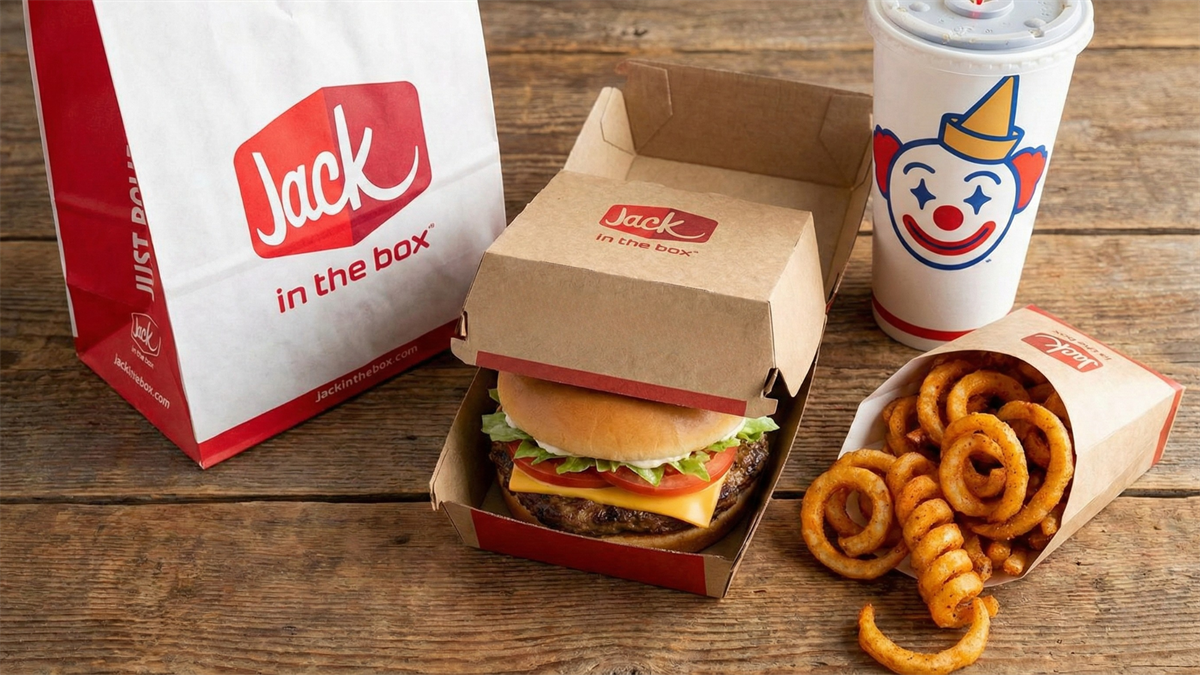
Comparing Jack in the Box (NASDAQ: JACK) with McDonald's (NYSE: MCD) might seem like apples and oranges, but there is a useful comparison. Where McDonald's executes at a high level, leans into digital, and takes market share, Jack in the Box suffered a series of executive missteps that culminated in lost market share, reduced shareholder value, higher debt, and suspended capital returns.
The connection is that Jack in the Box's problems can be corrected. It won't unseat McDonald's as the world's largest restaurant, but it can take cues from its more successful rival, reclaim lost ground and reinvigorate shareholder value. Last year's CEO change is the first of several moves that could take this consumer stock back to higher levels over time.
Analysts Remain Optimistic for a JACK Turnaround
Only 500 people today… (Ad)
Dr. Skousen: "Only 500 people today get the access code"
I've worked for the CIA. Met four US presidents.
But meeting Elon Musk face-to-face changed everything.
My research now leads me to believe he'll announce the SpaceX IPO on March 26, 2026.
I'm sharingan "access code" to grab a pre-IPO stake. But only with the first 500 people today.
Despite weak fiscal Q1 2026 results, the analyst response signals confidence in the turnaround plan. (Note that Jack in the Box's fiscal reporting period does not align with the calendar year.) Sales missed expectations in part because of store closures intended to rationalize and optimize the franchise footprint, but expectations for a recovery remain elevated. The first revision tracked by MarketBeat reaffirmed a Hold-equivalent rating while raising the price target to $23.
The $23 target sits below the consensus $26 but still supports the case for share-price recovery and the potential for a double-digit advance when it materializes. Currently, 21 analysts rate the stock a Hold, with a 67% conviction rate, and the consensus target implies more than 40% upside above the critical support level.
The critical support level in February 2026 is the long-term low set during the height of COVID-19 panic. That low represents a likely market bottom and a potential turning point.
Price action in 2025 suggests a bottom may be forming and could develop into a reversal if upcoming releases reflect operational improvements. The post-release action included a roughly 15% decline — significant, but not yet a definitive red flag. The recent pattern broadly resembles a Head & Shoulders bottom, which can precede a sustained rally if fundamentals improve.
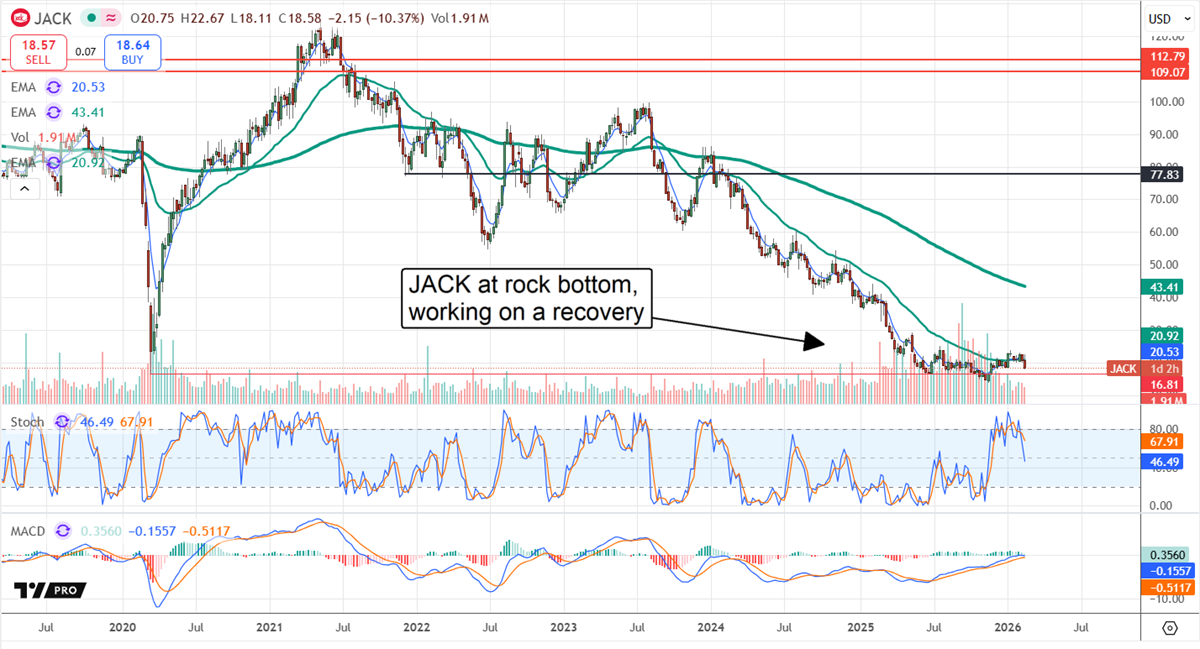
In this scenario, price action could dip in the near term before reaching lows and reversing. If the stock breaks below the established support, the decline could deepen and push JACK to levels not seen in over two decades, or even into the single-digit range. However, technical indicators and institutional activity suggest the $16.80 floor is a meaningful support level.
Institutions Set a Floor: Short Sellers Could Fuel a Rapid Rally
Institutional ownership indicates a high degree of confidence in the brand and its cash-generating ability. Although selling increased in Q4 2025 and Q1 2026, buying activity also rose and outpaced sales, producing net accumulation and a solid support base — the group now owns the vast majority of outstanding shares. The key question is what happens next; a short squeeze or a short-covering rally is a plausible catalyst.
Near-term headwinds remain, but store closures, quality improvements, and debt reduction would position the business for a healthier recovery, with a return to growth and eventual resumption of capital returns. With short interest above 26%, any positive catalyst could be potent. Assuming a squeeze takes hold, reaching the consensus $26 target could be an interim stopping point. Technical targets, high short interest and nearly 13 days to cover suggest the stock could run into the $30–$40 range, and potentially higher, if momentum builds.
Jack in the Box Amid Transformation: Catalysts Ahead
Potential catalysts for Jack in the Box include accelerated debt repayments, which would free up cash flow; asset monetization to lighten the balance sheet; portfolio rationalization to optimize the footprint; and clearer capital-allocation plans. Capital returns were suspended to pay down debt, but the company's progress on debt reduction increases the likelihood of dividends and/or share buybacks resuming in 2027.
Assuming a restart at even half the prior dividend, shareholders would receive a yield above 1%. At the end of Q1, share count was marginally higher while cash rose roughly 57%, providing room for accelerated debt reduction and financial flexibility going forward.
This message is a paid advertisement sent on behalf of Weiss Ratings, a third-party advertiser of MarketBeat. Why was I sent this email content?.
11780 US Highway 1,
Palm Beach Gardens, FL 33408-3080
Would you like to edit your e-mail notification preferences or unsubscribe from our mailing list?
If you need help with your newsletter, please contact MarketBeat's South Dakota based support team at contact@marketbeat.com.
If you would no longer like to receive promotional emails from MarketBeat advertisers, you can unsubscribe or manage your mailing preferences here.
© 2006-2026 MarketBeat Media, LLC. All rights protected.
345 N Reid Pl., Sixth Floor, Sioux Falls, SD 57103-7078. U.S.A..