
A couple of years ago, we started playing with the massive amounts of data that MarketBeat takes in everyday trying to figure out if there was a way to identify short term trading wins.
By analyzing earnings data, news sentiment, analyst recommendations, insider transactions and dozens of other data points, we think we’ve found an algorithm that finds interesting short-term stock ideas.
We call that algorithm the IdeaEngine and its stock ideas are published on MarketBeat All Access every Monday morning.
We make one IdeaEngine idea available free every Monday as an SMS alert. We’ll be releasing the next IdeaEngine alert on Monday morning, so make sure you are signed up before then.
Get MarketBeat’s Free Weekly IdeaEngine Stock Picks Here
William Bushee
MarketBeat
P.S. The IdeaEngine has had some good stock ideas recently, but it’s just an algorithm. It’s not always right and it should be only part of your research process. Remember that stock investing and trading involves risk and you should always consult with a competent financial professional before making investment decisions. Read our full terms of service here.
These 3 Cash Flow Machines Provide Stability in Uncertain Markets
Written by Nathan Reiff. Article Posted: 3/6/2026.

Key Points
- Cash flow generation is a key attribute of stable companies, allowing them flexibility to not only maintain operations but also to grow and to return value to shareholders via dividends or buybacks.
- Gilead Sciences and AbbVie are two large biopharma firms with a compelling history of cash flow generation, helping to facilitate continued R&D and pipeline development, among other things.
- Visa converts about half or more of its revenue to free cash flow, capitalizing on its high-margin business to facilitate growth and dividend payments.
- Special Report: Elon's "Hidden" Company
When times get tough for companies, cash flow is an essential element that can determine whether they survive a challenging market. Simply put, if a firm cannot meet its near-term obligations with cash on hand, it risks collapse. Equally important, cash flow enables longer-term planning—everything from expansion and acquisitions to strategic returns of shareholder value.
Cash flow is just one of many measures of stock stability, but it may be especially important for investors seeking companies likely to remain steady amid broad market uncertainty in 2026. The three companies below are household names and major industry players that also boast strong cash-flow histories to support plans for continued growth.
Strong Free Cash Flow Yield and a Commitment to Returning Value to Investors
Move Your Money BEFORE March 18th (Ad)
Ignore if You Have Shares of ChatGPT
Billionaires and elites are already in OpenAI (ChatGPT's company).
If YOU have been locked out...
Anchored by top-selling drugs for COVID-19, HIV, certain cancers, and more, Gilead Sciences Inc. (NASDAQ: GILD) is one of the largest biopharma firms available to investors. The company generates compelling free cash flow relative to its share price—its free cash flow yield is roughly 6%.
The company also commits to returning at least half of its free cash flow each year to stockholders. In 2025, including its dividend distributions, Gilead returned 63% of annual free cash flow to shareholders.
Despite its size and established position, Gilead has continued to grow. In Q4 2025, it beat analyst expectations for both earnings per share and revenue, supported by legacy drugs and a strong pipeline. In 2026, the company expects at least four major commercial rollouts of new products, helping to maintain a diversified portfolio.
Gilead faces ample competition in biopharma, particularly in oncology—an area some investors would like to see contribute more to total sales. That said, a large majority of Wall Street analysts have assigned bullish ratings to GILD shares and see roughly 6% more upside potential, even after a more than 28% rise in the past year.
Massive Dividend Growth Backed by Solid Cash Generation
Another major biopharma name, AbbVie (NYSE: ABBV), posts a free cash flow yield exceeding 5%, strong for a company of its size and industry. While AbbVie provides therapeutics across multiple medical areas, one of the company's most attractive features for investors is its dividend.
AbbVie currently has a dividend yield of about 2.9% and has more than quadrupled its dividend distributions since becoming a publicly traded company.
Although the company shows a high dividend payout ratio of 293%—which can concern investors worried about the sustainability of payments—it is supported by very strong free cash flow. For example, in 2025 AbbVie generated nearly $18 billion in free cash flow while paying out roughly $11.7 billion in total dividends.
The firm has continued to build earnings and revenue, beating Wall Street expectations in Q4 2025 and guiding higher for the future. This growth has been driven by leading drugs Skyrizi and Rinvoq, and AbbVie continues to invest heavily in R&D to deepen its pipeline.
Excellent Cash Generation Amid Consumer Resilience
Payments giant Visa Inc. (NYSE: V) operates a high-margin business model that allows it to generate substantial free cash flow, converting a meaningful portion of revenue into free cash flow in most quarters. With solid revenue performance—up 14.6% year over year in the latest period, for instance—Visa remains a reliable cash generator for investors.
Despite macro concerns such as tariffs and inflation, Visa's payments volume and processed transactions continue to rise as consumer spending proves resilient. That strength has enabled Visa to increase its dividend while maintaining a manageable 25.1% payout ratio; the stock currently offers a yield of 0.83%. Analysts continue to view Visa shares as a solid Buy, with roughly 22% upside potential projected going forward.
Cash Flow Kings: 2 Stocks to Hide In, 1 to Avoid
Written by Thomas Hughes. Article Posted: 3/5/2026.

Key Points
- Cash flow is king, and being rewarded in 2026 while those burning cash, with a long runway to profits, are punished.
- Cash flow enables capital return and bullish market support, as reflected in the analyst and institutional data trends.
- Stocks with cash burn carry more risks than one, as capital needs leave the door open for short sellers to cap gains and drive share prices lower.
- Special Report: Elon's "Hidden" Company
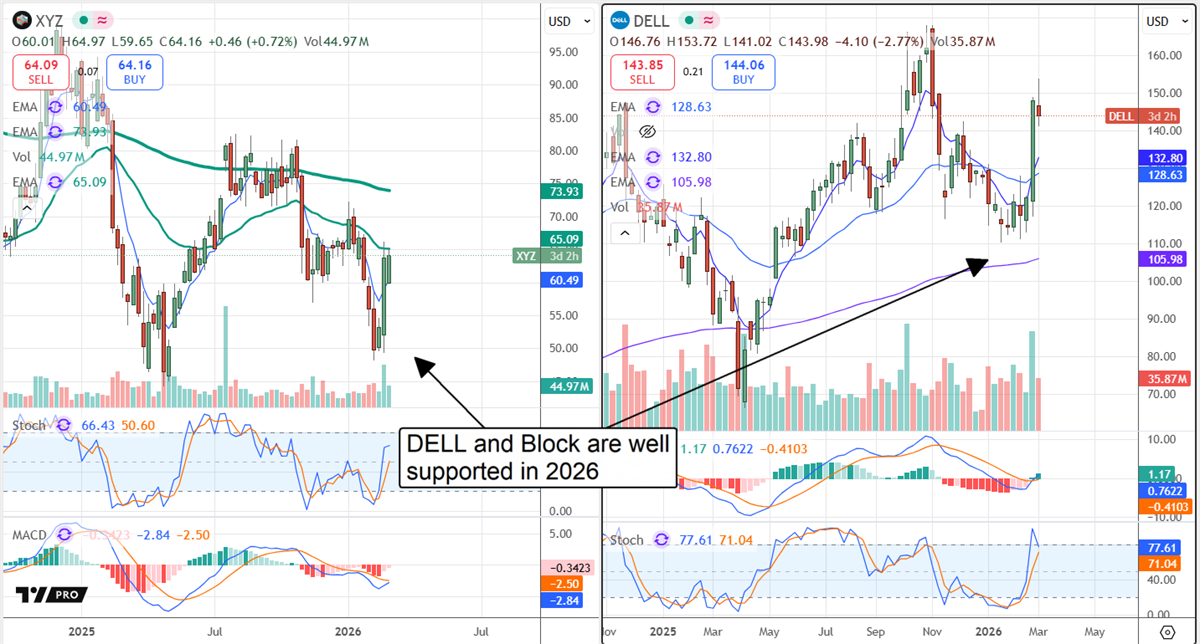
In today's markets, where macroeconomic concerns, AI spending and disruption, inflation, and interest rates weigh on performance, cash flow is king. Companies that produce revenue — and, more importantly, free cash flow and profits — are being rewarded, while those that don't are punished. For example, Dell (NYSE: DELL) (generating record cash from AI) and Block (NYSE: XYZ) (cutting costs to boost cash) are rebounding from early 2026 lows, while others, like Lucid (NASDAQ: LCID), which also show some business improvement, continue to flounder.
It All Starts With Gross Margin: Is The Underlying Business Profitable?
Gross margin is where this story begins. It measures the underlying operation's profitability by separating the cost of revenue from the product or service revenue. Dell and Block both report positive gross margins, are seeing margin expansion in 2026, are outperforming expectations, and are working to sustain or build on those strengths.
Why are companies flying spy planes over Elon's closely-guarded AI lab? (Ad)
Elon did the seemingly impossible – far faster than anyone expected… And it's sent the tech industry into PANIC MODE. ChatGPT, Claude, Google Gemini, and DeepSeek could soon become obsolete. And three little-known firms could soar 10X or higher as a result.
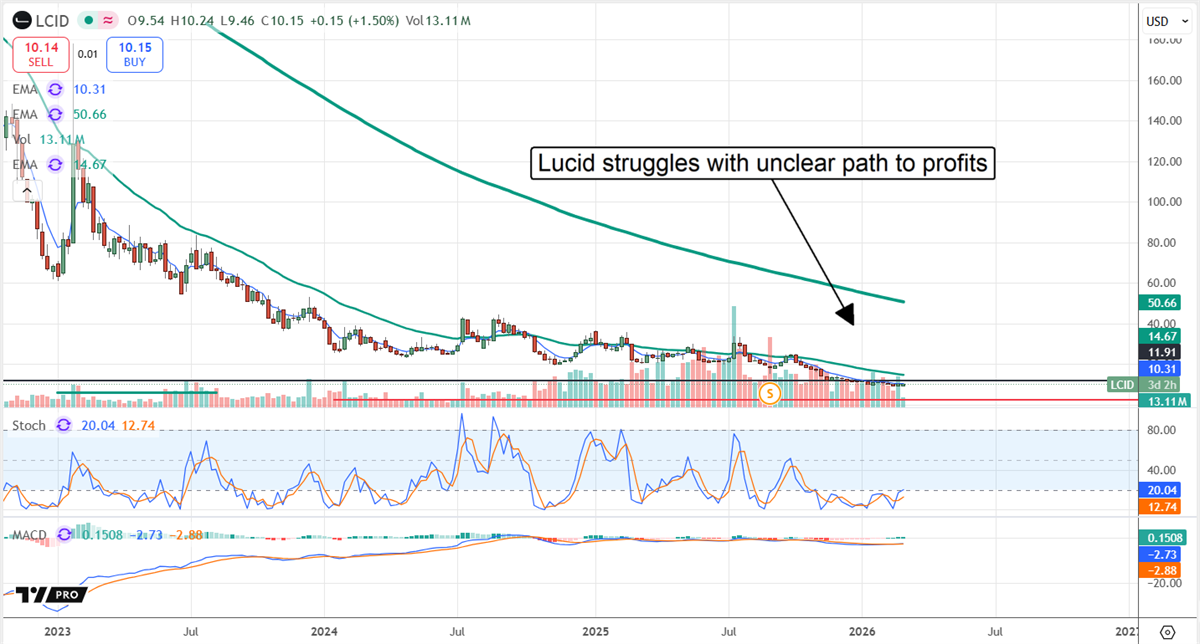
Get the details here.By contrast, Lucid — whose car business could be profitable at scale — is not yet there. The company not only generates negative cash flow, but its cost of revenue far exceeds revenue — even before accounting for R&D and general administrative costs. When it comes to picking cash-flow winners, Lucid is out of the game before it even starts.
There is some reason for optimism: Lucid is ramping production and delivering cars faster than anticipated, which brings its timeline to profitability forward. The drawback is that profitability is still not expected for several years, leaving ample time for execution risk and industry disruption to hurt market sentiment. In the meantime, Dell and Block are forecast to grow at steady paces while improving profitability.
Balance Sheets Reflect the Impact of Cash Flow
Quarterly results provide insights into operations, quality, and momentum, but the balance sheet reflects a company's health. Firms with healthy cash flow typically show rising cash or assets (or both), declining debt or liabilities (or both), and expanding equity. They can also enhance shareholder value through dividends and share buybacks.
Dell is a unique case. Its cash flow is robust enough to support aggressive capital returns alongside business investment, which has produced negative shareholder equity on the books. The offset is a large cash balance, manageable leverage, and sustainable capital returns — yielding about 1.35% in early 2026 — while buybacks reduced the share count by more than 5% in 2025.
Block does not pay dividends and has not repurchased enough shares to meaningfully reduce the share count, but it does return capital. Its balance sheet shows the ability to sustain and potentially increase those returns over time: a reduced but still ample cash position, increased assets, managed debt, and rising equity at year-end.
Lucid's balance sheet, however, highlights its cash burn. At the end of fiscal 2025 it showed falling cash, lower current and total assets, and higher debt and liabilities — not counting substantial dilution — all of which erode shareholder value. Equity fell from nearly $4 billion to under $1 billion and is likely to continue declining in 2026.
Cash Flow Equals Market Support in 2026
The importance of cash flow for market sentiment shows up in analyst recommendations and institutional trends. Analysts rate Dell and Block as Moderate Buys, with roughly 70% and 75% buy-side biases respectively, indicating strong conviction. By contrast, only a few analysts cover Lucid, and it is pegged at Sell.
Lucid's consensus price target implies potential upside, but recent revisions and the trend of estimates lean to the low end, and institutional investors are selling, keeping the stock under pressure. Conversely, price target revisions have been bullish for Dell and XYZ, helping push those stocks higher as of early March.
The risk for investors runs deeper than merely underperforming the market. Weak gross margins, ongoing cash burn, dilution, and tepid market support make names like Lucid vulnerable to short selling. Short interest is running near 40%, a level sufficient to keep the stock at long-term lows or push it lower. A short-squeeze or short-covering rally is possible but, in our view, unlikely in 2026.
This email is a sponsored message provided by MarketBeat Alerts, a third-party advertiser of DividendStocks.com and MarketBeat.
If you need assistance with your subscription, please feel free to email our U.S. based support team at contact@marketbeat.com.
If you no longer wish to receive email from DividendStocks.com, you can unsubscribe.
© 2006-2026 MarketBeat Media, LLC. All rights protected.
345 N Reid Place, Sixth Floor, Sioux Falls, SD 57103-7078. U.S.A..