A message from SmallCaps Daily As Gold and Silver Rally into an Enforcement Era, SMX Is Quietly Building the Backbone of Material Verification 
Gold’s record surge above $5,000 and silver’s continued strength reflect more than macro uncertainty — they highlight a growing problem across global supply chains: trust no longer scales. Precious metals operate under increasing ESG mandates, regulatory oversight, and geopolitical scrutiny, exposing the limits of documentation-based systems. Markets are shifting from “trust me” to “prove it,” and that shift is reshaping how value is assigned. Unlike most companies reacting to rising scrutiny, SMX was built specifically for materials like gold and silver, where provenance, custody, and verification are non-negotiable. SMX (NASDAQ: SMX) was built for exactly this environment. Its molecular identity technology embeds proof directly into the material itself, creating a tamper-resistant digital twin that travels with gold, silver, and other materials throughout their lifecycle. Proven at national scale and designed for regulated conditions, SMX is expanding horizontally across industries — positioning verification not as a cost of compliance, but as durable infrastructure markets are beginning to require. See how SMX is aligning with regulation, enforcement, and capital as verification becomes non-negotiable
Further Reading from MarketBeat Media Lululemon's Share Price Bottom Is In: Nowhere to Go But UpAuthored by Thomas Hughes. Published: 3/20/2026. 
Key Points - Lululemon is set up to rebound in 2026 as it builds momentum in international sales, drives cash flow, and buys back shares.
- Analysts weigh on price action in early 2026, as weak guidance undermines confidence, but outperformance is likely.
- Institutions are accumulating LULU at long-term lows, providing a floor for the action and limiting downside risk.
- Special Report: What happens to your IRA when the AI trade unwinds?
 Lululemon's (NASDAQ: LULU) share price may face hurdles in 2026, but signals from technical charts, valuation metrics, analysts, institutional activity and recent earnings suggest lower prices are unlikely. While risk remains for this retail stock, at current levels Lululemon's upside potential outweighs the downside, offering an attractive reward profile for investors willing to buy in. The charts are where it all starts. Lululemon's technicals across multiple timeframes point to a potential bottom and the earliest signs of a rebound. The monthly chart is the weakest yet still aligned, showing a bottom near $164 — roughly the late-2019 highs. That level also lines up with the early 2020 lows, driven by COVID-19 fears, and is likely to act as a strong floor given the price action then and the opportunity today. 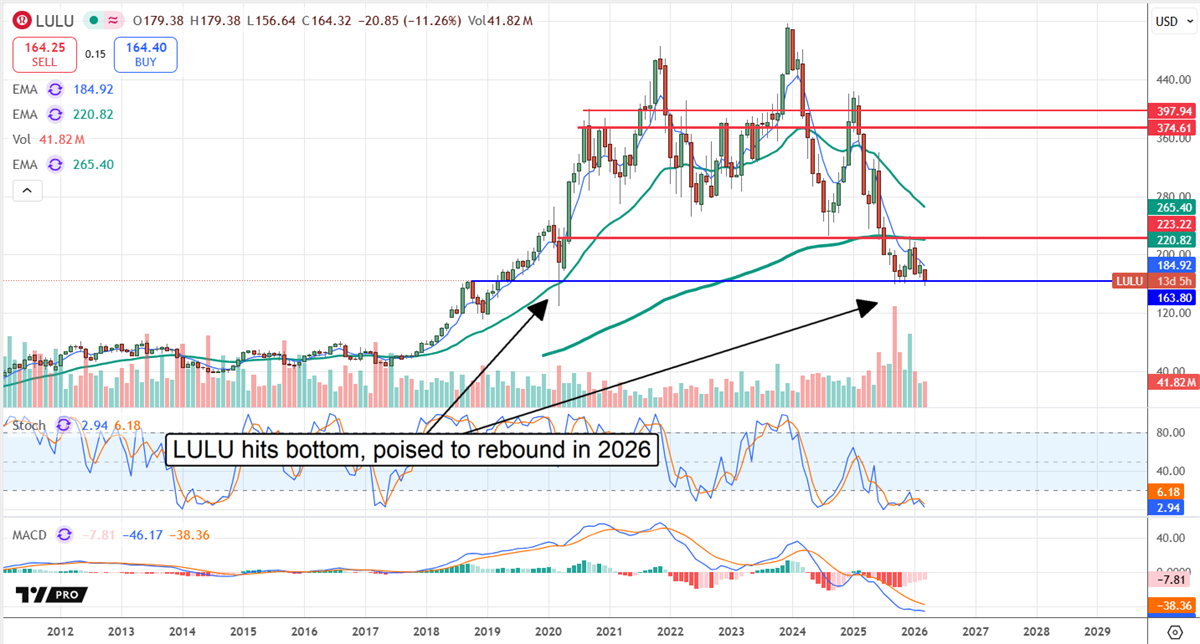
Weekly and daily charts strengthen the outlook, suggesting not just a price floor but the early stages of an upswing. In this scenario, Lululemon's stock is positioned to advance through 2026 and gain momentum as investor capital gradually rotates back into the name. Valuation metrics point to a deep-value opportunity: the stock sits near early-2020 price levels while revenue is more than 185% higher. The market premium from 2019 is no longer justified, yet the current 12X earnings multiple appears too low. That leaves room for both near-term multiple expansion and longer-term appreciation. Relative to the S&P 500's average valuation, current metrics suggest nearly 100% upside, while longer-term forecasts imply materially larger gains — in some scenarios 500% or more by 2035 or sooner. Analysts and Institutions Signal Floor for Lululemon Analyst sentiment weighed on the stock in early 2026. Price targets were trimmed after the fiscal 2025 earnings release, but the pattern of reductions fits with a market bottom. While some lowered targets sit below the current price, the most pessimistic estimates are outliers. The consensus of six targets issued within the first 18 hours after the release was about $180 — below the broader consensus but comfortably above the critical support level, with the high-end target near $225. As it stands, analyst sentiment does not provide an immediate catalyst for a rebound, though that could change later in the year as new results and guidance arrive. The company's cautious 2026 guidance was the main driver of the sentiment shift. If upcoming quarters beat those conservative assumptions and management issues stronger guidance, analyst and market sentiment could quickly improve. Institutional activity also supports the view that downside is limited. This group owns more than 85% of the stock and, after distributing shares in the back half of 2025, returned to accumulation in Q1 2026. In early Q1, institutions bought more than $2 for every $1 they sold — a strong pace that provides meaningful support. Lululemon Ended 2025 on a High Note: Guides Downbeat for 2026 Lululemon delivered a solid quarter to close fiscal 2025, reporting $3.64 billion in net revenue — a 0.8% increase that outperformed consensus by 170 basis points. Strength came from the International segment, offsetting mild declines in the Americas and a tougher comparison that included an extra week the prior year. Adjusting for that extra week, growth was stronger at 6%, comps were up 3% systemwide, and the company added 15 net new stores. Margins were pressured but less than feared, so while earnings contracted year over year, the decline was smaller than anticipated. GAAP earnings per share came in at $5.01, nearly 25% ahead of expectations. More importantly, cash flow, the balance sheet, and capacity for buybacks are in better-than-expected shape, supporting the case for a share-price rebound. Share buybacks are significant. The company reduced the share count by 3.85% in fiscal 2025 and is expected to continue repurchases aggressively in 2026. Balance sheet metrics show no red flags, indicating sufficient capitalization and leverage to execute strategy and build shareholder value. |