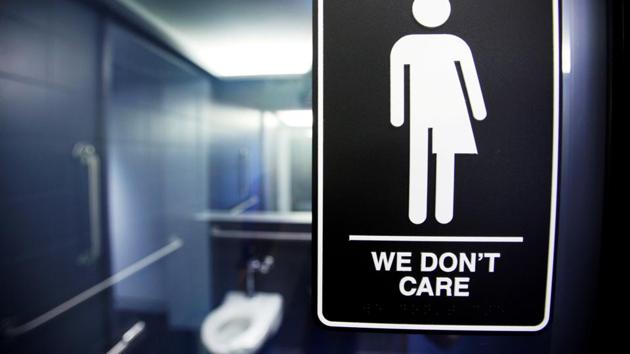
| Hello readers. The UK Supreme Court has defined ‘woman’ as someone who is biologically born female. What does this mean for the rights of transgender women? Read on… The big story Who is a woman? UK Supreme Court ruling is a setback to transgender rights A woman is defined as someone who is born biologically female, Britain’s top court has ruled . The interpretation is for purposes of the country’s Equality Act, the landmark five-judge bench judgement has clarified. Yet, the ruling comes as a blow since it excludes transgender women, even those with gender reassignment certificates, from the legal definition. What will this mean on the ground? It will impact not just transgender women’s access to toilets—a huge red flag in the so-called culture wars—but access to a host of single-sex facilities. Where, for instance will transgender women be housed in prisons and hospital wards? How will they access domestic violence shelters meant for women? Can a transgender woman sue her organization for equal pay? And, of course, the judgment will mean that transgender girls and women can no longer participate in women’s sport. The case was brought by a group called For Women Scotland (FWS), a non-profit that is opposed to the granting of rights to transgender women, and financed by author J K Rowling. The group went to court after Scotland passed a law in 2018 that set targets for increasing the proportion of women on public boards—and included trans women in its definition. FWS lost the case and appealed to the UK Supreme Court. “What we wanted was clarity in the law—when something is described as a single-sex service, a single-sex space, that this relates to biology,” Susan Smith from WFS told BBC. The UK Supreme Court has said its ruling is limited to the country’s equality laws and that it is not commenting more broadly on whether trans women are women. “We counsel against reading this judgment as a triumph of one or more groups in our society at the expense of another. It is not,” Lord Patrick Hodge, deputy president of the Supreme Court said. [Read the judgement here ]  X/JK Rowling Yet, that did not stop JK Rowling from tweeting a photo of herself with a cigar on her superyacht, gloating over the victory of TERFs, or trans-exclusionary radical feminists. “I love it when a plan comes together,” she tweeted. The Indian landscape Feminists in India are not as divided about the granting of rights to transgender women. “Because of our culture, we understand the presence of hijras,” says Chayanika Shah, a member of Hasratein-e-Zindagi-Mamooli, a queer feminist collective. As a result, the women’s movement here is not fractured the way it is in the UK. “Not only is there a collectivization of the hijra community with trans people talking about rights and citizenship, nobody is saying that they are not women.” For the first time, the Nalsa judgement of 2014 recognized that gender is non-binary. It affirmed the right to self-determination and directed the centre and state governments to secure the fundamental rights of all transgender citizens, bracketed under a generalized omnibus “third gender” category. 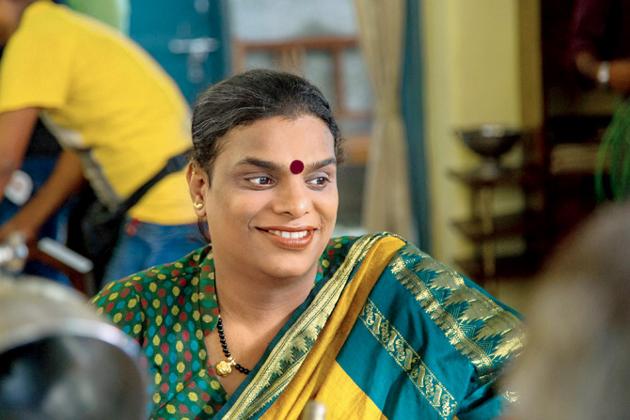 Shreegauri Sawant in a video grab for an ad for Vicks that challenged ideas on motherhood “I was trapped in the wrong body,” says Shreegauri Sawant, one of the first petitioners in the Nalsa case, who transitioned 30 years ago. “I consider myself as a transgender. I don’t have to be a woman. I was born in one gender and have taken so much effort to change that gender.” Fourteen years ago when Sawant wanted to adopt a daughter she found she had no legal right to do so, which is when she approached the Supreme Court. “The Nalsa judgement gave us identity as transgender but no legal rights to property, adoption, marriage,” she says. Everyone should have the same opportunities regardless of gender, continues Sawant. “If I am educated and capable of being a doctor, my gender should not have to play a role,” she says. [Shreegauri Sawant’s ad went viral with over 8 million views. Watch here ] Over a decade later, even the promise of Nalsa has not been fulfilled. In 2019, when Parliament passed the Transgender Persons (protection of rights) Act which guaranteed rights to equality, non-discrimination and freedom, it also brought in a certain degree of bureaucratic control; requiring a medical report to be presented to a district committee before their gender could be ratified, for instance. “We still don’t understand what our laws are saying,” says Shah. “In real life everyone, from the medical practitioner who gives the gender certificate to the administrator who has to actually issue the card, thinks of a woman as someone with a vagina, ovaries, and who can produce children.” Shelter homes set up by the state and run by non-profits from the community have come up in some states but state funding is already unavailable in some states. The culture wars Transgender rights have in recent years become a battleground in the so-called culture wars with those like Rowling arguing that liberal support for transgender women has infringed on the rights of biological women. On the other side of the transgender debate are those who believe that gender is fluid, a spectrum with artificial boundaries of male and female. There is a recognition too of broader societal oppression and a belief that in no case should individuals be discriminated against on the basis of their gender. Access to toilets, preferred pronouns, sports and athletics have all been thrown into the mix. As presidential candidate, Donald Trump had declared there are only two unchangeable biological identities, male and female, and pledged to end “transgender lunacy”. Among Trump’s first acts as US president was to roll back diversity, equality and inclusion initiatives from federally funded programmes. Earlier this week, he asked the US Supreme Court to allow enforcement of a ban on transgender people in the military while legal challenges proceed.  Donald Trump holding up his executive order in February that bans transgender girls and women from competing in women’s sport Other executive orders are under legal challenge, but there is no mistaking Trump’s stand, whether it is restricting access to gender-affirming medical care for transgender minors or banning transgender female athletes from competing in women’s sport through an order called Keeping Men Out of Women’s Sports. In the UK, Labour has flip-flopped its position on trans rights. In its election manifesto, the party pledged to make getting a gender recognition certificate easier. But now prime minister Keir Starmer welcomed the Supreme Court ruling for bringing “clarity and confidence”. How the ruling will play out in excluding transwomen from single-sex spaces remains to be seen. What also remains to be seen is whether the judgment will signal a broader shift “from an era that leaned towards trans inclusion, via self-declared gender, to one rooted in biology and competing rights—seen by some as regression, others as reset,” notes The Guardian in an editorial . But to assume that the UK Supreme Court ruling will remain confined to its borders and not have a legitimizing effect on the two-gender theory is naïve. Its ruling against groups of people already discriminated against, who are fighting for basic recognition if not rights will be seen all over the world as precedent. Already, in New Zealand, a minority coalition partner has introduced a bill, which if enacted, would define women and men by their biology. |